

REVIEW · HIROSHIMA
Okunoshima Rabbit Island Cycling Tour with Local Guide
Okunoshima is famous for its wild rabbits, but the island’s most important story is far darker. This small Seto Inland Sea island once vanished from maps because of its secret poison gas work. A bicycle tour with local guide Junko brings both sides of Okunoshima into view.
I like the small group size, capped at five, and the way the route joins sea views with hard history. I also like that the tour includes a bicycle, insurance, and a guide who clearly cares about explaining the island rather than simply pointing at rabbits. The main drawback is the short two-hour schedule: you see the key sites, but this is not a slow, unplanned island day.
Key points to know before you book
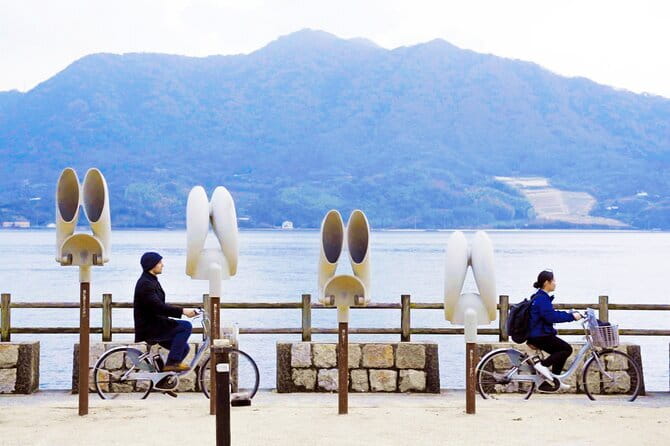
- Wild rabbits meet wartime ruins: Okunoshima’s friendly rabbits share the island with former poison gas facilities and military remains.
- Junko adds the human side: Her personal passion for the island’s past is a major part of the experience.
- The route covers about 4 kilometers of island: You cycle between the lighthouse, shrine, storage ruins, power plant, and cannon battery.
- The group is very small: A maximum of five people makes it easier to hear the guide and ask questions.
- The ferry costs extra: Budget 360 yen for the ferry between Tadanoumi and Okunoshima.
- Rain can cancel the tour: If a 60 percent or higher chance of rain is forecast by noon the day before, the operator cancels without a fee.
Why Okunoshima is more than a rabbit stop
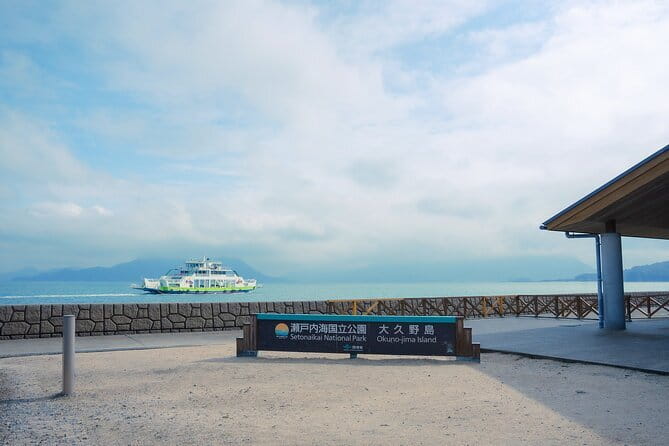
The rabbits are the easy reason to visit Okunoshima. They are visible, charming, and a natural hit with families and photographers. But if you only come for cute animals, you will miss the island’s real weight.
Okunoshima was once removed from maps because of its wartime role. Poison gas was secretly produced and stored here, and the island also held military defenses. Today, the same quiet setting can feel almost unreal. Rabbits move through the greenery while concrete ruins point to a past that was anything but peaceful.
That contrast gives this tour its purpose. You are not simply cycling around an island and stopping for photographs. You are being asked to connect the peaceful Okunoshima you see now with the place it was during the war.
I especially like that the route does not treat the ruins as background decoration. The Nagaura Poison Gas Storage Ruins and the old power plant are part of the main story. Several buildings cannot be entered for safety reasons, so the guide’s explanation matters. Without context, you would see crumbling structures. With context, you begin to understand why the island was hidden.
More Coastal Bike Rides in Japan:
- From Perth: Rottnest Island Full-Day Bike and Ferry Trip
★ 4.7 · 2,548 reviews - Valencia Bike Tour from the City to the Beach, plus Bike Guy App!
★ 5.0 · 1,187 reviews - Electric Bike Beach Adventure with Tequila Tasting and Lunch
★ 5.0 · 1,162 reviews
A compact ride for a small group
The tour lasts about two hours and has a maximum of five people. That is a useful format for Okunoshima. A bicycle lets you cover the island’s main points without spending the whole visit walking, while the small group keeps the pace personal.
The island has a circumference of about 4 kilometers. The listed stops add up to roughly 115 minutes, so the schedule is active but not frantic. You will have time to cycle between places, listen to the guide, and look around, but you should not expect long breaks at every stop.
A moderate level of physical fitness is recommended. The tour includes bicycle use, but the available information does not give details about bicycle type, hills, or riding conditions. If you are comfortable with a short recreational ride, the distance sounds manageable. If cycling is difficult for you, ask about the riding requirements before booking.
The group format also affects the feel of the day. With no more than five people, Junko can explain the story clearly and respond to questions. The tour requires at least two participants to operate, so a solo booking is possible but is not guaranteed to run on its own.
The lighthouse and Okunoshima’s sea setting

The first stop is Okunoshima Lighthouse, with about 10 minutes set aside. You cannot go inside the lighthouse, so this is an exterior viewing stop rather than a climb.
That limitation is worth knowing in advance. If you are hoping for a high lookout from inside the tower, you will be disappointed. Still, the location gives you a chance to take in the Seto Inland Sea, with its broad spread of more than 700 islands. The sea setting is one of the tour’s best counterpoints to the island’s wartime story.
I would treat this stop as a quick orientation point. It gives you the feel of Okunoshima as a small island in a much larger inland sea, rather than as an isolated attraction built around rabbits.
One hour to see the island itself
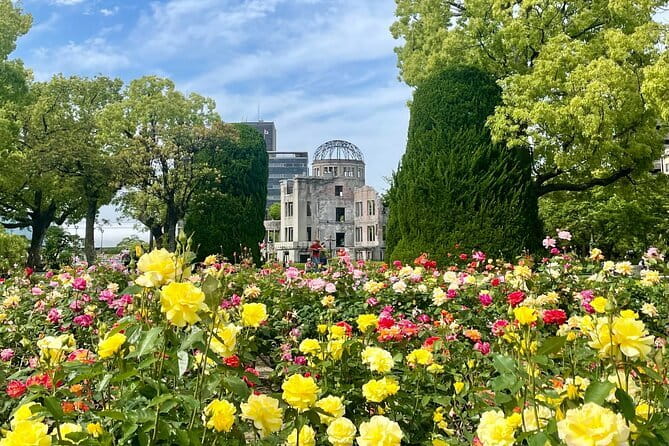
The main Okunoshima portion lasts about an hour. This is where the bicycle earns its place. You can move between the island’s wooded roads, open views, rabbit areas, and historic remains without taking up the whole day.
Okunoshima is part of Setonaikai National Park, and the setting is a big part of the appeal. The island is small, but it does not feel like a single exhibit. You see sea, trees, old structures, and wildlife in one compact circuit.
The rabbits are wild, not a formal animal show. That makes the encounters feel less staged, though it also means you cannot control how many you see or where they appear. The tour description refers to hundreds of rabbits, and the route is designed to put you among the island’s most recognizable residents.
This is also where a guide adds value. A self-guided cycle ride would show you the scenery, but it might not explain why certain buildings matter or how the island’s public image changed. Junko’s role is to connect the visible remains with the forgotten story behind them.
More Guided Tours in Japan:
- Tokyo Guided Small-Group Biking Tour
★ 5.0 · 1,250 reviews - Tokyo Top Highlights 3h Guided E-bike Tour
★ 5.0 · 714 reviews - 3h Tokyo E-Bike Tour: Hidden Gems, and Local Life with guide
★ 5.0 · 670 reviews - Hiroshima 2hr Peace Cycling Tour with Local Guide
★ 5.0 · 321 reviews
Okuno Shrine, where rabbits meet religion
Okuno Shrine is the only shrine on the island, and the stop lasts about 10 minutes. It is now also home to rabbits, which gives the site a distinctive Okunoshima feel.
The shrine is a quieter pause in the route. After the broad sea views and military remains, it offers a smaller, more reflective setting. The rabbits make it lively, but the shrine also reminds you that the island is not only a historical site. It has religious and everyday layers too.
Ten minutes is enough to see the shrine and take in its setting, but not enough for a long visit. That is typical of this tour. You get a clear look at each key point, then continue around the island.
The poison gas storage ruins from a safe distance

The Nagaura Poison Gas Storage Ruins are one of the most important stops. This facility once stored tanks filled with poison gas. Today, you cannot enter because of safety concerns, so you view it from nearby.
That restriction is not a flaw in the tour. It is part of the reality of the site. You are seeing a former military facility, not a restored museum building prepared for public access. The distance may make the stop less dramatic than walking through the structure, but it also keeps the focus on what the building represents.
This is one place where Junko’s explanations are especially valuable. The ruins alone cannot tell you the full story. A guide can help you understand why the island was concealed and why these remains still matter.
The subject is serious, and the tour does not turn the wartime past into a quick photo opportunity. The rabbits make Okunoshima popular, but the poison gas site is the reason this island carries such a difficult story.
The old power plant and the cost of a short tour
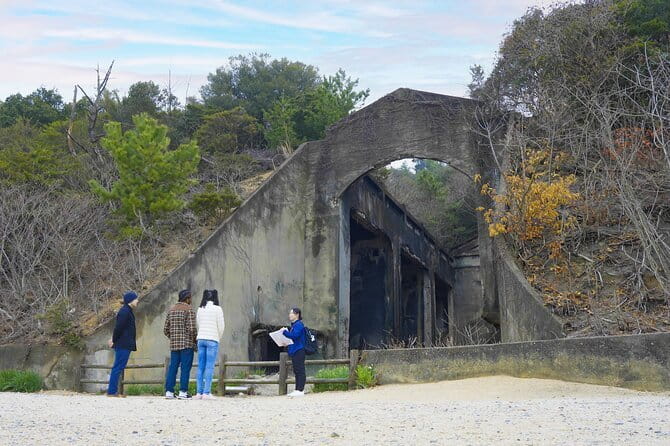
The former power plant gets another 10-minute stop. It was used when poison gas was secretly made on Okunoshima, and it too is closed to entry for safety reasons.
Like the storage ruins, the power plant is best understood as part of a connected system. It was not an isolated building. It supported the hidden work carried out on the island. Seeing both sites helps you picture the scale and organization of the operation.
The drawback is time. Ten minutes is enough for a look from outside and a clear explanation, but you will not have a long period to study the structure. The same is true across the tour. This is an introduction to Okunoshima’s history, not a full archival visit.
If you want a slower examination of every ruin, you may prefer to stay on the island longer after the cycling tour. The tour ends at the Kyukamura Okunoshima hotel, giving you a fixed point for continuing your own visit.
Northern Cannon Battery Remnants up close
The final listed stop is the Northern Cannon Battery Remnants, with about 15 minutes. Unlike the storage facility and power plant, these gun battery remains can be seen closely.
This is a useful finish because it gives you a more direct look at the island’s military defenses. The previous two stops are viewed from a distance, while the cannon battery lets you get nearer to the physical remains.
Fifteen minutes is the longest dedicated time at any of the shorter historical stops. It should give you enough room to look around and understand the site’s position within Okunoshima’s wartime role.
By this point, the tour has shown you several different parts of the island’s past: hidden production, storage, power, and defense. That range makes the experience more substantial than a simple rabbit ride.
What Junko adds to the experience
The strongest personal element is guide Junko. The tour’s comments describe her as kind and deeply committed to sharing Okunoshima’s history. That matters here because the island’s story is not easy to read from the ruins alone.
A guide who cares about the subject can also help set the right tone. Okunoshima’s rabbits are playful, but the poison gas history calls for care. Junko appears to handle both sides of the island, giving you the chance to enjoy the wildlife without allowing it to erase the wartime past.
I would choose this tour over a basic bicycle rental if you want to understand what you are seeing. If you only want a bike and time with rabbits, renting independently may give you more freedom. You would, however, lose the structure and personal explanation that make the historic stops worthwhile.
Price, ferry cost, and what you receive
The tour costs $59.12 per person. The price includes bicycle use, all listed taxes and fees, and travel insurance. The ferry is separate, costing 360 yen between Tadanoumi and Okunoshima.
For a two-hour activity, the price is not the cheapest way to spend time on the island. The value depends on how much you want from the guide. You are paying for a small group, a planned route, a bicycle, insurance, and interpretation of sites that are easy to misunderstand on your own.
The maximum of five is important here. A large group would make the short stops feel more rushed and would make it harder to ask questions. With such a small cap, the price is easier to justify for anyone interested in the island’s story.
Food and drinks are not included. Private transportation is also not included. You need to handle your own travel to the meeting point and pay the ferry separately.
The tour starts and ends at Kyukamura Okunoshima, at 5476-4 Tadanoumicho, Takehara, Hiroshima. The stated end point is in front of the hotel. The experience is near public transportation, and you receive a mobile ticket, which is handy for a day involving a ferry and a short scheduled activity.
Weather, timing, and cancellation details
This is an outdoor bicycle tour, so weather matters. If the Japan Meteorological Agency forecasts a 60 percent or higher chance of rain by noon the day before the tour, the operator cancels without a cancellation fee.
If bad weather cancels the activity, you can choose another date or receive a full refund. The same applies if the minimum number of participants is not reached. The tour needs at least two people to operate.
For your own plans, leave some flexibility around the booking. The weather rule gives you useful protection, but a cancellation could affect a tightly packed Hiroshima schedule. You can cancel for a full refund up to 24 hours before the start time. Changes or cancellations inside that window are not accepted and are not refunded.
Confirmation is sent within 48 hours of booking, subject to availability. Since the tour is often booked about 27 days ahead, booking earlier makes sense if your Hiroshima dates are fixed.
Who will enjoy this Okunoshima ride
I would recommend this tour to you if you want three things in one outing: wild rabbits, sea scenery, and a clear account of Okunoshima’s wartime past. It works especially well for first-time visitors who might otherwise see only the island’s cute side.
It also suits you if you prefer a small group. A maximum of five is a real advantage for a site where explanations matter. Junko’s enthusiasm is another reason to choose the guided option.
This may not be the best match if you want a long, leisurely island day, extensive time inside historic structures, or a private tour. The route is shared, the schedule is short, and several ruins can only be viewed from outside.
Families and casual cyclists may enjoy the combination of animals and easy-to-grasp history, provided everyone can manage the ride. The activity calls for moderate physical fitness, so it is not designed as a fully passive sightseeing trip.
Should you book the Okunoshima cycling tour?
Book it if you want to understand Okunoshima rather than simply photograph its rabbits. The small group, included bicycle, and guide Junko give you a focused way to cover the island’s main sights in about two hours.
Skip it if you already plan to spend a full day exploring independently and want complete control over your pace. Even then, the historical explanation is the part you may miss most.
At $59.12 plus the 360-yen ferry, this is fair value for a compact, guided introduction. The rabbits may bring you to Okunoshima, but the island’s hidden wartime past is what makes this particular ride worth your time.
FAQ
How long does the Okunoshima cycling tour last?
The tour lasts approximately two hours.
Where does the tour start and end?
It starts and ends at Kyukamura Okunoshima, 5476-4 Tadanoumicho, Takehara, Hiroshima. The tour ends in front of the hotel.
Is the ferry included in the tour price?
No. The ferry between Tadanoumi and Okunoshima costs 360 yen and is paid separately.
What does the tour price include?
The price includes bicycle use, all fees and taxes, and travel insurance.
How many people can join the tour?
The tour is a shared group activity with a maximum of five participants.
What is the minimum number of participants?
At least two participants are required for the tour to operate.
Can I enter the Okunoshima Lighthouse?
No. Entry to the lighthouse is currently prohibited, so you view it from a short distance.
Can I enter the poison gas storage ruins and power plant?
No. Entry to both sites is prohibited for safety reasons. You view them from a short distance.
Do I need to be physically fit for the tour?
The tour recommends a moderate level of physical fitness because it includes cycling around the island.
What happens if it rains?
If the Japan Meteorological Agency forecasts a 60 percent or higher chance of rain by noon the day before, the tour may be canceled without a cancellation fee. You can then choose another date or receive a full refund.
Just added around Japan
- Iya Valley BROMPTON Slow Cycling Tour★ 5.0 · 28 reviews
- eTour de Matsumoto – Electric Bike Tour★ 5.0 · 16 reviews
- ONLY YOU in the Bamboo Forest! 4 hours E-bike tour with a local★ 5.0 · 45 reviews
- Pedal Adventure Kyoto’s iconic landmarks on an e-bike tour★ 5.0 · 189 reviews
- South Kyoto in a Nutshell: Gentle Backstreet Bike Tour!★ 5.0 · 225 reviews
- The Beauty of Kyoto by Bike: Private Tour★ 5.0 · 47 reviews
- Explore Hidden Alleyway with a Local Expert (Afternoon Tour)★ 5.0 · 17 reviews
- Secret Eastern Kyoto Biking Adventure★ 5.0 · 44 reviews
Hiroshima Bike Tours, compared.
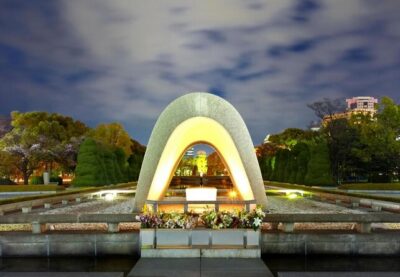
Hiroshima in a Nutshell: Morning Bike Adventure
Read our review →
Hiroshima 2hr Peace Cycling Tour with Local Guide
Read our review →

Hiroshima 3hr Peace Cycling Tour with Local Guide
Read our review →

Hiroshima Country Cycling: Explore Rural Life 1 HR from City
Read our review →
Browse the lists this tour appears in