

REVIEW · HIROSHIMA
Hiroshima 3hr Peace Cycling Tour with Local Guide
Hiroshima’s most powerful stories are spread beyond the Peace Memorial Museum, and this three-hour e-bike tour connects them at a steady, easy pace. You ride from the Peace Park to Hiroshima Castle, riverside monuments, surviving trees, the Red Cross Hospital remains, and the railway line, while a local guide explains what changed before and after August 6, 1945.
I like the small group of no more than 10 and the chance to cover far more ground than you could on foot. I also like the personal angle: guides such as Shin and Moe have shared family connections to the bombing, giving the facts a human voice. The main catch is that the tour moves through sensitive material quickly, so you may still want time at the Peace Memorial Museum afterward.
Key points to know
- Personal local storytelling: Guides including Shin, Moe, Toma, Kana, and Thomas bring family memories and local perspective to the route.
- Easy electric bicycles: The route is generally flat, and the e-bikes help in Hiroshima’s summer heat.
- A wider view of Hiroshima: You see the Peace Park, castle, rivers, parks, bridges, hospital remains, railway, and surviving trees.
- Small shared group: The maximum is 10 people, though the pace may slow when children or less confident cyclists join.
- Three hours well spent: The tour leaves the afternoon open for the museum, Miyajima, food, or more city exploring.
- Weather backup: Rain may bring a walking route, a different date, or a full refund.
Why cycling gives Hiroshima’s story more shape
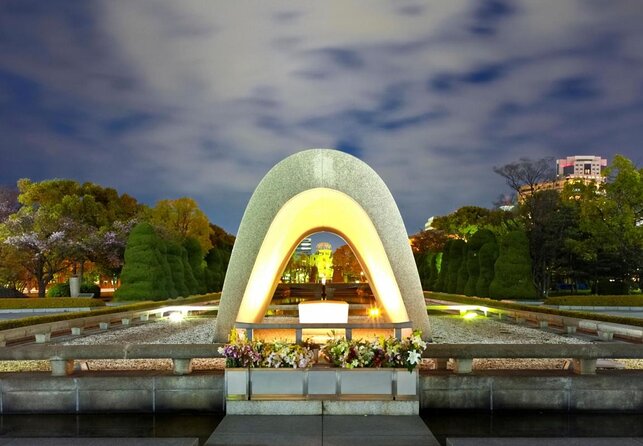
The Peace Memorial Park and Atomic Bomb Dome are essential, but they are only part of Hiroshima’s story. The bomb affected a wide area, and the city’s recovery can be hard to grasp when you visit one memorial at a time. A bicycle helps you connect those places.
You begin at the Hiroshima Peace Park Rest House at 10:00 for the morning departure, or 14:00 for the afternoon version. The guide explains the route, introduces the group, and handles the bicycle setup. The tour lasts about three hours and returns to the same point.
The ride is not a race. The route includes stops every few minutes, with gentle cycling between them. You should expect a shared pace rather than a private schedule. If someone in the group is new to cycling, especially a child, the guide may slow down.
The electric bicycles are a major help. Several people who rode with Shin, Moe, and other guides found the bikes comfortable and easy to manage. That matters in warm weather, when the motor lets you pay attention to the city rather than the effort of pedaling. The bikes are described as somewhat small by one participant, so taller riders may want to check their comfort at the start.
More Guided Tours in Japan:
- Tokyo Guided Small-Group Biking Tour
★ 5.0 · 1,250 reviews - Tokyo Top Highlights 3h Guided E-bike Tour
★ 5.0 · 714 reviews - 3h Tokyo E-Bike Tour: Hidden Gems, and Local Life with guide
★ 5.0 · 670 reviews
Hiroshima Castle and the first clues to the bombing
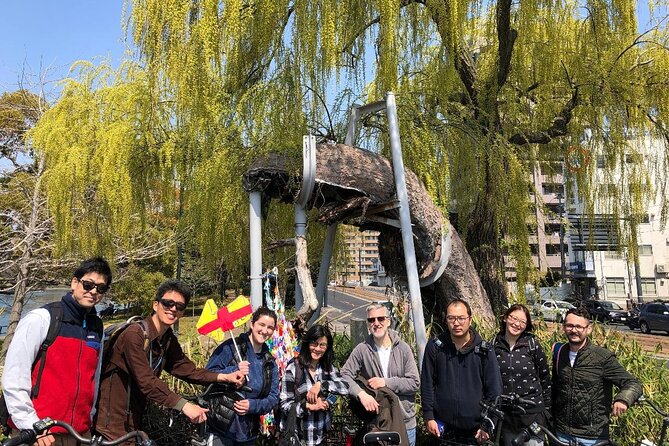
The first proper stop is Hiroshima Castle, reached almost immediately after the meeting point. The schedule allows about 20 minutes here.
The castle grounds help place Hiroshima before the war. The site also held a military headquarters that became the first location to report the atomic bombing. That detail gives the tour an early link between the city’s military role and the events that followed.
You will not have time for a long castle visit on this route. Think of the stop as a historical introduction, not a full castle tour. The guide uses the location to explain what happened in the first moments after the blast and how communication worked when so much of the city had been destroyed.
Next comes Hiroshima Gokoku Shrine and its gate. The stop lasts about 15 minutes and includes lesser-known remains, such as the Guardian Dog statue and the shrine gate that survived the bombing.
This is one of the tour’s useful qualities: it does not only take you to the famous places. Small surviving objects can make the scale of destruction more concrete. You are looking at something that remained in place while much of the surrounding city disappeared.
Central Park and Aioi Bridge
From the shrine, you cycle through Chuo Park, also called Hiroshima Central Park. The route allows about 20 minutes here, giving you a quieter stretch of trees and open space.
The park is not a major memorial in itself, but it provides a pause between difficult subjects. You can see how much green space now exists in a city that was reduced to ruins. That contrast is part of the tour’s larger theme: Hiroshima is not presented only as a place frozen in 1945.
The group then reaches Aioi Bridge, with about 10 minutes for the stop. The bridge was the intended target for the bomb, though the blast struck away from the exact point. Its position beside the rivers is important because the surrounding bridges and water routes shaped movement through the city after the bombing.
This stop is brief, so listen closely. The guide may point out details that are easy to miss if you visit alone. You should not expect a long riverside visit here, but it works well as a link between the city’s geography and the bombing’s aim.
The Atomic Bomb Dome and Motoyasu River
The Atomic Bomb Dome receives about 15 minutes. This is the tour’s most recognizable site, and you will hear about the memories and stories connected to the people of Hiroshima.
The dome is powerful partly because it is so visible. You can see the preserved structure from several angles, then move on by bicycle instead of remaining in one crowded viewing area. Still, 15 minutes is not enough for every detail. I would return later if you want photographs, a slower look, or time to read the surrounding displays.
The route continues beside the Motoyasu River and the Peace Bridge for about 15 minutes. This is one of the more pleasant cycling sections, with riverside scenery and a view toward the city south of the central park area.
That ride helps you understand Hiroshima as a river city. The waterways are not just attractive; they also mark distances from the blast center and show how the modern city has grown along the same basic routes.
A few more bike tours around Japan worth a look
- Hidden Kyoto E-Biking tour
★ 5.0 · 1,843 reviews - Bike Tour Exploring North Kyoto plus Lunch
★ 5.0 · 1,087 reviews - Tokyo Great Cycling Tour
★ 5.0 · 811 reviews - Arashiyama Bamboo Forest & Hidden Gems Bike Tour (Early Bird)
★ 5.0 · 613 reviews
Higashisenda Park and the Red Cross Hospital remains
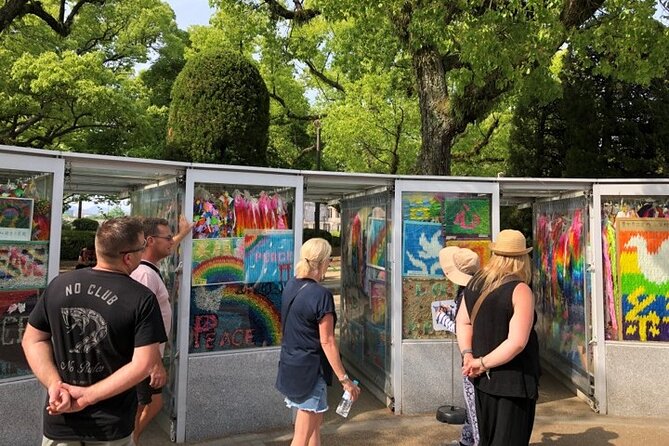
Higashisenda Park is about 1 kilometer from the center of the blast. The tour allows 20 minutes here. Trees from countries around the world have been planted in the park, giving the stop an international dimension without turning it into a grand ceremonial visit.
The trees also change the tone of the route. You have just seen the dome and the river, and now you are in a green space linked to stories of recovery and remembrance. The guide explains the meaning of the site and the stories connected with it.
The next stop, about 1.5 kilometers from the blast center, is the Atomic Bomb Window Frame Monument at the Hiroshima Red Cross Hospital. You have 20 minutes here.
This is among the harder stops to face. The remains of the hospital building show the force of the explosion in a direct, physical way. Instead of hearing only about destruction in general terms, you see part of a working medical building that survived in damaged form.
The stop may feel stark, and the guide’s pacing matters. Guides such as Shin and Moe have been praised for balancing facts with personal family stories and a calm, respectful manner. The route does not treat the bombing as a distant textbook event. It keeps returning to people, buildings, and ordinary city life.
The surviving railway and Miyuki Bridge
At the Hiroshima Railway stop, the guide points out that two trains survived the blast and continued to be used. The stop takes about 10 minutes.
That detail gives you a different angle on the disaster. A railway is part of daily life, not a formal monument. Seeing how transport continued adds a practical sense of the city’s immediate struggle to function.
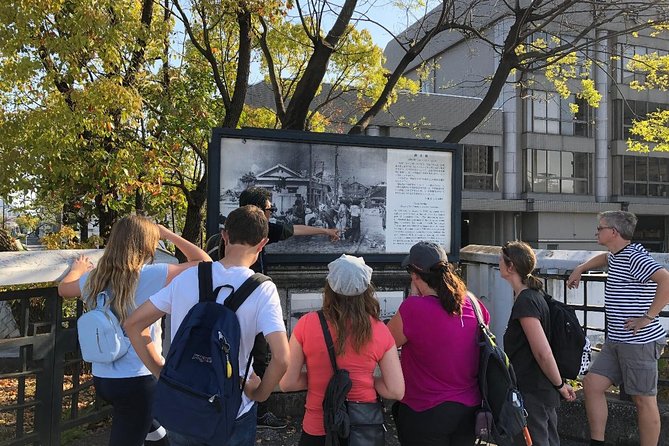
The tour then reaches Miyuki Bridge and the Kobayashi River for about 10 minutes. This area marks the point where the bomb’s reach ended. A displayed photograph shows the difference between the scene then and the city you see today.
This is a good place to think about distance. The route has carried you outward from the blast center, and the stops make that measurement visible. Instead of seeing one memorial and trying to imagine the scale, you have physically crossed part of it.
The surviving weeping willow and Peace Boulevard
The surviving weeping willow tree is described as the tour’s highlight. You spend about 10 minutes near the tree, which continued to grow despite the belief that natural growth would not return for many decades.
The tree is a simple sight, but that is part of its force. It is not a massive structure or a formal museum display. It represents survival through something ordinary and living. The guide uses it to talk about Hiroshima’s strength and the return of growth after the bombing.
The final ride follows Peace Boulevard, with about 10 minutes for monuments and trees connected to Hiroshima’s past. You also see the present-day city functioning around them.
That closing stretch matters. The tour does not end only with destruction. It brings you back toward the Peace Park through a working city, showing recovery as something ongoing rather than a story with a neat final chapter.
How the guide changes the experience
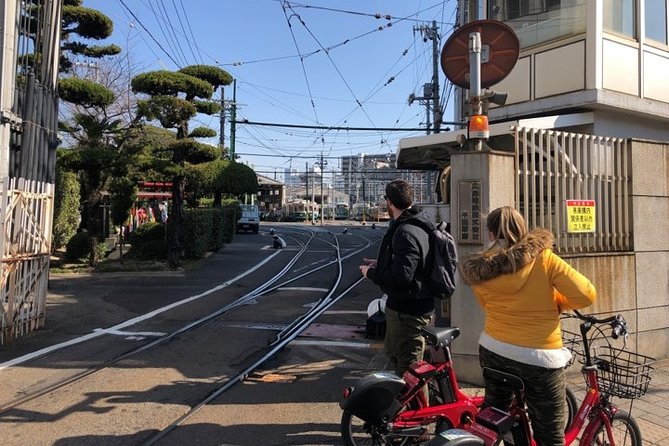
The route is fixed, but the guide shapes how much you take from it. Shin is frequently singled out for lively delivery, clear English, and personal family stories. His mother was still unborn when the bomb fell, and he has explained how the event shaped his family and community.
Moe has also led tours with a personal connection. Her four grandparents lived through the bombing, and she has shared those stories with care. Other guides named in the tour’s feedback include Toma, Thomas, Kana, and local women guides who were praised for clear explanations and thoughtful answers.
You should not expect every departure to have the same guide, so the style may vary. What you can reasonably expect is a local guide leading a small mixed group through sites that are difficult to connect without help.
The strongest guides keep the tone human without making the tour feel theatrical. They explain the facts, answer questions, and connect the past to Hiroshima’s present. Personal stories can be especially useful for teenagers, since the subject becomes easier to discuss when it is tied to one family’s experience.
Price, timing, and practical value
The listed price is $85.89 per person. That is not the cheapest way to see Hiroshima, but the value comes from the amount covered in three hours: bicycle use, guide service, included entrance costs, bicycle accident insurance, and a route connecting sites that are spread across the city.
You also save time. Walking this full circuit would take much longer, while public transport would not give you the same continuous view between stops. The electric bicycle makes the distance manageable without turning the outing into a strenuous exercise session.
The tour returns to the Peace Park at about 13:00 for the morning departure and 17:00 for the afternoon departure. The morning option is especially useful if you want to visit the Peace Memorial Museum afterward, have lunch in central Hiroshima, or continue to another part of the city.
There is no luggage storage at the Rest House. Coin lockers are available at the International Conference Center Hiroshima and Hiroshima Peace Memorial Museum, about a six-minute walk away. Plan this before the meeting time, since arriving late without prior notice can result in cancellation without a refund.
Adult electric bicycles require a height of at least 145 centimeters. Children from 110 to 145 centimeters may use one of two available children’s bicycles for a booking, and child seats are available for children under 22 kilograms and under 115 centimeters. Children under 15 can use the child or adult bicycles at the child rate.
Weather, pace, and the two-hour alternative
This is a weather-dependent activity. If rain makes the bicycle route unsafe, you may be offered a rainy-day walking route, another date, or a refund.
The rainy-day route focuses on the Peace Memorial Park, Atomic Bomb Dome, hypocenter, Former Bank of Japan, Fukuromachi Elementary School, and the main street. It covers a smaller area on foot and is scheduled to finish at 13:00 or 17:00, depending on the departure.
You can also choose a two-hour version. That shorter route focuses on the Peace Park and the city’s wartime and postwar recovery. The three-hour route adds Hiroshima Castle and gives you more time for places tied to the prewar city and reconstruction.
I would choose three hours if Hiroshima is a major reason for your visit or if you want personal conversation with the guide. The two-hour option suits you better if your schedule is tight or you already plan to spend a long session at the museum.
Who should book this Hiroshima cycling tour
I would recommend this tour to you if you want context rather than a quick photo stop. It works especially well for first-time visitors, families with older children, and anyone who likes to learn through movement instead of standing in one place.
It also suits you if you are nervous about cycling. The route is generally flat, the electric bikes are easy to use, and the guides take safety seriously. Still, you must be comfortable riding in a shared group and following the guide’s pace.
This may not suit you if you want a private tour, a silent museum-style visit, or long uninterrupted time at each monument. The group can include children and less experienced riders, and the schedule leaves only short periods at major sites.
FAQ
Where does the Hiroshima Peace Cycling Tour begin?
It begins at the Hiroshima Peace Park Rest House in Hiroshima’s Naka Ward.
Where does the tour end?
The tour returns to the Hiroshima Peace Park Rest House.
How long is the cycling tour?
The tour lasts about three hours. The morning departure runs from 10:00 to 13:00, and the afternoon departure runs from 14:00 to 17:00.
How many people can join?
The shared tour has a maximum of 10 participants.
Are electric bicycles provided?
Yes. Adult electric bicycles are available for participants at least 145 centimeters tall. Children’s bicycles and child seats are also available under the stated height and weight limits.
Are entrance fees included?
Yes. Any listed entrance fees are included in the tour price.
What happens if it rains?
The tour may change to a rainy-day walking route, move to another date, or be refunded. The walking route includes the Peace Memorial Park, Atomic Bomb Dome, hypocenter, Former Bank of Japan, Fukuromachi Elementary School, and the main street.
Can I leave luggage at the meeting point?
There is no luggage storage at the Rest House. Coin lockers are available at the International Conference Center Hiroshima and Hiroshima Peace Memorial Museum, about a six-minute walk away.
What is the cancellation policy?
You can cancel at least 24 hours before the local start time for a full refund. Cancellations or changes made less than 24 hours before the start time are not accepted for a refund.
Should you book it?
Yes, if you want to understand how Hiroshima connects its wartime past with its rebuilt present. The personal family stories from guides such as Shin and Moe are a major reason to choose this route, while the e-bikes let you reach quieter and more widely spaced sites without tiring yourself out.
Book the three-hour version if you have room in your schedule and want the fullest route. Afterward, give yourself extra time at the Peace Memorial Museum and Atomic Bomb Dome. The cycling tour gives you the city’s shape and many of its key stories, but Hiroshima rewards a slower second look.
Just added around Japan
- Iya Valley BROMPTON Slow Cycling Tour★ 5.0 · 28 reviews
- eTour de Matsumoto – Electric Bike Tour★ 5.0 · 16 reviews
- ONLY YOU in the Bamboo Forest! 4 hours E-bike tour with a local★ 5.0 · 45 reviews
- Pedal Adventure Kyoto’s iconic landmarks on an e-bike tour★ 5.0 · 189 reviews
- South Kyoto in a Nutshell: Gentle Backstreet Bike Tour!★ 5.0 · 225 reviews
- The Beauty of Kyoto by Bike: Private Tour★ 5.0 · 47 reviews
- Explore Hidden Alleyway with a Local Expert (Afternoon Tour)★ 5.0 · 17 reviews
- Secret Eastern Kyoto Biking Adventure★ 5.0 · 44 reviews
Hiroshima Bike Tours, compared.
Hiroshima in a Nutshell: Morning Bike Adventure
Read our review →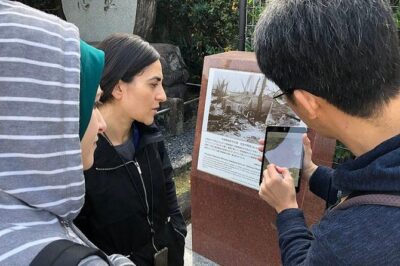
Hiroshima 2hr Peace Cycling Tour with Local Guide
Read our review →


Hiroshima Country Cycling: Explore Rural Life 1 HR from City
Read our review →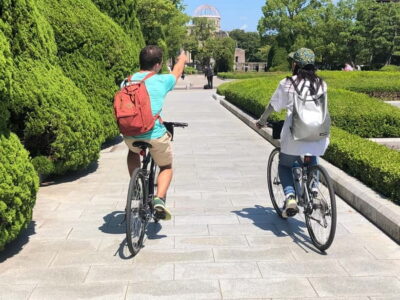

Browse the lists this tour appears in