

REVIEW · KYOTO
Explore Hidden Alleyway with a Local Expert (Afternoon Tour)
Kyoto reveals itself best between the famous sights, where narrow lanes, wooden houses, river paths, and ordinary neighborhood life replace the usual postcard views. This three-hour afternoon bike tour takes you from the old geisha districts to the Imperial Palace and the Kamo River, with a guide who can explain what you are seeing as you ride.
I like the small private format, limited to two to six people per guide, and I like the route’s variety: quiet Miyagawacho, elegant Gion, a willow-lined stream, palace grounds, and a local river stop. The main concern is practical: you need to ride safely on Kyoto roads, and the tour may feel quick if you want long visits at each stop.
Key points to know before you book

- Quiet lanes instead of only headline sights: Ride through Miyagawacho and Gion, where traditional wooden houses and old streets provide a more intimate view of Kyoto.
- Five distinct stops in three hours: The route covers Miyagawacho Kaburenjo, Gion, Tatsumi Bridge, Kyoto Imperial Palace, and Kashiwayacho by the Kamo River.
- Small groups make a difference: Two to six people ride with each guide, and the activity is private to your party.
- Yuichi earned special praise: One rider singled out Yuichi for being personable, funny, and informative.
- Rain does not automatically cancel the outing: You can continue by bicycle with a free poncho or switch to walking and public transportation.
- Riding ability matters: Children must be at least 10 years old, 145 centimeters or taller, and able to cycle safely on the road without help.
Why this route gives you a better feel for Kyoto

Kyoto can be hard to read from a tour bus or a checklist of temples. The grand sights are worthwhile, but the city’s character often appears in smaller details: the width of a lane, the quiet front of a wooden house, the way a river path changes the pace of a neighborhood.
That is the strength of this outing. You are not spending three hours at one major monument. You are moving through several parts of Kyoto, and the changes come quickly. One moment you are pedaling through an old alley lined with traditional homes. Soon after, you are back on a main road, then beside a stream, then on the broad grounds of the former Imperial residence.
The cycling also helps you cover ground without the enclosed feeling of a vehicle. You can see more than you would on foot, while still moving slowly enough to notice the streets around you. This makes the tour useful if your Kyoto stay is short or if you want an orientation ride early in your visit.
The afternoon start time is 2 p.m. That gives you a relaxed morning for another activity, though it also means the tour takes place during the middle and later part of the day. Light and atmosphere can change as you ride, especially in the older districts. The tour lasts about three hours and returns to the starting point.
Other bike tours people book around Kyoto:
- Hidden Kyoto E-Biking tour
★ 5.0 · 1,843 reviews - Bike Tour Exploring North Kyoto plus Lunch
★ 5.0 · 1,087 reviews - Arashiyama Bamboo Forest & Hidden Gems Bike Tour (Early Bird)
★ 5.0 · 613 reviews
Starting near Kyoto Station and getting on the road
The meeting point is at 552-13 Higashiaburanokōjichō in Shimogyo Ward, Kyoto. The activity begins and ends there, so you do not need to arrange a separate return transfer after the ride.
The operator trains its guides in an in-house program covering Kyoto culture, traffic safety, group riding, and local manners. That matters here. Cycling through Kyoto is not the same as riding on a quiet recreational trail. You will be sharing roads and narrow passages, and the guide’s job includes keeping the group together and helping everyone ride responsibly.
The group limit is one of the most useful features. Each guide can take two to six people. A group of seven to twelve can be arranged with an additional guide, but the standard setup remains small. This gives you a better chance to hear explanations and ask questions without stopping the entire outing for every point.
One important catch: a single-person booking is not accepted. If you are traveling alone, this is not a straightforward option unless another person joins your reservation or the operator confirms an arrangement.
The equipment details should be checked when you book. A rider specifically praised the e-bikes, saying they were the way to go, but the general activity information describes a guided bike tour rather than clearly promising an electric bicycle for every booking. If an e-bike matters to you, ask KCTP to confirm what you will ride.
Miyagawacho Kaburenjo and Kyoto’s old wooden lanes
The first stop is Miyagawacho Kaburenjo, in Miyagawacho, one of Kyoto’s five traditional geisha districts. It is also the second largest of those districts.
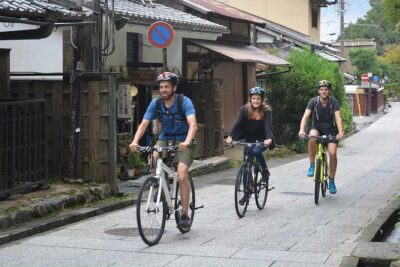
You stop for about 15 minutes. That is not long enough for a full cultural tour, but it is enough to take in the setting and hear how the district developed. The lane is lined with traditional Japanese wooden houses, and its quiet mood gives you a sharp change from the busy streets elsewhere in Kyoto.
This is one of the places where a bike tour earns its price. You can reach a tucked-away street without spending much of your limited sightseeing time on foot. The guide can also help you understand the difference between simply seeing an old building and recognizing the role of the district in Kyoto’s entertainment culture.
Keep your expectations sensible. Miyagawacho is a living neighborhood, not a stage set built for sightseeing. The stop is brief, and you should treat the area with care. Avoid blocking narrow lanes, keep your voice down, and do not assume that traditional-looking buildings are open to the public.
Gion, where old Kyoto meets a busy city
The ride continues to Gion, perhaps the name most closely linked with Kyoto’s geisha culture. Gion developed as a major district for maiko and geiko, and its older streets still carry an elegant, formal feel.
The scheduled stop lasts around 15 minutes. You may see the district’s traditional architecture and get a sense of its layout, but this is not a performance or a guaranteed opportunity to see a maiko or geiko. That distinction matters. The value is in the streets themselves and in the guide’s explanation, not in treating the neighborhood as a display.
Gion can be crowded, so the bicycle format has both an advantage and a drawback. You can approach from quieter lanes and move on when one area feels too packed. At the same time, you must be alert around pedestrians and other bicycles. Your guide will manage the group, but you still need to ride carefully and follow instructions.
I would pay close attention to the transition between the quiet side streets and the larger roads. That shift is part of the tour’s design. Kyoto is not only old lanes and wooden facades. It is also a working city, and the ride lets you see both sides within a short time.
Same city, a different ride:
- 5 Top Highlights of Kyoto Full Day Bike Tour (E-bike option)
★ 5.0 · 511 reviews - Full Day Biking Tour Exploring the Best of Kyoto
★ 5.0 · 498 reviews - Kyoto: Memory Kyoto E-Bike Tour
★ 4.8 · 297 reviews - E-Bike Tours of the highlights of Kyoto!!!
★ 5.0 · 291 reviews
Tatsumi Bridge and the willow-lined stream

Tatsumi Bridge offers a quieter pause. The route follows a stream, with willow branches moving in the breeze and a calmer atmosphere than the main streets nearby.
You spend about 15 minutes here. This is a short stop, but it gives the tour some breathing room. After the concentrated streets of Miyagawacho and Gion, the water and greenery create a different rhythm. It is a good place to slow down, take photographs, and let the city feel less crowded.
The appeal is visual and sensory rather than monumental. There is no large entrance gate or famous interior to explore. Instead, you get a small Kyoto scene that works because of its setting: a narrow waterway, a path, old surroundings, and the movement of leaves in the air.
If you want long photo stops, you may find the schedule tight. The guide has several locations to cover, so this is best viewed as a carefully chosen pause rather than a full visit. You will get more from it if you enjoy changes in atmosphere instead of measuring the tour by the number of major buildings entered.
Kyoto Imperial Palace and its broad garden paths
The route then reaches Kyoto Imperial Palace, once the residence of Japan’s Imperial Family. The palace area is now open to the public as a national garden, with seasonal flowers and broad grounds.
The group spends about 20 minutes here, cycling along gravel paths. This is the longest listed stop, and the open setting provides a strong contrast to the narrow alleyways earlier in the afternoon.
The palace grounds help explain Kyoto’s scale. The old districts feel close and enclosed, while the Imperial Palace area opens out. You can ride rather than simply walk from one section to another, which makes sense during a three-hour route covering several parts of the city.
There is also a tradeoff. Cycling along gravel is different from riding on smooth pavement, so you should be comfortable handling a bicycle at a controlled pace. The stop is designed as part of a wider ride, not as a detailed palace visit. If the palace is your main reason for coming, set aside additional time on another day.
Still, I like its place in the itinerary. The Imperial Palace is not treated as an isolated monument. It becomes one part of a larger story about how Kyoto’s grand spaces, quiet lanes, and river corridors fit together.
Kashiwayacho and time beside the Kamo River
The final stop is Kashiwayacho, where you can relax beside the Kamo River, a favorite local riverside area. The scheduled visit lasts around 20 minutes.
After several historic districts and formal sites, the river offers a more everyday setting. This is where the tour feels least like a standard sightseeing circuit. You are not only looking at preserved architecture. You are seeing a place used for rest and ordinary city life.
The stop is included in the activity, and its relaxed pace works well near the end of the ride. You can take a break, enjoy the open space, and think back over the changes in the route. The tour begins in traditional entertainment districts and ends beside a river used by local residents.
Again, the stop is not a long riverside excursion. It is a short pause within a route that returns to the original meeting point. If you want to spend an hour by the Kamo River, plan that separately.
The guide can make or break the ride

A bike tour needs more than a route. The guide has to handle traffic, keep the group together, explain local customs, and judge when to stop. KCTP says its guides receive training in culture, road safety, group riding, and local etiquette.
Yuichi received especially strong praise for being personable, informative, and funny. That combination is worth noting because cycling can otherwise become a simple transfer from one stop to another. A guide who explains the setting and keeps the mood light can turn the ride into a useful introduction to Kyoto.
Guide assignments can change, so you should not book solely on the assumption that Yuichi will lead your group. Still, his name gives you a clear picture of the kind of guide the operator aims to provide: someone who can mix facts with conversation rather than deliver a stiff speech at every stop.
The private format helps here. Your party can ask questions at a natural pace, and the guide can adjust the ride within the planned route. You will not be one person in a large pack trying to hear instructions over traffic.
Price, timing, and who gets good value
At $102.47 per person, this is not the cheapest way to see Kyoto. The value comes from the combination of a three-hour guided ride, a small group, cycling equipment, and a route that links several districts without requiring you to arrange the transport between them.
I think the price makes the most sense for a family or small group with limited time. One rider found it a useful way to see several parts of the city while under time pressure, and that is exactly where the tour earns its keep. You can cover more ground than you would on foot and receive context along the way.
It is less compelling if you already know Kyoto well, dislike cycling in city traffic, or want long visits inside major sights. The tour offers short stops rather than extended museum-style visits. You are paying for movement, guidance, and access to quieter streets.
The activity is commonly booked about 13 days ahead. That is a useful planning marker, especially if your dates are fixed. Confirmation is sent within 48 hours of booking, subject to availability.
Rain, age limits, and the practical details
The tour operates in rain. You can continue by bicycle with a free rain poncho, or choose a walking tour using buses or the metro, with public transportation included in the tour fee.
That flexible approach is a real advantage in Kyoto, where weather can change your plans quickly. You should still be ready for a different feel if you switch from cycling to public transportation. The route may be less fluid, and the experience will no longer have the same quiet-lane rhythm.
Children must be at least 10 years old and at least 145 centimeters tall. They must also be able to ride a bicycle safely on the road without assistance. This is not a ride for a child who still needs an adult to steady the bicycle.
The cancellation information needs careful checking before payment. One set of terms says you can receive a refund if you cancel at least three days before the tour by 6 p.m. Japan time, while another says the experience is non-refundable and cannot be changed. Because those statements conflict, contact KCTP and confirm the rule that applies to your booking. A minimum number of participants is also required, and if the operator cancels for that reason, you should be offered another date or experience, or a full refund.
Should you book this Kyoto bike tour?
Book it if you want a small-group introduction to Kyoto’s quieter side, need to cover several districts in one afternoon, and feel comfortable cycling on city roads. It is especially useful for families and small parties who want a guide, a fixed route, and a mix of traditional neighborhoods, palace grounds, and river scenery.
Think twice if you want a slow visit at each sight, cannot ride independently, or are mainly interested in entering major buildings. The five stops are well chosen, but the schedule keeps moving.
For many visitors, the strongest reason to choose it is not one single landmark. It is the way the ride connects very different parts of Kyoto in three hours, with a small group and a guide who can make the transitions meaningful. Confirm the bicycle type, clarify the cancellation terms, and then book if that balance of movement and local detail suits your trip.
FAQ
Where does the Kyoto bike tour start and finish?
The tour starts at 552-13 Higashiaburanokōjichō in Shimogyo Ward, Kyoto. It ends back at the same meeting point.
What time does the tour begin?
The scheduled start time is 2 p.m.
How long does the activity last?
The bike tour lasts about three hours.
How many people can join each guide?
Each guide accepts a minimum of two and a maximum of six people. Groups of seven to twelve can be arranged with an additional guide.
Can one person book this activity alone?
No. A single-person booking is not accepted.
What happens if it rains?
The tour still operates. You can ride with a free rain poncho or switch to a walking tour using buses or the metro, with the public transportation included in the tour fee.
Are children allowed to join?
Children must be at least 10 years old, at least 145 centimeters tall, and able to ride a bicycle safely on the road without assistance.
Which places does the tour visit?
The route includes Miyagawacho Kaburenjo, Gion, Tatsumi Bridge, Kyoto Imperial Palace, and Kashiwayacho by the Kamo River.
What is the cancellation policy?
The supplied terms conflict. One section allows a refund for cancellation at least three days before the tour by 6 p.m. Japan time, while another says the experience is non-refundable and cannot be changed. Confirm the applicable rule with KCTP before booking.
Just added around Kyoto
- ONLY YOU in the Bamboo Forest! 4 hours E-bike tour with a local★ 5.0 · 45 reviews
- Pedal Adventure Kyoto’s iconic landmarks on an e-bike tour★ 5.0 · 189 reviews
- South Kyoto in a Nutshell: Gentle Backstreet Bike Tour!★ 5.0 · 225 reviews
- The Beauty of Kyoto by Bike: Private Tour★ 5.0 · 47 reviews
- Secret Eastern Kyoto Biking Adventure★ 5.0 · 44 reviews
- Explore Hidden Alleyway with a Local Expert (Morning tour)★ 5.0 · 61 reviews
- Kyoto Bamboo Forest & Golden Pavilion E-Bike Tour★ 5.0 · 50 reviews
- KIYOTO’s Kyoto Private E-Cycling Tour: Highlights & Hidden Gems★ 5.0 · 48 reviews
Kyoto Bike Tours, compared.
Arashiyama Bamboo Forest & Hidden Gems Bike Tour (Early Bird)
Read our review →
5 Top Highlights of Kyoto Full Day Bike Tour (E-bike option)
Read our review →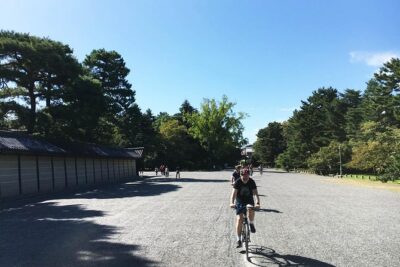
Full Day Biking Tour Exploring the Best of Kyoto
Read our review →
Afternoon Kyoto Bike Tour: Bamboo Forest, Monkeys & Hidden Spots
Read our review →Browse the lists this tour appears in