
REVIEW · BERLIN
Berlin: Experience the Alternative Kreuzberg on a Bike Tour
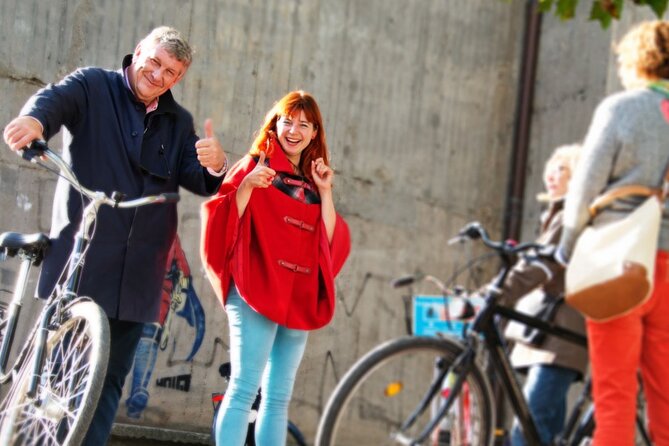
Berlin’s alternative side is best understood from a bicycle, where one street can shift from grand architecture to squats, street art, Turkish markets, riverfront clubs, and raw 1970s concrete. This three-hour ride moves through Kreuzberg, Kreuzkolln, and Friedrichshain, with guides such as Jake, Bjorn, Rico, and Karl bringing their own stories and routes.
I like the small-group size of four to 15 people and the way the ride mixes Berlin Wall history with present-day neighborhood life. I also like the frequent stops, which keep the cycling manageable and give you time to hear the story behind places such as Das Baumhaus, Görlitzer Park, and Oberbaum Bridge.
The main consideration is that this is as much a talking tour as a cycling tour. One guide may stop often for explanation, so if you want three hours of fast riding, this will feel slow. Bring clothing that can handle rain and watch your trousers near the bike chain.
Key points to know before you ride
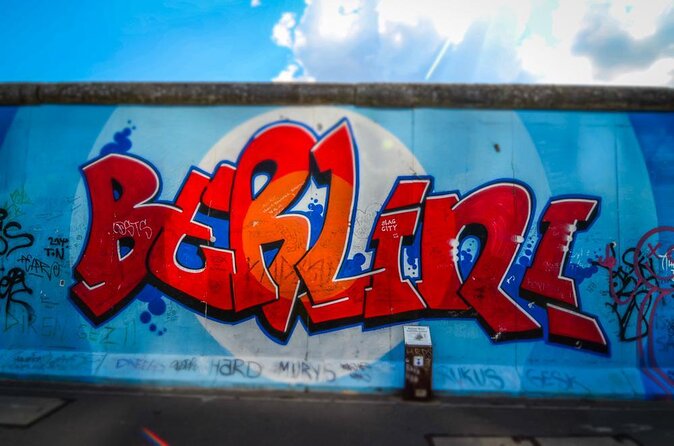
- The route crosses several sides of Berlin: You move from old Nikolaiviertel to Kreuzberg, the East Side Gallery, Friedrichshain, and Kottbusser Tor.
- The focus is local life, not only famous sights: Expect stories about squats, guest workers, political activism, the Wall, artists, and changing neighborhoods.
- The ride is relaxed rather than athletic: You stop often for short talks, making it suitable for most people who can ride a bicycle.
- Every guide shapes the route: The Free Berlin concept means the precise selection and order of stops can vary.
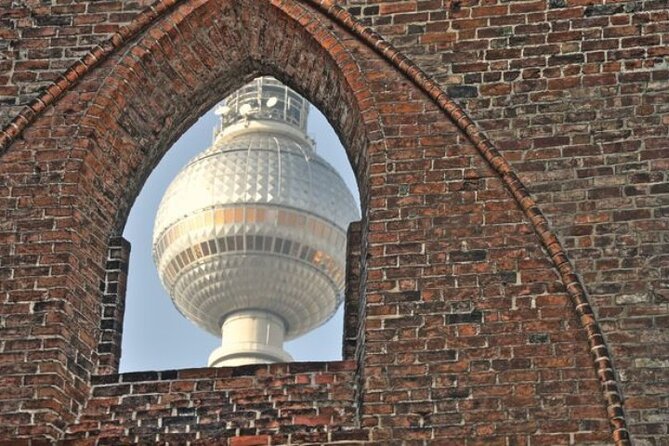
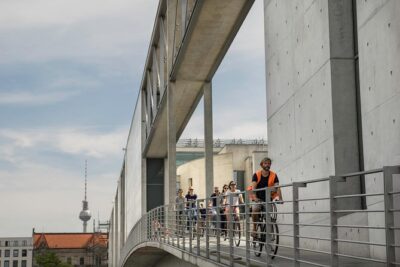
- The best views arrive beside the Spree: From the YAAM area, Osthafen, and Oberbaum Bridge, you see the TV Tower, Holzmarkt, river, and former border zone.
- You get the essentials: A bicycle, helmet, and guide are included, while food and drinks are not.
Why this bike ride shows Berlin better than a checklist tour
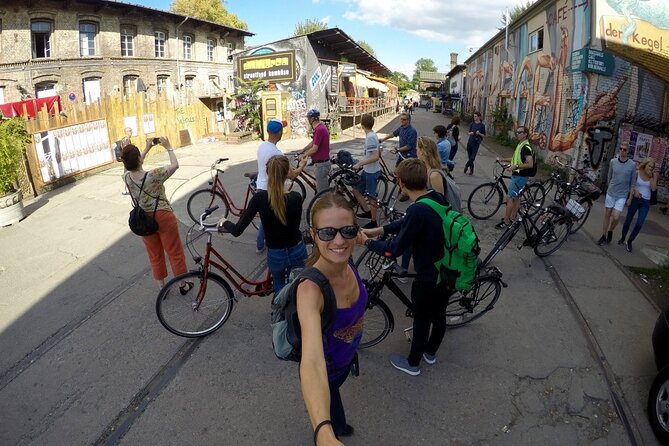
This is not a standard ride past Berlin’s grandest monuments. It is built around contrast. You see the polished capital, but you also pass places shaped by migration, protest, squatting, music, street art, and the division of the city.
That makes the bicycle useful. Kreuzberg and Friedrichshain cover enough ground that walking between these areas would take much of the day. By bike, you can connect the Wall, the Spree, residential streets, parks, bridges, and former industrial sites without spending the tour underground or in traffic.
I also like the way the route explains Berlin as a city still in motion. A former border strip becomes a creative district. A railway site becomes a park. A building occupied by artists becomes part of Berlin’s cultural story. The tour does not present Kreuzberg as a frozen counterculture museum. It shows the tension between alternative life and new development.
The score of 4.8 from 126 ratings, with 97 percent recommending the experience, fits the strongest parts of the ride: guides who are lively, careful, and willing to add personal stories. Jake, Bjorn, Rico, Rufus, Vincent, Karl, and others have each been praised for humor, clear explanations, and a strong feel for the city. The guide matters here because the streets alone do not explain themselves.
A few more bike tours around Berlin worth a look
- Berlin: Sights and Highlights Bike Tour with a Local Guide
★ 4.8 · 2,698 reviews - Berlin Highlights 3-Hour Bike Tour
★ 5.0 · 948 reviews - Berlin City Bike Tour with Beer Garden Stop
★ 5.0 · 917 reviews
Starting at Nikolaiviertel and leaving the postcard Berlin behind
The meeting point is Free Berlin Bike Tours and Rental at Poststraße 11, near Nikolaiviertel. The listed start time is 2:24 pm, and the ride returns to the same meeting point after about three hours.
Nikolaiviertel is a useful opening because it represents a carefully presented, historic version of central Berlin. The tour uses it as a quick point of departure before moving into neighborhoods that feel less arranged for sightseeing. You get your bearings, then leave the old center behind.
That opening contrast sets the tone. This is not a tour that spends the afternoon in the most familiar part of Berlin. It uses the center as a reference point and then heads toward the everyday city.
The bicycles and helmets are included. The group size is limited to 15, with a minimum of four needed for the activity to operate. That is small enough for a guide to manage at crossings and answer questions, though 15 riders can still feel like a proper group on narrow streets.
Kreuzberg: migration, politics, and street-level Berlin
Kreuzberg is the heart of the ride. It is one of Berlin’s best-known districts, but the tour approaches it through its mixed character rather than a short list of sights.
You can expect discussion of migration, neighborhood politics, changing rents, artists, and the mixture of people who have shaped the area. Kreuzberg is not presented as simply trendy or rebellious. It is a district where old apartment blocks, modern construction, political posters, food businesses, creative spaces, and hard urban edges sit close together.
The frequent pauses work well here. You stop, listen, and look around instead of trying to absorb the neighborhood while steering. One French-speaking rider found the ride easy enough for most people and appreciated the regular explanations, though expected a little more cycling and less talking. That is a fair description of the pace.
At Engelbecken, the city briefly softens. The water and open space create an unexpected pause among pre-fabricated blocks, older buildings, and newer architecture. It is a good place to think about how sharply Berlin’s districts can change within a few minutes.
The stop is also useful for understanding Kreuzberg as a varied place rather than a single style. You are not only looking at graffiti or nightlife. You are seeing how different eras of construction and different communities share the same district.
Das Baumhaus and the spirit of Berlin’s improvised spaces
Das Baumhaus, known as the Treehouse by the Wall, carries one of the tour’s more unusual stories. It concerns a guest worker who adapted quickly to Kreuzberg life, built a garden structure beside the Wall, and claimed a small piece of space with boldness and persistence.
This is the kind of stop that makes the tour worthwhile. You are not simply told when the Wall was built or dismantled. You get a story about how people lived beside it and how Berlin’s unofficial culture could turn overlooked land into something personal.
The route also passes a building shaped by multiple squattings and later used by artists. Its story reaches from the early alternative scene through the 1980s and into the early 2000s. The important point is not just that artists occupied a building. It is how repeated acts of protest and reuse changed the role of the place.
These stops help explain why Berlin’s counterculture is tied to buildings and land. The city’s alternative reputation grew from specific spaces, not from a general attitude alone.
Same city, a different ride:
- Berlin Highlights: 3-Hour Bike Tour
★ 4.9 · 809 reviews - Berlin Highlights Sightseeing Bike Tour in Small Groups
★ 5.0 · 652 reviews - Berlin: The Wall and Third Reich Guided Bike Tour
★ 4.8 · 578 reviews - Berlin: Alternative Bike Tour of Kreuzberg & Friedrichshain
★ 4.7 · 548 reviews
YAAM, the Spree, and the best wide city views
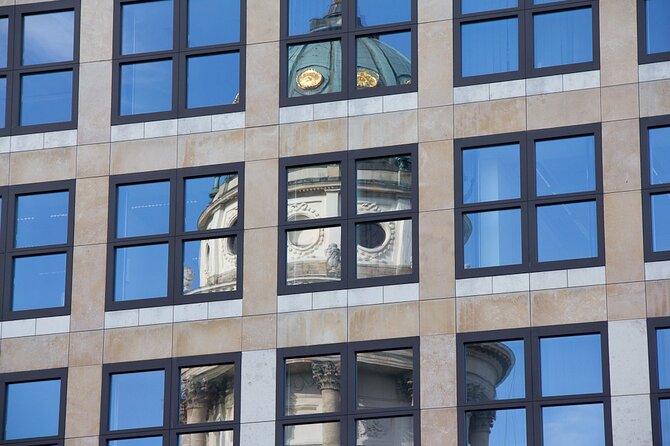
Near YAAM, the view opens toward the TV Tower, Holzmarkt, Oberbaum Bridge, and the Spree. YAAM itself is known as a club, but from this point the wider view is the attraction.
I would pay attention here. After the tighter streets of Kreuzberg, the river gives you room to see how Berlin’s past and present overlap. Former industrial areas sit beside cultural projects and new business districts. The TV Tower provides a familiar point of orientation, while the river traces the old division between parts of the city.
One account of the ride describes a relaxing river section with architecture, stories, and even a cold beer on board. The supplied tour details do not promise a boat ride or drinks, so you should not book expecting that feature. The dependable part is the riverfront setting and the guide’s explanation of what you are seeing.
The route then reaches the East Side Gallery, the longest remaining section of the Berlin Wall. Its painted panels are among Berlin’s most recognizable public artworks. The setting is important: the Wall now sits beside a redesigned business quarter, showing how quickly this former border zone has changed.
The stop is short, around 10 minutes, so you will get an introduction rather than a full art tour. If you want to study every mural, return on your own another day. The bike ride gives you context and a practical way to connect the gallery with the neighborhoods around it.
Oberbaum Bridge and Osthafen: a border that became a meeting place
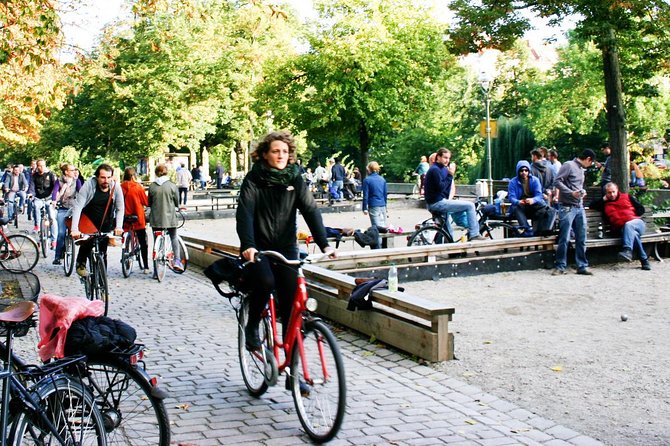
Oberbaum Bridge is one of the area’s defining sights. Its meaning is both physical and symbolic. A bridge crosses a river, but here it also suggests the crossing of borders, systems, and identities.
The route uses the bridge to connect the older stories of divided Berlin with the city you see now. The towers and brickwork give you a strong visual pause, while the surrounding district shows the effects of redevelopment.
At Osthafen, the former restricted borderland is now associated with young urban creatives and new uses along the Spree. The river offers another brief break and a clear view of why the Wall was placed where it was. Water, rail routes, industry, and open land made this a heavily controlled edge during the East German period.
A nearby unusual sculpture receives several interpretations, with the official explanation perhaps the least convincing. That small detail matches the character of the route. Not every piece of Berlin comes with one tidy answer, and the guide leaves room for curiosity and argument.
Falckensteinstraße and Görlitzer Park
Falckensteinstraße is a strong example of Kreuzberg’s mixed identity. Buildings, people, history, and daily life all crowd into a short stretch. You get a sense of a major city, but also of local escape routes and small corners where life feels separate from the capital around it.
This part of the ride is useful if you are trying to understand why Kreuzberg attracts both people seeking alternative communities and people drawn by its growing popularity. The atmosphere is not one simple thing. It can feel scruffy, creative, residential, political, commercial, and relaxed within the same outing.
Görlitzer Park occupies the site of a former railway station. Its conversion into a park captures one of Berlin’s recurring patterns: old infrastructure gets reused, but never loses its past completely.
The stop also addresses the thin line between alternative living and disorder. That is an important distinction. Berlin’s counterculture is not only art studios and friendly cafés. It can include conflict, neglected spaces, activism, and debates over how public areas should be used.
The guide’s role is especially important here. Rico was praised for being funny, friendly, safe, and well informed about the city. Those qualities matter on streets where the social story is more complicated than a photo stop.
Liegnitzer Straße, the Turkish market, and a slower side of Kreuzberg
At Liegnitzer Straße, the route points out an odd symbol of wealth in a district known for activism, anarchist ideas, and modest urban life: a car loft where residents can take a vehicle up to a balcony.
It is an amusing sight, but also a useful lesson. Kreuzberg is not simply outside capitalism. It contains sharp contrasts between communal projects, political movements, ordinary Berlin residents, and high-end development.
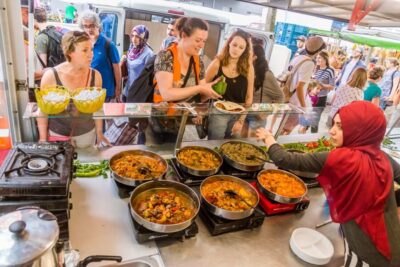
The tour then reaches a waterfront area associated with the Turkish market on Tuesdays and Fridays. Since food and drinks are not included, treat this as a setting and local tip rather than a planned meal stop. If the market is operating during your visit, you may want to return later with time to browse.
Another pause offers a more bohemian break, with people playing boule and taking life at an easier pace. These short stops help prevent the tour from becoming a nonstop history lecture. You see how residents use public space, not only what happened there.
The larger message is that Kreuzberg cannot be reduced to a label such as anarchist, messy, artistic, or trendy. It contains all of these elements, along with their opposites.
Admiral Bridge and Kottbusser Tor finish the story with a jolt
Admiral Bridge provides one of the ride’s most human scenes. In warm weather, people gather for a drink, conversation, or a sunset. You can begin an evening here among strangers, and the setting has a relaxed, open quality.
It is a fitting late stop because the tour has moved through so many versions of Berlin. You have seen the Wall as a political structure, as a canvas, and as part of a changing business district. Now you see a bridge used simply as a place to meet.
The final stop, Kottbusser Tor, changes the mood. Known locally as Kotti, it brings heavy traffic, stark 1970s architecture, and a visible drug scene. This is not polished Berlin, and the tour does not try to soften the contrast.
That honesty is one reason the ride feels useful. You are shown the city’s rough edges as well as its attractive riverfronts and creative quarters. Kotti can feel intense, especially after the quieter atmosphere around Admiral Bridge, but that contrast is central to understanding the district.
What the $42.33 price buys you
At $42.33 per person, the tour is a reasonable buy if you value orientation, local stories, and an efficient way to cover several districts. You receive a bicycle, helmet, and professional guide, with no separate equipment charge.
The value is less about the distance covered than the interpretation. You could cycle past the East Side Gallery, Oberbaum Bridge, and Kreuzberg streets on your own, but you would miss much of the context about squatting, migration, the Wall, artists, redevelopment, and neighborhood life.
Food and drinks are extra. I would plan accordingly, especially if the Turkish market or riverfront interests you. The ride lasts about three hours, so it also works well early in a Berlin stay. You get a map in your head before returning to places you want to explore more slowly.
The route is designed for families, and children are welcome. Infant seats can be provided on request. Children must be accompanied by an adult, and you should dress for the weather because the ride operates in all conditions.
Who will enjoy this ride most
I would choose this tour if you want:
- A first look at Kreuzberg and Friedrichshain before exploring them on foot
- Berlin Wall context beyond Checkpoint Charlie and the central memorials
- A relaxed ride with frequent stops
- Personal stories and neighborhood details from guides such as Jake, Bjorn, Karl, Rico, or Rufus
- A broad view of Berlin’s alternative culture, including its contradictions
- A family-friendly activity that does not require strong athletic ability
I would hesitate if you want a fast, sporty ride or a tightly fixed route. The Free Berlin approach lets each guide shape the outing, so the exact stops and order may differ. That flexibility is part of the appeal, but it means you should not expect a scripted tour with identical commentary every day.
The route operates in English or German depending on the option selected. Confirmation is provided at booking, and the experience is near public transportation. Free cancellation is available up to 24 hours before the local start time. Because the tour requires a minimum group, a departure can be replaced with another option or fully refunded if that minimum is not reached.
Should you book the Alternative Kreuzberg bike tour?
Book it if you want to see Berlin as a living city rather than a collection of famous buildings. The strongest parts are the personal guides, the frequent stops, and the links between Wall history and present-day Kreuzberg life.
Jake’s personal stories, Bjorn’s energy, Rico’s humor and care, Karl’s clear explanations, and Vincent’s cultural insight show how much the guide shapes the experience. The route can reveal places you would likely miss while walking between major sights.
Skip it if you want mostly uninterrupted cycling or a precise, fixed itinerary. For everyone else, $42.33 buys a useful three-hour introduction to the city’s alternative districts, with enough practical context to plan the rest of your Berlin visit.
FAQ
Where does the bike tour start and finish?
The tour starts at Free Berlin Bike Tours and Rental, Poststraße 11, 10178 Berlin, Germany, near Nikolaiviertel. It finishes back at the same meeting point.
How long does the tour last?
The experience lasts approximately three hours. The listed start time is 2:24 pm.
Are bikes and helmets included?
Yes. Bicycle use and a helmet are included in the tour price. Infant seats can also be provided on request.
Is the ride suitable for children?
Yes. Children are welcome, and the activity is described as family-friendly. Children must be accompanied by an adult.
Is the route the same every time?
Not necessarily. Each guide designs their own route under the Free Berlin concept, so the exact route and order of stops may vary.
What happens if the tour is canceled because too few people book?
If the minimum number of participants is not reached, you will be offered a different date or experience, or you can receive a full refund.
Just added around Berlin
- Jetbike Berlin fun bike beer bike★ 5.0 · 60 reviews
- Small-Group Historical Bike Tour in Berlin★ 4.5 · 103 reviews
- Berlin: Private Bike Tour of the Berlin Wall and Third Reich★ 5.0 · 23 reviews
- Alternative Berlin Bike Tour – Off the Beaten Tracks in Small Groups★ 5.0 · 99 reviews
- Berlin: Guided Private Bike Tour to Explore the Highlights★ 5.0 · 12 reviews
- Berlin Wall and Cold War Bike Tour in Small Groups★ 5.0 · 114 reviews
- Potsdam Bike Tour with Rail Transport from Berlin★ 4.5 · 81 reviews
- Berlin : Guided Private Sightseeing Tours with Funbikes, Teambikes★ 5.0 · 20 reviews
Berlin Bike Tours, compared.
Sights and Highlights Bike Tour with a Local Guide
Read our review →
Berlin Highlights Sightseeing Bike Tour in Small Groups
Read our review →
Alternative Bike Tour of Kreuzberg & Friedrichshain
Read our review →
Browse the lists this tour appears in