
REVIEW · BERLIN
Berlin: Guided Private Bike Tour to Explore the Highlights
Berlin’s story makes more sense when you move through it by bicycle. This private three-hour ride links medieval Berlin, Nazi-era sites, Cold War borders, postwar reconstruction, and the modern government quarter without trapping you inside a bus.
I like the flexible guiding style, since guides such as Jake, Juliet, Fabian, David, Rico, Julia, and Daan have brought their own stories and interests to the route. I also like that the bikes and helmets are supplied, and that past rides covered about 14 kilometers without feeling strenuous. The main drawback is pace: ten-minute stops give you a useful introduction, not time for museums or long visits.
Key points to know before booking

- A private route with a personal touch: Only your group takes part, and guides can adjust the ride to your interests.
- Major Berlin sights in three hours: Expect Brandenburg Gate, Checkpoint Charlie, Potsdamer Platz, the Holocaust Memorial, Reichstag, and Museum Island.
- Safe cycling rather than a hard workout: One reported route covered about 14 kilometers with little effort, while the guide handled the city riding carefully.
- Strong storytelling is central: Guides bring anecdotes about politics, rebuilding, culture, policing, and Berlin’s divided past.
- English and German versions differ: Prenzlauer Berg is listed for the German tour, while Checkpoint Charlie is specifically included in the English version.
- Useful for families and first-day orientation: Children are welcome, infant seats can be requested, and the tour ends where it begins.
Why a bicycle is a smart way to see Berlin

Berlin is broad and spread out. The Brandenburg Gate, Museum Island, Checkpoint Charlie, Potsdamer Platz, and the former East Berlin center are not all clustered around one square. On foot, you can spend much of the day simply getting from one major sight to the next.
A bicycle fixes that problem. You cover ground quickly, but you still feel the city changing around you. A street lined with government buildings can give way to a memorial, a park, or a former border crossing within minutes. You also get short pauses at each stop, enough for your guide to explain what happened there and point out details you might otherwise miss.
This is not a racing tour. The ride is designed around sightseeing, and the supplied bikes and helmets keep the practical side simple. A past route covered roughly 14 kilometers and was described as safe and easy, which gives you a useful sense of the physical demand. You should still be comfortable riding in an urban setting and be prepared for all-weather operation.
The private format matters. Your group does not have to follow the interests of a large public departure, and the guide can respond to questions or requests. Fabian, for example, shaped a special route around a group’s wishes and discussed history, culture, and Berlin policing. That kind of flexibility is hard to get on a fixed group tour.
More City Bike Tours in Germany
- Berlin: Sights and Highlights Bike Tour with a Local Guide
★ 4.8 · 2,698 reviews - Berlin Highlights 3-Hour Bike Tour
★ 5.0 · 948 reviews - Berlin City Bike Tour with Beer Garden Stop
★ 5.0 · 917 reviews
Starting in Nikolaiviertel, Berlin’s oldest-feeling corner
The meeting point is Free Berlin Bike Tours and Rental at Poststraße 11, near Nikolaiviertel. The neighborhood offers a gentle introduction to the city. Its old-town atmosphere was created largely in the late 1980s, so it is not an untouched medieval quarter, but it gives you a sense of how Berlin presents its earliest roots.
From here, you may also see the Berlin TV Tower rising above the center. When it opened in 1969, it was the second-tallest tower in the world. That fact helps explain the building’s importance in East Berlin: it was not only a communications tower, but also a proud symbol of the former German Democratic Republic.
The short opening stop is useful because it places you in central Berlin before the tour moves into larger historical themes. Do not expect a long look inside the tower or a ticketed visit. This is an orientation stop viewed from the outside.
Bebelplatz and the memory of book burning
Bebelplatz packs a remarkable amount of Berlin into one square. Around it are the city’s old university, the former opera house, a Catholic cathedral, a former bank building, and a guardhouse with a temple-like appearance. Your guide uses this setting to explain the square’s importance beyond its architecture.
Bebelplatz is also the site of the Nazi book burning in 1933. Thousands of books were burned publicly here, an early and chilling sign of the regime’s attack on free thought and culture. The memorial below the square is easy to miss if you do not know where to look, so a guide adds real value.
You get about ten minutes at the stop. That is enough to understand the event and look across the square, but not enough for a detailed architectural study. I would treat this as a strong introduction to Berlin’s difficult past, not as a substitute for a dedicated memorial tour.
The route also passes the university associated with more than 25 Nobel Prize winners, including Albert Einstein, and with Karl Marx. Several guides have studied or still study there, which gives this section a personal link to the city’s academic life.
Unter den Linden connects old Berlin to the center

Unter den Linden is Berlin’s grand central boulevard, often compared with the Champs-Élysées. Its name comes from the linden trees that line the avenue, and its buildings connect royal Berlin, Prussian power, education, religion, and modern public life.
The tour does not simply follow the biggest road from start to finish. The guiding concept allows each guide to create a route, and the bike format makes it possible to use quieter streets where appropriate. That is one of the better reasons to choose a bicycle rather than a coach.
You will not spend long at one spot here. Instead, Unter den Linden works as a moving chapter in the tour, linking Bebelplatz, Museum Island, Brandenburg Gate, and the wider government area. Pay attention to how quickly the city shifts from monumental architecture to ordinary city streets.
More Private Bike Tours in Germany
- Private Berlin Street Food Tour by Bike
★ 5.0 · 87 reviews - The Beauty of Berlin by Bike: Private Tour
★ 5.0 · 59 reviews - Private Berlin Street Food Bike Tour
★ 4.9 · 42 reviews - Party and Beer Bike Private Sightseeing Tour Berlin with Pick-up
★ 4.5 · 32 reviews
Checkpoint Charlie and the divided city
Checkpoint Charlie is one of Berlin’s best-known Cold War sites. It was the most famous border station between East and West Berlin, and its name still carries the drama of the divided city.
The setting today can feel more commercial than solemn. That is precisely why a guide helps. You can learn what the crossing represented, how Berlin’s division affected daily life, and why this particular checkpoint became so widely known.
The English version specifically includes Checkpoint Charlie. If you are booking in English, this is an important part of the route. The ten-minute pause gives you the key context, but you should not expect a museum visit or a long examination of Cold War exhibits.
The cycling route also helps here. You see the distance between former border points and understand that the wall was not one isolated barrier in a remote place. It cut through the working city.
Potsdamer Platz, from nightlife to no man’s land

Potsdamer Platz tells Berlin’s twentieth-century story in a single location. In the 1920s it was a busy entertainment and traffic center. During the city’s division, it became a broad zone of no man’s land. After reunification, it turned into one of Europe’s largest construction sites around the millennium.
That sequence is what makes the stop worthwhile. Modern towers and broad plazas can look slick and impersonal until you know that the area once sat beside the Berlin Wall and had been left largely empty. The rebuilding effort shows how strongly reunited Berlin wanted to make a new center.
Your guide can help you read the area as more than office buildings. Look at the scale, the new streets, and the contrast between old Berlin photographs and the current city. Again, ten minutes will give you the main idea, but not a detailed architectural tour.
The Holocaust Memorial asks you to slow down
The Memorial to the Murdered Jews of Europe is one of the most important stops on the ride. Its field of concrete blocks creates an unsettled, disorienting space close to the Brandenburg Gate and the Reichstag.
The point is not to provide a neat explanation of an indescribable crime. Germany’s approach here is to keep the murder of Europe’s Jews visible and to encourage public remembrance rather than burying the past. Your guide can provide the historical setting, while the memorial itself requires a quiet personal response.
You may walk among the blocks during the short stop, but do not expect enough time for the underground Information Centre unless the route and timing are specifically adjusted. The cycling format brings you to the memorial efficiently, yet this is one place where you may wish to return later for a longer visit.
Tiergarten gives the ride breathing room

After several dense historical sites, the route reaches Tiergarten, Berlin’s large central park. The name means Garden of the Animals, though it refers to the area’s former use as a hunting ground rather than its current function as a zoo.
This portion gives your legs and mind a break. You can ride through open green space before returning to the monumental center. It also shows a side of Berlin that is easy to miss when you focus only on walls, memorials, and government buildings.
Since the tour operates in all weather, dress for the forecast. Rain will not automatically stop the ride, and there is no promise of hotel pickup or drop-off. You meet at the central starting point and return there at the end.
Brandenburg Gate and the Reichstag
Brandenburg Gate is Berlin’s defining symbol. It has represented royal power, national division, Nazi spectacle, and reunification, so its meaning has changed with the city around it. The gate is especially powerful when you understand that the Berlin Wall once stood nearby and that this area was closed off during the division.
The Reichstag is close by. Germany’s parliament now has a transparent dome, a design that signals public access and political openness. The building sits within the modern government quarter, where new architecture meets the old center.
You will see both buildings from the outside during the tour. The ten-minute stops work well for orientation and photographs, but a visit to the Reichstag dome requires separate arrangements and is not included. Still, this pairing makes good sense: Brandenburg Gate represents Berlin’s past divisions, while the Reichstag points toward the country’s present political life.
Museum Island closes the central story
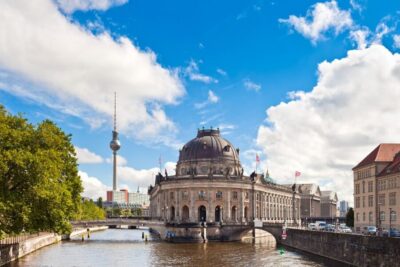
Museum Island, on the Spree, is known for its grand museums and imposing architecture. The area is often called Berlin’s Spree Athens, a name that reflects its nineteenth-century ambition to create a major center of art, learning, and public culture.
The tour gives you a view of the buildings and explains their place in Berlin. It does not include museum admission, so plan a separate visit if you want to see the collections inside. That is not a weakness so much as a useful division of time. The bike tour gives you the city’s structure, then you can choose which museum deserves your afternoon.
The ride finishes back at Poststraße 11. That makes it easy to continue exploring central Berlin on your own, though food and drinks are not included.
How the flexible route affects your experience
The company’s approach lets each guide design a route rather than forcing every departure into one identical pattern. That can make the tour feel more personal, but it also means the exact balance of stops may depend on your guide, language, timing, and group interests.
The supplied itinerary includes Prenzlauer Berg for the German version only. This neighborhood is known for its bohemian character and its transformation since reunification. If you want Prenzlauer Berg specifically, confirm the language and route before booking.
The English route includes Checkpoint Charlie, while the German route lists Prenzlauer Berg. That difference is worth noting for mixed-language groups or anyone choosing between versions. You can also ask about a different start time by email or phone.
Guides bring different strengths. Jake is described as funny and deeply interested in history. Juliet focuses on Berlin’s rebuilding after World War II and the choices that shaped the city. Rico handled a small bike problem with confidence, while David led a group of 12 with humor and historical stories. These details suggest a team that treats the guide’s personality as part of the experience, not just as a voice reading facts.
Price, group size, and practical value
At $107.77 per person, this is not Berlin’s cheapest sightseeing option. The value depends heavily on your group size and your plans. You are paying for a private experience, a guide, a bicycle, and a helmet, rather than simply renting a bike or joining a large fixed group.
For a couple or family that wants a tailored route, the price can make sense. A private guide can answer your questions and adjust the emphasis, which saves time if you are especially interested in the Cold War, Nazi Germany, architecture, or reunification. Group discounts may also improve the per-person cost for larger parties.
The tour is family-friendly, and children must be accompanied by an adult. Infant seats can be provided on request. Since the activity runs in all weather, comfortable clothing and practical outerwear matter more than stylish sightseeing clothes.
Free cancellation is available up to 24 hours before the start time for a full refund. Changes or cancellations made less than 24 hours before the start are not accepted for a refund.
Who should book this Berlin bike tour?
I would choose this tour early in a Berlin stay. It gives you a citywide framework, introduces the main political and historical sites, and can help you decide where to return for a longer visit. One useful tip from the guiding team is to book it near the start of your trip because guides can supply local suggestions along the way.
It suits active couples, families, friends, and small private groups who want more ground covered than a walking tour allows. It is also a good fit if you prefer conversation and stories over a recorded audio guide.
I would hesitate if you want long interior visits, a slow architectural study, or a tour focused on only one period. The stops are short, and the route is designed for breadth. You should also be comfortable on a bicycle and ready to ride in changing weather.
Final verdict: a strong first look at Berlin
Book this tour if you want Berlin’s major sights connected into one clear story. The best features are the private format, capable guides, supplied equipment, and the ability to cover about 14 kilometers without turning the outing into a workout.
Choose it especially if your group values humor, questions, and local anecdotes. Just remember that this is an overview by bicycle. For the Holocaust Memorial, Reichstag dome, museums, or Cold War exhibits, plan separate visits after the ride.
FAQ
How long is the Berlin private bike tour?
The tour lasts approximately three hours.
What sights are included?
The route includes Nikolaiviertel, the Berlin TV Tower area, Bebelplatz and its book burning memorial, Checkpoint Charlie, Unter den Linden, Potsdamer Platz, the Holocaust Memorial, Tiergarten, Brandenburg Gate, the Reichstag, and Museum Island.
Is Checkpoint Charlie included in the English tour?
Yes. Checkpoint Charlie is specifically included in the English version.
Is Prenzlauer Berg included in the English tour?
The supplied tour information lists Prenzlauer Berg only for the German version.
Are bicycles and helmets provided?
Yes. Use of a bicycle and helmet is included.
Can children join the tour?
Yes. Children are welcome, but they must be accompanied by an adult. Infant seats can be provided on request.
Where does the tour start and finish?
It starts at Free Berlin Bike Tours and Rental, Poststraße 11, 10178 Berlin, Germany, and finishes back at the same meeting point.
More Private Bike Tours in Berlin
- Berlin: Private Bike Tour of the Berlin Wall and Third Reich
★ 5.0 · 23 reviews - Berlin : Guided Private Sightseeing Tours with Funbikes, Teambikes
★ 5.0 · 20 reviews - Private Highlights of Berlin Bike Tour
★ 5.0 · 13 reviews - Party Bike Private Party Up To 14 People in Old Town Scottsdale
★ 5.0 · 3,541 reviews
More City Highlights Bike Tours in Berlin
- Berlin Highlights: 3-Hour Bike Tour
★ 4.9 · 809 reviews - Berlin Highlights Sightseeing Bike Tour in Small Groups
★ 5.0 · 652 reviews - Berlin: Guided Bike Tour to Explore the Highlights
★ 4.8 · 506 reviews - Berlin City Bike Tour with Beer Garden Stop
★ 4.9 · 308 reviews
Just added around Berlin
- Jetbike Berlin fun bike beer bike★ 5.0 · 60 reviews
- Small-Group Historical Bike Tour in Berlin★ 4.5 · 103 reviews
- Berlin: Private Bike Tour of the Berlin Wall and Third Reich★ 5.0 · 23 reviews
- Alternative Berlin Bike Tour – Off the Beaten Tracks in Small Groups★ 5.0 · 99 reviews
- Berlin Wall and Cold War Bike Tour in Small Groups★ 5.0 · 114 reviews
- Berlin : Guided Private Sightseeing Tours with Funbikes, Teambikes★ 5.0 · 20 reviews
- Berlin : The best bike tour with a Berlin guide and insider tips★ 5.0 · 14 reviews
- Potsdam Bike Tour with Rail Transport from Berlin★ 4.5 · 81 reviews
Berlin Bike Tours, compared.
Sights and Highlights Bike Tour with a Local Guide
Read our review →

Berlin Highlights Sightseeing Bike Tour in Small Groups
Read our review →
Alternative Bike Tour of Kreuzberg & Friedrichshain
Read our review →
Browse the lists this tour appears in