
REVIEW · BERLIN
Alternative Berlin Bike Tour – Off the Beaten Tracks in Small Groups
Berlin’s alternative side is best understood by bicycle, and this ride takes you well beyond the usual Brandenburg Gate circuit. You pedal through former East Berlin, creative courtyards, gritty club districts, parks, and streets where the city’s past and present sit side by side.
I like the small maximum group of 14, which means less stopping and regrouping than on a large city tour. I also like the guides’ personal connection to Berlin’s art, music, politics, and neighborhood life. Anna, Marcus, Paul, and others are praised for adding their own stories rather than reciting dates.
The main thing to consider is traffic. Berlin is fairly flat and the ride is manageable for anyone with moderate fitness, but busy streets and mixed bike traffic can feel daunting, especially for a younger rider. The tour also runs in the afternoon and lasts about three and a half hours, so dress for the weather and bring water.
Key points at a glance

- East Berlin beyond the postcard sights: Ride through Friedrichshain and Kreuzberg, two districts central to Berlin’s alternative culture.
- A useful mix of history and street life: See Karl-Marx-Allee, the Berlin Wall, artist spaces, parks, clubs, and ordinary residential streets.
- Small-group cycling: The group is capped at 14, helping the tour keep a steady pace with fewer long waits.
- Bikes and helmets included: You do not need to rent equipment separately at the Berlin on Bike depot.
- Personal guides make the difference: Guides including Anna, Marcus, Paul, George, Lauren, Edgar, Maria, and Klaus have been praised for clear explanations and local stories.
- Good value for an active afternoon: At $43.54, the tour combines equipment, guiding, and several neighborhoods in one outing.
Why this Berlin bike tour feels different

Many Berlin tours focus on the city’s grand political sights. This one follows a more textured route through places that explain how Berlin became known for creative freedom, nightlife, street art, and cultural experimentation.
You begin at Berlin on Bike in the Kulturbrauerei complex in Prenzlauer Berg. From there, the route moves toward Friedrichshain and Kreuzberg, with stops that are short enough to keep the ride moving. You are not simply cycling from one monument to another. The point is to connect districts, hear how they changed, and notice the everyday details between the headline sights.
I especially like that the route includes both famous places and less polished ones. You may see monumental Soviet-era housing on Karl-Marx-Allee, then ride past club spaces, graffiti, artist projects, and parks where the atmosphere changes from block to block.
That mixture gives you a better sense of Berlin than a tidy central sightseeing loop. It also means the tour is not designed for people who want a long stop at every major attraction. You are riding, listening, looking, and moving on.
A few more bike tours around Berlin worth a look
- Berlin: Sights and Highlights Bike Tour with a Local Guide
★ 4.8 · 2,698 reviews - Berlin Highlights 3-Hour Bike Tour
★ 5.0 · 948 reviews - Berlin City Bike Tour with Beer Garden Stop
★ 5.0 · 917 reviews
Starting at KulturBrauerei in Prenzlauer Berg
The meeting point is Berlin on Bike, at Knaackstraße 97 inside or near the Kulturbrauerei complex. The depot is close to public transportation, and it is where you collect your bicycle and helmet before setting off.
Kulturbrauerei is an excellent place to begin. This large former industrial complex covers about 25,000 square meters and is made up of courtyards, brick buildings, and old industrial architecture. It has been protected since 1974 and is one of Berlin’s better-preserved late nineteenth-century industrial sites.
The stop here is brief, about five minutes, so think of it as an introduction rather than a full architectural visit. You will get a quick look at the setting and then begin riding. If the complex interests you, you may want to return on your own later, when you can explore at a slower pace.
The bicycles and helmets are included, which helps keep the price sensible. You do not have to spend part of your afternoon finding a rental shop, choosing a bike, or returning equipment elsewhere.
Volkspark Friedrichshain and Berlin’s everyday green spaces
The route continues toward Volkspark Friedrichshain, opened in 1846 as Berlin’s first municipal green area. It offers a useful change of pace after city streets and gives the group room to pause.
I like this part of the route because parks show how Berlin residents use the city between its museums and monuments. You get a break from traffic, and the guide can place the surrounding districts in context without competing with constant street noise.
The tour does not promise a long park visit, and the overall schedule is fairly active. Still, the inclusion of green space helps balance the urban riding. You are not spending three and a half hours only on roads.
Karl-Marx-Allee and the scale of former East Berlin
Karl-Marx-Allee is one of the most striking sections of the ride. Its broad avenue is lined with large apartment blocks and towers shaped by Socialist Classicism, with some influence from the Prussian Schinkel school.
The architecture is powerful because it was designed to make a statement. The scale is much grander than the casual cafés and independent shops found in other parts of Friedrichshain. Your guide can help explain how the avenue reflects East Berlin’s political and architectural ambitions.
The stop is listed as about five minutes, but the bicycle ride itself gives you time to take in the long views and repeated building forms. You should not expect an interior tour or a detailed architectural lecture at every block. Instead, you get a clear visual lesson while moving through the neighborhood.
This section also makes the tour useful for first-time visitors who want more than the standard Wall checkpoints. You see a major piece of former East Germany in the context of a living district, not as an isolated museum exhibit.
Same city, a different ride:
- Berlin Highlights: 3-Hour Bike Tour
★ 4.9 · 809 reviews - Berlin Highlights Sightseeing Bike Tour in Small Groups
★ 5.0 · 652 reviews - Berlin: The Wall and Third Reich Guided Bike Tour
★ 4.8 · 578 reviews - Berlin: Alternative Bike Tour of Kreuzberg & Friedrichshain
★ 4.7 · 548 reviews
RAW Tempel and the city’s alternative culture

The RAW site is one of the most distinctive stops. It occupies a former industrial railway area and is used for intercultural projects, exhibitions, markets, clubs, and bars.
The place matters because it shows the informal side of Berlin’s cultural life. It is not polished in the manner of a conventional gallery district. Its appeal comes from the mixture of art, nightlife, temporary projects, and repurposed industrial space.
The stop itself is short, around five minutes, so you will not have time to explore every corner. That is a fair limitation to keep in mind. If RAW catches your attention, mark it as a place to revisit after the tour rather than expecting a full evening there.
Several guides are praised for explaining the city’s club and art scenes through personal experience. Anna, in particular, is described as bringing firsthand familiarity with the alternative scene and street-art groups. Marcus and George are also praised for using personal stories to make the city easier to understand.
The Berlin Wall and Oberbaum Bridge

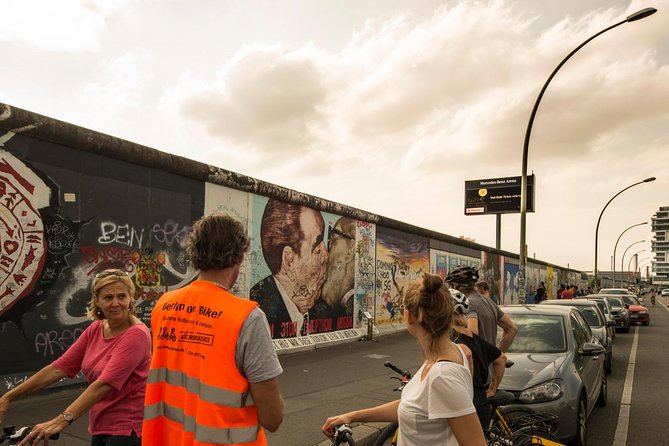
The route includes a permanent open-air gallery along the longest remaining section of the Berlin Wall, beside the Spree between Ostbahnhof and Oberbaum Bridge. This is the East Side Gallery area, where painted sections of the Wall turn a former barrier into a public art site.
The cycling format works well here. Rather than arriving by coach, waiting for a large group to unload, and then leaving again, you approach the Wall as part of the city around it. You can connect the painted panels with the river, the railway, and the changing districts on either side.
Oberbaum Bridge is another major visual moment. Its red-brick towers and arches connect Friedrichshain and Kreuzberg, making it both a practical crossing and a symbol of the two districts meeting.
The bridge can be busy, and urban riding requires attention. One rider specifically noted that Berlin traffic can feel harrowing, particularly for a younger child. Your guide manages the group, but you should still feel comfortable cycling near cars, other bikes, and pedestrians before booking.
Kreuzberg, art spaces, and Görlitzer Park

After Friedrichshain, the route moves into Kreuzberg, where the tone shifts again. The tour includes a center for modern visual arts with exhibitions, workshops, and an artist-in-residence program. The exact amount of time spent there can depend on the group and the guide, but it adds a more organized art setting to the route’s rougher creative spaces.
Görlitzer Park is the final named stop. The park was created in the late 1980s and early 1990s after the old Görlitzer Bahnhof railway facilities were removed. Its history helps explain how former industrial and railway land became public recreation space.
The park is also a place where the tour’s candid approach matters. Some riders specifically appreciated hearing about culture clashes, squatter communities, political art, nightlife, and parts of Berlin that a standard city route skips. This is not a sanitized introduction to the city. You may encounter subjects and settings that are complicated or rough around the edges.
That honesty is a strength if you want to understand modern Berlin as a changing city. It may be less appealing if you prefer a strictly historic tour with quiet monuments and formal museums.
How the guides shape the experience
The route is important, but the guide is likely to determine how much you enjoy it. The strongest descriptions focus on guides who can connect architecture and history with actual neighborhood life.
Anna is repeatedly praised for her enthusiasm, her knowledge of the local alternative scene, and her ability to remember people’s names. She has also been noted for engaging well with a family that included an 11-year-old. Paul is praised for leading a smaller group with good bikes and a relaxed pace.
Marcus and George are highlighted for their personal stories and friendly explanations. Lauren is credited with having more time for stories because the group was small. Edgar even conducted the tour in French when circumstances allowed, although the advertised language is English.
You should not assume that one particular guide will lead your departure. Still, these comments give you a useful idea of the guiding style to expect: informal, engaged, and rooted in Berlin’s neighborhoods rather than limited to textbook facts.
Pace, fitness, traffic, and family suitability
The ride lasts about three hours and 30 minutes, though some descriptions place it closer to three and a half to four hours. Berlin is fairly flat, and the route is not presented as a strenuous athletic ride.
You should have moderate physical fitness and be comfortable staying on a bicycle for several hours. The pace is intended to let you see and absorb the city, but it is still a longer ride with repeated street crossings and stops.
Families can enjoy it, especially with teenagers. A 14-year-old was described as enjoying the varied route, and an 11-year-old completed the tour with support from the guide. For younger children or anyone nervous around traffic, I would consider the riding conditions carefully.
The tour operates in all weather conditions, so bring suitable clothing. At the same time, poor weather can lead to cancellation with a different date or a full refund. The practical lesson is simple: check the forecast, wear layers, and do not count on a dry afternoon.
Is $43.54 good value?
At $43.54 per person, I consider this a fair price for a guided small-group ride lasting roughly half a day. The cost includes the local guide, bicycle, and helmet, so you are paying for more than access to a rental bike.
The value comes from the range of neighborhoods covered. In one outing, you get industrial architecture, Soviet-era housing, parks, Wall art, a major bridge, modern art spaces, and alternative cultural sites. Seeing all of those areas independently would require route planning, bike rental, and a good deal of map checking.
The price is less attractive if you want long visits inside attractions. The stops are generally brief, and the experience is built around riding and commentary. You are paying for orientation and access to local context, not a series of full museum admissions.
Free cancellation is available up to 24 hours before the start time. If the minimum group size is not met, the operator offers another date, another experience, or a full refund.
Who should book this ride?
I would choose this tour if you have already seen some of central Berlin and want to understand the city’s eastern and alternative districts. It is particularly well suited to people interested in street art, modern culture, Berlin Wall stories, architecture, nightlife, and the way old industrial areas are reused.
It also works well early in a Berlin stay because the ride helps you get your bearings. You will see districts that you may want to revisit for food, bars, music, galleries, or another look at the Wall.
I would choose a different tour if your priority is the Brandenburg Gate, Museum Island, Checkpoint Charlie, or a detailed account of every major wartime site. This ride gives you a different Berlin, with more local streets and cultural context than central landmarks.
For most reasonably fit adults and older children, the small group, included equipment, flat route, and lively guiding make it a strong afternoon choice. Just prepare for traffic, weather, and a moving rather than museum-style experience.
FAQ
How long does the Alternative Berlin Bike Tour last?
The tour lasts approximately three hours and 30 minutes. Some descriptions place the total outing closer to three and a half to four hours.
Where does the tour start and finish?
It starts and ends at Berlin on Bike, at Knaackstraße 97, 10435 Berlin, Germany, near the Kulturbrauerei. The activity ends back at the meeting point.
What is included in the price?
The local guide, bicycle, and helmet are included. Food, drinks, and hotel pickup and drop-off are not included.
What language is the tour offered in?
The advertised language is English. One past departure was conducted in French, but you should book with English as the expected tour language.
How large is the group?
The tour has a maximum of 14 participants. This keeps the group smaller than many standard city sightseeing tours.
What happens if the weather is bad?
The experience can be canceled because of poor weather. In that case, you are offered a different date or a full refund. The tour otherwise operates in all weather conditions, so you should dress appropriately.
Just added around Berlin
- Jetbike Berlin fun bike beer bike★ 5.0 · 60 reviews
- Small-Group Historical Bike Tour in Berlin★ 4.5 · 103 reviews
- Berlin: Private Bike Tour of the Berlin Wall and Third Reich★ 5.0 · 23 reviews
- Berlin: Guided Private Bike Tour to Explore the Highlights★ 5.0 · 12 reviews
- Berlin Wall and Cold War Bike Tour in Small Groups★ 5.0 · 114 reviews
- Berlin : Guided Private Sightseeing Tours with Funbikes, Teambikes★ 5.0 · 20 reviews
- Berlin : The best bike tour with a Berlin guide and insider tips★ 5.0 · 14 reviews
- Potsdam Bike Tour with Rail Transport from Berlin★ 4.5 · 81 reviews
Berlin Bike Tours, compared.
Sights and Highlights Bike Tour with a Local Guide
Read our review →
Berlin Highlights Sightseeing Bike Tour in Small Groups
Read our review →
Alternative Bike Tour of Kreuzberg & Friedrichshain
Read our review →
Browse the lists this tour appears in