
REVIEW · BERLIN
Small-Group Berlin Wall Bike Tour
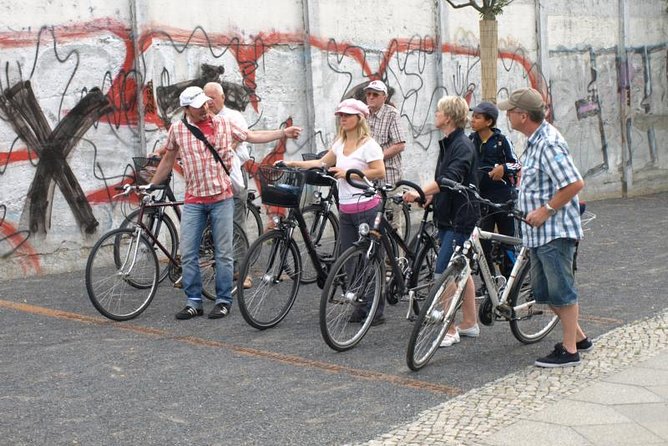
Berlin’s Berlin Wall story makes more sense when you move through the city instead of viewing isolated monuments from a bus window. This four-hour bicycle tour links former border crossings, Nazi-era sites, government buildings, and reclaimed borderland in one steady outing.
I like two things right away: the group is capped at eight riders, and the route reaches places that show different sides of Berlin’s past. Guide Katryn is described as enthusiastic and well informed, which matters when the subject shifts quickly from the Cold War to the Nazi period and modern Berlin.
The main consideration is time. Several stops last only two to five minutes, so this is a guided overview rather than a series of long museum visits. You will need to stay with the group, and the tour runs in all weather.
Key points before you book

- The route covers nine major Berlin sites, including Checkpoint Charlie, the Reichstag, the Berlin Wall Memorial, and the Palace of Tears.
- The group size is limited to eight, giving you a better chance to ask questions than on a large city tour.
- The tour begins at Bornholmer Strasse, one of the most meaningful places connected with the Wall’s opening in 1989.
- Most stops are brief, so expect clear historical explanations and exterior visits rather than lengthy museum time.
- The price is $40.32 per person, with a local professional guide included. Food and drinks cost extra.
- You return to the starting point, and free cancellation is available up to 24 hours before departure.
Why a bicycle suits Berlin’s Wall story

Berlin is a practical city for cycling, and this tour uses that strength well. The former Wall ran across a wide stretch of the city, so seeing several important places on foot would take much longer. A bicycle lets you cover ground while keeping the trip more personal than a coach tour.
The route is not only about the Wall itself. You will also see the Reichstag, Brandenburg Gate, the Topography of Terror, and Potsdamer Platz. That mix helps you place the Cold War border within the larger story of Berlin, a city shaped by war, division, reunification, and rebuilding.
I especially like the connection between the starting point and the final stop. You begin near Bornholmer Strasse, tied to the first border crossing to open on November 9, 1989, and later visit the Berlin Wall Memorial and Mauerpark. The route gives you both the political event and the everyday spaces left behind by the border.
The tour is rated five stars with a 100 percent recommendation from 17 ratings. That is a small sample, so I would not treat it as a guarantee, but the praise is consistent on the point that matters most here: Katryn brings energy and strong historical knowledge to a small group.
A few more bike tours around Berlin worth a look
- Berlin: Sights and Highlights Bike Tour with a Local Guide
★ 4.8 · 2,698 reviews - Berlin Highlights 3-Hour Bike Tour
★ 5.0 · 948 reviews - Berlin City Bike Tour with Beer Garden Stop
★ 5.0 · 917 reviews
Starting at Bornholmer Strasse
Your meeting point is BBT-Sightseeing & More, at Bornholmer Strasse 75 in the 10439 area of Berlin. The tour starts at 10:00 a.m. and ends back at the same meeting point.
Starting here is more than a matter of convenience. Bornholmer Strasse was the first border station to open on November 9, 1989, the night the Berlin Wall began to fall. The stop later in the tour, Platz des 9. November 1989, focuses on that event, so the meeting area gives the day a fitting beginning and end.
You should allow enough time to reach the meeting point before 10:00 a.m. The location is near public transportation, which helps, though the supplied details do not specify a particular train, tram, or subway connection. Bring clothing suited to the forecast. The tour operates in all weather, and a bicycle outing can feel very different in rain or cold.
Reichstag and Brandenburg Gate
The Reichstag is the first listed stop. You get a short look at the parliament building, with admission listed as free. The stop lasts about two minutes, so expect an introduction and a chance to take in the building rather than a visit inside.
The Reichstag works well as an opening landmark because it connects present-day Germany with the divided city you are about to explore. Its role as the parliament building gives you a quick reminder that Berlin is not simply a museum of the Cold War. It is also the political center of modern Germany.
The Brandenburg Gate follows, with about five minutes to hear about Berlin’s city story and the Wall. This is one of the city’s most recognizable sights, but its importance is not only visual. During the division of Berlin, the gate sat in the restricted area near the Wall and became a powerful symbol of a divided city.
A short stop is enough to understand the basic significance, though you will not have time for a long visit or detailed photography session. If you want extensive time at the Brandenburg Gate, return later on your own.
Topography of Terror and Potsdamer Platz

The Topography of Terror shifts the subject from the Cold War to the Nazi period. The stop lasts about five minutes and focuses on city history and Berlin’s Wall history. That combination is useful because Berlin’s twentieth-century story did not begin with the Wall. The city’s wartime destruction and Nazi government shaped the setting in which postwar division took place.
Do not expect a full museum visit during this tour. Five minutes is enough for orientation, not for reading a large exhibition in detail. If this site is a priority for you, plan a separate visit when you can take your time.
Potsdamer Platz comes next, with about two minutes. The area is a sharp example of Berlin’s changing city center, and the guide uses it to explain the city and the Wall. Again, the timing is brief. You will get context while moving through the city, not a long architectural tour.
This part of the route is valuable because it shows how quickly Berlin’s surroundings change from one historical chapter to another. You move from government and national symbols to Nazi-era memory, then into a major central district shaped by the division and later redevelopment of Berlin.
Same city, a different ride:
- Berlin Highlights: 3-Hour Bike Tour
★ 4.9 · 809 reviews - Berlin Highlights Sightseeing Bike Tour in Small Groups
★ 5.0 · 652 reviews - Berlin: The Wall and Third Reich Guided Bike Tour
★ 4.8 · 578 reviews - Berlin: Alternative Bike Tour of Kreuzberg & Friedrichshain
★ 4.7 · 548 reviews
The Palace of Tears at Friedrichstrasse

The Palace of Tears was the former border station at Friedrichstrasse train station. The name comes from the farewells that took place there, as people crossed the border and families separated. Today it is a museum about daily life on both sides of the border.
The tour allows about three minutes here. That gives you the essential setting and a short explanation, but not a full museum experience. The stop is still worthwhile because it puts a human face on the border. Checkpoint Charlie is the famous symbol, while the Palace of Tears points to the ordinary, painful business of crossing and saying goodbye.
I would treat this as a preview. If the personal side of division interests you most, note the location and return independently for a longer look. The bicycle tour keeps moving, so its strength is connecting several places rather than giving each museum a full block of time.
Checkpoint Charlie and the divided city

Checkpoint Charlie receives about four minutes. It was the most famous border station during the Cold War, and the guide explains its place in Berlin’s divided-city story.
This is a classic Berlin stop, but it can be easy to reduce it to a photo opportunity. A guide adds value by explaining why this crossing mattered and how it fit into the wider border system. The short visit also keeps the tour from spending too much of its four hours at one well-known location.
You should keep your expectations clear. This is not an extended museum tour at Checkpoint Charlie, and the itinerary does not include admission to a separate attraction there. You will hear the historical setting and see the place as part of the cycling route.
Berlin Wall Memorial and Mauerpark

The Berlin Wall Memorial gets the longest stop on the central part of the route, about 10 minutes. It includes exhibitions about the Wall and the former borderland. That extra time makes sense. The memorial is designed to help you understand how the border worked as a physical zone, not just as a single concrete barrier.
This is one of the stops where a guide can make a real difference. The Wall’s layout, former border area, and remaining traces can be hard to understand from a quick glance. A small group of no more than eight gives you a better chance to ask for clarification without holding up a large crowd.
Mauerpark follows, with about five minutes. The park occupies reclaimed borderland and is now one of Berlin’s best-known public spaces. Its presence on the route shows what happened after the Wall disappeared: former restricted ground became part of ordinary city life.
The stop is short, but the contrast is strong. You are not only looking at the machinery of division. You are also seeing land returned to the public. That makes Mauerpark a useful part of the tour, even if you will want extra time there on another visit.
Platz des 9. November 1989

The final major stop is Platz des 9. November 1989, where the tour spends about 15 minutes. This was the former border station that opened first on November 9, 1989.
The longer stop gives the guide room to explain the night the border began to open. It also brings the route back to the event hinted at near Bornholmer Strasse. After seeing official buildings, memorials, and famous crossings, you finish with the moment when the system began to break apart.
This is likely the most useful stop for understanding the sequence of events. The Berlin Wall did not simply vanish as a single planned ceremony. A particular border crossing opened first, and that action helped trigger a wider change. The tour’s final extended stop gives that story room to breathe.
You then return to the original meeting point. Since the activity ends where it begins, you can plan onward transportation from a familiar location.
What the four-hour schedule really means
Four hours sounds generous, but nine stops require a brisk rhythm. Several listed visits last only two to five minutes, while the longest stops are about 10 and 15 minutes. The rest of the time is spent cycling between sites and listening while the group moves through Berlin.
I see that as a strength if you want an overview on your first day. You can learn the basic shape of Berlin’s Wall story, identify places worth revisiting, and stay active at the same time. It is less suitable if you prefer to read every exhibit, spend an hour at each memorial, or stop often for photographs.
The small group helps. With a maximum of eight participants, the guide can keep the ride together without the impersonal feel of a large group. Katryn is specifically noted for enthusiasm and strong historical understanding, and that combination is useful on a route with many short explanations.
The supplied information does not state the type of bicycle, the amount of riding difficulty, or the exact distance. Most participants can take part, but you should still be comfortable spending several hours on a bicycle. Service animals are allowed.
Is $40.32 a fair price?
At $40.32 per person, the tour is priced as a reasonably accessible half-day activity rather than a premium private experience. Your fee covers a local professional guide and the bicycle tour itself. Food and drinks are not included, so plan to handle refreshments separately.
The value comes from the number of sites linked in one route. Visiting the Reichstag area, Brandenburg Gate, Topography of Terror, Potsdamer Platz, Palace of Tears, Checkpoint Charlie, the Berlin Wall Memorial, Mauerpark, and Bornholmer Strasse on your own would require planning and several transport decisions.
You are also paying for interpretation, not just movement. Berlin’s Wall sites can feel scattered, and their meaning is not always obvious when you see them one by one. A guide connects the places into a story.
The tradeoff is that this price does not buy long interior visits. If you want extensive time in museums, add separate visits after the ride. For a first look at the city’s major Wall-related places, the cost is sensible.
Who should book this ride?
I would recommend it to first-time Berlin visitors who want a clear introduction to the city’s modern history and enjoy active sightseeing. It also suits people who prefer a small group and want to ask questions without competing with a crowd.
The tour is a good fit if you want to:
- Cover many Wall-related sites in one morning
- Combine history with physical activity
- See Berlin by bicycle rather than from a coach
- Learn from a local guide
- Get ideas for places to revisit later
I would be more cautious if you dislike cycling in changeable weather or need long, quiet visits at museums and memorials. The all-weather policy means you should dress for conditions, and the short stop times favor a moving overview.
Book at least three people together, since a minimum of three is required for a booking. The activity can be canceled if the minimum number is not met, in which case a different date or experience, or a full refund, is offered. You can cancel for a full refund up to 24 hours before the start time.
Should you book the Small-Group Berlin Wall Bike Tour?
Book it if you want an active, well-organized introduction to Berlin’s divided past and present-day city. The route is broad, the group is genuinely small, and the price includes a local professional guide. The strongest feature is the connection between the places, from Bornholmer Strasse and the first border opening to the Wall Memorial, Mauerpark, and the former border crossings.
Do not book it expecting a slow museum day. You will see many important sites, but several visits are only a few minutes long. For most visitors, I would use this as a first-day orientation, then return to the Palace of Tears, Topography of Terror, or Berlin Wall Memorial if one of them catches your interest.
FAQ
How long is the Berlin Wall bike tour?
The tour lasts approximately four hours.
What time does the tour begin?
The tour starts at 10:00 a.m.
Where does the tour begin?
It begins at BBT-Sightseeing & More, Bornholmer Strasse 75, 10439 Berlin, Germany.
Where does the tour end?
The activity ends back at the meeting point.
How many people can join the tour?
The maximum group size is eight participants.
Is there a minimum number of people required?
Yes. A minimum of three people per booking is required.
What is included in the price?
A local guide and professional guide service are included.
Are food and drinks included?
No. Food and drinks are not included.
Does the tour operate in bad weather?
Yes. The tour operates in all weather conditions, so you should dress appropriately.
Can I cancel for a refund?
Yes. You can cancel up to 24 hours before the experience start time for a full refund. Changes or cancellations made less than 24 hours before the start time are not accepted for a refund.
Just added around Berlin
- Jetbike Berlin fun bike beer bike★ 5.0 · 60 reviews
- Small-Group Historical Bike Tour in Berlin★ 4.5 · 103 reviews
- Berlin: Private Bike Tour of the Berlin Wall and Third Reich★ 5.0 · 23 reviews
- Alternative Berlin Bike Tour – Off the Beaten Tracks in Small Groups★ 5.0 · 99 reviews
- Berlin: Guided Private Bike Tour to Explore the Highlights★ 5.0 · 12 reviews
- Berlin Wall and Cold War Bike Tour in Small Groups★ 5.0 · 114 reviews
- Berlin : Guided Private Sightseeing Tours with Funbikes, Teambikes★ 5.0 · 20 reviews
- Berlin : The best bike tour with a Berlin guide and insider tips★ 5.0 · 14 reviews
Berlin Bike Tours, compared.
Sights and Highlights Bike Tour with a Local Guide
Read our review →

Berlin Highlights Sightseeing Bike Tour in Small Groups
Read our review →
Alternative Bike Tour of Kreuzberg & Friedrichshain
Read our review →
Browse the lists this tour appears in