
REVIEW · ITALY
Bologna Panoramic Bike Tour
Bologna reveals itself quickly from a bicycle. In about two hours, you roll from the Cavaticcio park area through medieval squares, university streets, and some of the city’s best-known churches. It is a useful way to get your bearings before exploring on foot.
I like the compact route, which covers seven major sights without asking you to spend a full day pedaling. I also like the small maximum of 15 people and the practical city bikes, which have baskets and are suited to ordinary streets. The main drawback is traffic. You need to feel comfortable cycling around cars, pedestrians, and busy city-center roads.
Key points to know before booking

- Seven central sights in about two hours: The route includes the Two Towers, Piazza Maggiore, the Archiginnasio, San Domenico, and Santo Stefano.
- A public tour with a maximum of 15 people: The group size is small enough to follow a guide, but it is not a private experience.
- Morning timing can make a difference: Bologna’s streets are easier to manage before the city becomes busier, especially on a Sunday morning.
- Guides bring different strengths: Harry has been praised for safety and clear explanations, Vanessa for using side streets and cycle paths, and Giuseppe for keeping the tour friendly in wet weather.
- Expect an overview, not long museum visits: Each scheduled stop lasts about five minutes, so the value comes from seeing the city’s layout and hearing stories while riding.
- The price is $54.07 per person: That is reasonable for a guided orientation, but less attractive if you want lengthy historical talks or extensive stops.
Why a bicycle works well in Bologna
Bologna is a city best understood in layers. The medieval core, university buildings, churches, towers, parks, and public squares are close together, yet walking between every stop can take more time than you expect. A bicycle lets you connect these places in one clean circuit.
The route begins at Via Caduti di Cefalonia, 4, then returns to the same point. That makes the tour easy to fit into a morning or afternoon plan. You do not need to arrange a separate ride back from the end of the route.
I particularly like the way this experience mixes famous sights with less obvious city spaces. Cavaticcio is not the standard first stop for a visitor focused only on postcard views. It helps show how Bologna has reused former industrial and urban areas as places for culture, festivals, and evening life.
The bike also gives you a quick sense of scale. You pass through streets and squares rather than simply arriving at one monument after another. That matters in Bologna, where the relationship between the arcades, lanes, piazzas, towers, and university quarter is part of the city’s character.
Still, this is not a relaxed countryside ride. You are cycling in and around the center, and one rider found the busy streets difficult. You should be comfortable paying attention to traffic and pedestrians while also listening to the guide.
More City Bike Tours in Italy
- Rome: Top Highlights & Hidden Gems Tour by Cannondale E-Bike
★ 4.9 · 1,760 reviews - Florence: 2-Hour Guided Sightseeing Bike Tour
★ 4.5 · 1,004 reviews - Naples: City Highlights Guided Bike Tour
★ 4.7 · 850 reviews
Cavaticcio and Bologna’s modern cultural side
Cavaticcio park is the opening stop, with about five minutes set aside for it. The park has become part of a newer cultural and entertainment area connected with MAMbo, the Cassero, and the Cineteca.
This is a useful first look at Bologna beyond its medieval buildings. In summer, the space hosts a long festival, so the area can feel different depending on the season and time of day. You may see a quiet urban park, or a place being prepared for events.
Do not expect a long stop here. The point is orientation. You get a quick sense of how Bologna has made room for cultural venues and public gathering spaces near the old center.
Torre Prendiparte and the skyline of towers
The route then reaches Torre Prendiparte, a 12th-century tower built by the Guelph Prendiparte family for defense against enemies. At about 60 meters, it is second in height only to the Asinelli Tower.
This stop gives useful context for Bologna’s famous skyline. The city’s towers were not built simply as decoration. They reflected family power, rivalry, defense, and the crowded political life of medieval Bologna.
Five minutes is enough to hear the basic story and look up at the structure. It is not enough for an interior visit or a detailed architectural lesson, so you should treat this as a visual stop along the cycling route.
The tower also helps prepare you for the next landmark, the Two Towers. Seeing both in sequence makes the city’s medieval competition easier to picture.
The Two Towers, Bologna’s unmistakable symbol
The Two Towers are at the heart of the city, near the entry point of the ancient Via Emilia. The Asinelli Tower is the taller and better-known of the pair, while the nearby Garisenda Tower has its own distinctive, leaning profile.
On this tour, you stop for about five minutes. That is enough to take in the scale of the towers and learn why they are so closely tied to Bologna’s identity. It is not a tower-climbing visit, so anyone wanting an ascent or a long look inside will need to plan that separately.
This is one of the route’s strongest moments for first-time visitors. You see the towers as part of the city’s streets rather than as an isolated monument. The bicycle makes it easier to understand how they sit at a major junction in the old center.
The area can be busy. Keep your attention on the guide, your bike, and pedestrians moving around the square. The tour is most comfortable when you accept that this is a city ride, not a closed-road excursion.
More City Highlights Bike Tours in Italy:
- Rome: Standard or E-Bike Highlights Guided Tour
★ 4.7 · 777 reviews - Rome: City Highlights E-Bicycle Tour
★ 4.9 · 740 reviews - Verona e-Bike Tour: City Center and Panoramic Views
★ 4.9 · 708 reviews - Milan: Highlights and Hidden Gems E-Bike Tour
★ 4.7 · 558 reviews
Piazza Maggiore and the heart of the old city
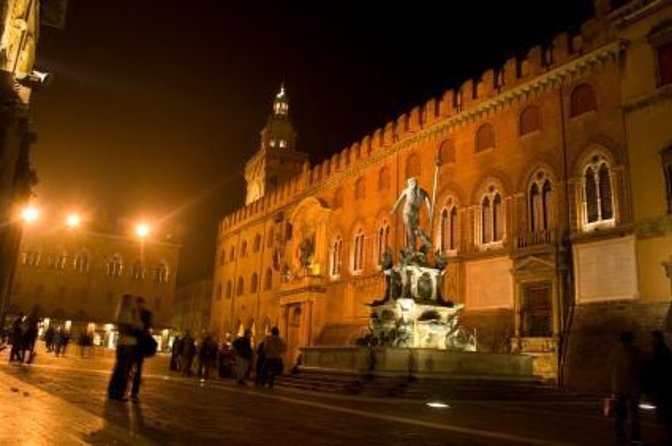
Piazza Maggiore has been Bologna’s central meeting place for centuries. It is surrounded by major medieval buildings, including Palazzo del Podestà, Palazzo d’Accursio, and the Basilica of San Petronio.
The five-minute stop gives you a quick introduction to the square’s main buildings. San Petronio is especially striking because of its imposing gray facade, which was never completed. That unfinished surface is not a minor detail. It gives the basilica a very different look from the polished church facades you may see elsewhere in Italy.
I would use this stop to note what you want to revisit later on foot. The public tour keeps moving, and Piazza Maggiore deserves more time than the schedule allows. Mark the square, the basilica, and the surrounding palaces for a return visit.
This is also a good place to judge the tour’s style. The experience favors a moving overview, with short stops and explanations, rather than sitting in one location for a long lecture. That works well if you want a broad introduction. It may feel too brief if you already know Bologna and want detailed art or political history.
The Archiginnasio and Bologna’s university tradition
The Archiginnasio is one of Bologna’s most important buildings and was once the home of the ancient university. Its location in the historic center makes it an easy and logical addition to the Piazza Maggiore section of the route.
A bike tour can give you the building’s role in the city without requiring you to spend the whole morning inside museums. You learn why Bologna is strongly linked with university life and see how education shaped the center.
Again, the planned stop is about five minutes. If you want to inspect the building closely or explore its interior, you should return independently. The tour’s purpose here is to place the Archiginnasio into the larger story of Bologna, not to provide a full guided visit.
I like this part because it adds a different layer to the ride. The Two Towers speak of medieval families and power. Piazza Maggiore shows civic life. The Archiginnasio points to learning and the long influence of the university.
San Domenico, art, and Dominican history
The Basilica of San Domenico was built by Dominican friars to hold the remains of Saint Dominic, founder of the order, who arrived in Bologna around 1200. The church is one of the city’s major art and religious sites.
The route allows around five minutes here. That is enough to identify the basilica and hear why it matters, but not enough for a detailed look at its art, chapels, or interior decoration.
You should think of this stop as a prompt for later exploration. If religious art and medieval church history interest you, San Domenico deserves a separate visit. The bike tour gives you the basic setting and helps you remember where it is.
This is also a good example of the tour’s limits. Several churches appear in quick succession, and each deserves more time than the schedule gives. The advantage is coverage. The cost is depth.
Santo Stefano and the Seven Churches complex
The final sightseeing stop is the Basilica of Santo Stefano, a group of religious buildings facing the square of the same name. It is also called the Seven Churches complex.
This is a fitting end to the route because it gathers several historic buildings into one memorable setting. You get a sense of how Bologna’s religious life developed through connected spaces rather than a single grand church.
The planned stop lasts about five minutes, so you will want to return if you wish to study the complex carefully. Still, seeing Santo Stefano after San Domenico and San Petronio gives the ride a useful rhythm. You encounter different types of religious architecture instead of repeating the same sort of church visit.
The tour then returns to the starting point. From there, you can continue on foot, find lunch, or revisit the places that caught your attention.
Guides, language, and the feel of the ride
The tour is offered in English. It can also work for a mixed English and Italian group, as one two-hour ride was conducted bilingually without causing trouble for the group.
Guide style may vary. Harry has been praised for clear explanations, attention to safety, and a well-paced route. Vanessa has used side streets, piazzas, and cycle paths while offering ideas for places to visit later. Giuseppe has kept the experience friendly and helpful even in the rain.
Those details matter because the guide is the main source of value. The stops themselves are public places you could reach without paying for a tour. You are paying for the route, the connections between sights, the local context, and the practical help of someone leading you through city streets.
The public format also sets limits. The group can include people with different interests and cycling speeds. It is not designed for long pauses or extended answers to very specific questions. A private tour would be a better fit if you want intensive art history, many anecdotes, or a flexible pace.
The group maximum is 15 people. That is a useful middle ground. You are not in a huge crowd, but you should not expect the guide’s full attention at every moment.
Bikes, streets, weather, and comfort
The bicycles are small city bikes with front baskets. That setup is practical for a short urban ride. You can carry a few small items in the basket, and the design suits a route through streets and squares rather than a long-distance cycling trip.
The most important practical issue is traffic. One of the strongest positive accounts specifically praised the guide’s safety awareness, while another rider found the busy streets difficult. These points fit together: a careful guide helps, but you still need to be alert and reasonably confident on a bike.
Morning is a smart choice when available. A Sunday morning, especially during an unusually quiet local event period, can be calmer than a typical city-center ride. You should not count on empty streets, but an early start may make the route easier.
Weather matters. The experience requires good weather and may be canceled if conditions are poor. In that case, you are offered another date or a full refund. A rainy ride has taken place successfully, but weather can still affect comfort and the operator may cancel when conditions are unsuitable.
Service animals are allowed, and the activity is near public transportation. Most people can participate, but the cycling requirement remains important. If you are uneasy riding around traffic, this may not be the right way to see Bologna.
Is $54.07 a fair price?
At $54.07 per person, the tour is priced as a guided orientation rather than a full-day cultural program. You get about two hours, an English-speaking guide, a city bike, and a route connecting seven important places.
I consider that fair if you are new to Bologna and want to learn the city’s layout quickly. The ride can save you time during your first day, and the guide can point out places worth revisiting. It is especially useful for someone who likes to see a lot before choosing which sights deserve a longer visit.
The value is weaker if you plan to rent a bicycle anyway and prefer to explore independently. The short stops mean you are not receiving lengthy visits at the basilicas or the Archiginnasio. A self-guided ride costs less, though you lose the local explanations and the convenience of a planned circuit.
The public format keeps the price below what a private guide would usually cost, but it also means less flexibility. If four people are paying, the total becomes a more serious expense. At that point, compare the price with a private experience or a simple bike rental, depending on how much instruction and history you want.
Who should book this Bologna bike tour?
I would recommend it to first-time visitors who want a clear introduction to central Bologna without spending half a day walking. It suits people who enjoy short explanations, a steady pace, and seeing famous sights from the street.
It is also a good choice for visitors who want to identify places for a second visit. The route passes churches, towers, university buildings, squares, and a cultural park, giving you a useful menu for the rest of your stay.
You may want something else if you dislike urban cycling, need long stops, or want a specialist art-history tour. The five-minute pauses are enough for context, not close study. A private tour would better serve anyone seeking detailed questions and a slower route.
Free cancellation is available until 24 hours before the start time. Changes or cancellations inside that window are not refunded, and the operator may cancel if the minimum number is not reached.
My recommendation
Book this tour if you want to get your bearings fast, enjoy cycling, and value a guide who can connect Bologna’s towers, churches, squares, and university buildings into one route. Choose a morning departure when possible, and save time later to revisit Piazza Maggiore, the Archiginnasio, or Santo Stefano.
Skip it if you expect a deep architectural lecture or a leisurely stop at every monument. At $54.07, the tour earns its price through coverage, guidance, and convenience. Its best use is as your Bologna introduction, not as your only cultural visit.
FAQ
Where does the Bologna Panoramic Bike Tour start?
The tour starts at Via Caduti di Cefalonia, 4, 40125 Bologna BO, Italy.
Where does the tour end?
The ride returns to the starting point at Via Caduti di Cefalonia, 4.
How long does the tour last?
The tour lasts approximately two hours.
What language is the tour offered in?
The tour is offered in English. A bilingual English and Italian group has also been accommodated.
How many people can join the tour?
The maximum group size is 15 people.
What sights are included?
The route includes Cavaticcio, Torre Prendiparte, the Two Towers, Piazza Maggiore, the Archiginnasio of Bologna, the Basilica of San Domenico, and the Basilica of Santo Stefano.
Does the tour enter the buildings?
The listed stops are short, generally about five minutes each, and the experience is a cycling tour of the city. Entry tickets are not charged for the listed stops.
Is the tour suitable for most people?
Most people can participate, but you need to be comfortable riding a bicycle around city streets. Service animals are allowed.
What happens if the weather is poor?
The experience requires good weather. If it is canceled because of poor weather, you are offered another date or a full refund.
Just added around Italy
- The heart of the 5 Terre: Monterosso and national park ebike tour★ 5.0 · 40 reviews
- E-Bike Val d’Orcia Experience★ 5.0 · 20 reviews
- Wine Tour Ebike Experience★ 5.0 · 175 reviews
- Montecatini Terme cycle and wine tasting visit★ 5.0 · 19 reviews
- 3 Hour E-bike Tour with Parmesan and Balsamic Vinegar★ 5.0 · 36 reviews
- Miles and smiles /// Milan’s ride★ 5.0 · 77 reviews
- Small-group Milan Highlights e-Bike Tour★ 5.0 · 113 reviews
- Private Milan Bike Tour★ 5.0 · 72 reviews
Italy Bike Tours, compared.
Rome EBike Tour: Appian Way, Catacombs & Roman Aqueducts
Read our review →
Top Highlights & Hidden Gems Tour by Cannondale E-Bike
Read our review →
Appian Way & Aqueducts E-Bike Tour (Catacombs & Food)
Read our review →
Appian Way, Catacombs, & Roman Aqueducts E-bike Tour
Read our review →
Rome City Small Group Bike Tour with quality Cannondale EBike
Read our review →
Tuscany Bike Tours Through the Chianti Hills with Wine Tasting
Read our review →
Rome by Night – Ebike Small Group Tour – Food and Wine (Option)
Read our review →Browse the lists this tour appears in