

REVIEW · ROME
Rome: Appian Way, Catacombs, & Roman Aqueducts E-bike Tour
Rome’s ancient Appian Way makes a fine escape from central Rome, but getting there by e-mountain bike adds something special: you cover a lot of ground without giving up the quiet of the Roman countryside. One minute you’re near the Aurelian Walls, the next you’re rolling past tombs, villas, and grassland beneath towering aqueduct arches.
I like two things here. First, the route links several major Roman sites that are awkward to reach together by public transport. Second, the small groups, sturdy Cannondale bikes, and careful guides make a long ride feel manageable. The drawback is clear: this is not a gentle city cycle. The 27-kilometer route includes gravel, uneven paths, and traffic on some connecting streets.
Key points
- Two tour lengths: Choose four hours without an underground catacomb visit, or six hours with a guided visit to the Catacombs of St. Callixtus or St. Sebastian.
- A long, varied route: Ride 27 km, with about 60% on off-road paths through parks and the Appian Way.
- Ancient Rome beyond the center: See the Circus of Maxentius, Tomb of Cecilia Metella, Villa dei Quintili, Roman Aqueducts, Caffarella Park, and Baths of Caracalla.
- Strong guiding and safety: Guides including Oscar, Arina, Agnese, Bita, Cas, and Pablo are noted for clear history talks and careful handling of city traffic.
- Good equipment: Cannondale e-mountain bikes have anti-puncture tires, and helmets are required.
- Best for confident cyclists: Electric assistance helps with distance and hills, but you still need to handle gravel, bumps, and urban roads.
Why the Appian Way works so well by e-bike
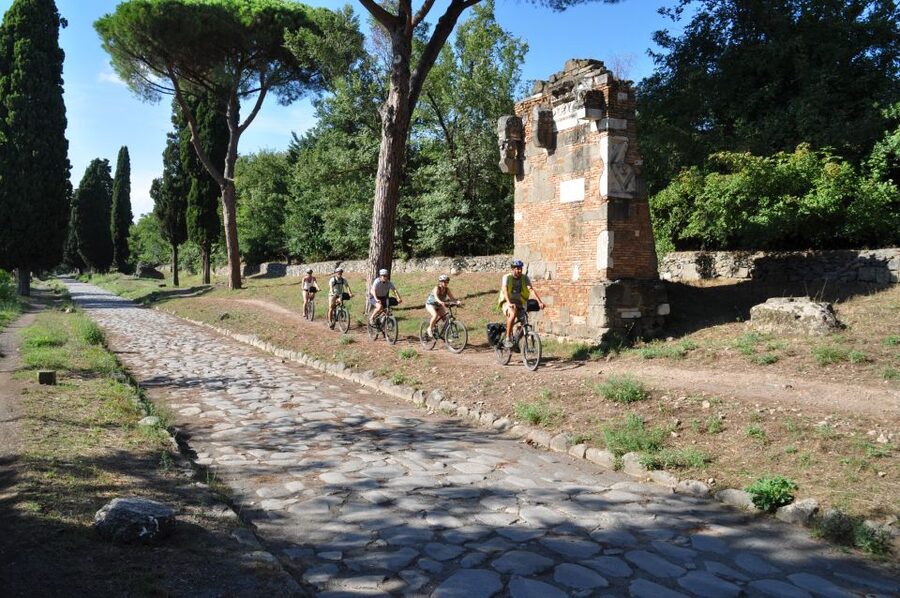
Many Rome tours keep you within the old city center. This one takes you out toward the city’s southern edge, where ancient ruins sit among fields, umbrella pines, and open country. You get a break from Rome’s tight streets while still seeing some of its most important Roman remains.
The electric assist matters because the route is long. You pedal the full distance, but the bike helps on climbs and lets you keep moving without burning out. One family covered about 16 miles during the six-hour version and found the power assistance made the distance easy. That does not turn the tour into a motorized sightseeing ride, though. You still need balance, braking skills, and enough confidence to manage uneven ground.
The group limit is 10 people. That is small enough for a guide to keep an eye on the back of the group, explain sites during stops, and help with bike settings. Guides such as Arina, Oscar, Agnese, Bita, and Pablo have been praised for pacing groups well and taking care around traffic.
More E-Bike Tours in Italy
- Rome EBike Tour: Appian Way, Catacombs & Roman Aqueducts
★ 5.0 · 1,766 reviews - Rome: Top Highlights & Hidden Gems Tour by Cannondale E-Bike
★ 4.9 · 1,760 reviews - Rome: Appian Way & Aqueducts E-Bike Tour (Catacombs & Food)
★ 4.9 · 1,498 reviews
Starting at Via Labicana 49

The meeting point is Via Labicana 49, within walking distance of both the Colosseum and Manzoni Metro stations. From the Colosseum, allow about 10 to 15 minutes. Walk past the Colosseum as the street becomes Via Labicana, then look for number 49 on the right.
From Manzoni, the walk takes about 10 minutes. Follow Viale Manzoni toward the Colosseum until it changes into Via Labicana. Number 49 will be on the left.
You begin by getting fitted with a helmet and checking the Cannondale e-mountain bike. The helmet is mandatory, which is sensible given the mix of city streets and rougher paths. You also receive a five-liter handlebar bag and a biodegradable bottle of water. Bring comfortable shoes, and remember that food and extra drinks are not included.
Through the Aurelian Walls and toward ancient Rome
The route leaves the modern city through St. Sebastian’s Gate in the Aurelian Walls. These walls once marked the edge of imperial Rome, and passing through them gives the ride a useful sense of transition. The traffic and buildings begin to thin as you move toward the Appian Way.
The first urban section requires attention. About 40% of the tour takes place in the city, and traffic is unavoidable while connecting the Appian Way with the Aqueducts Park. Your guide chooses quieter streets where possible, gives instructions before crossings, and keeps the group together.
This is where cycling experience matters most. Several riders with little e-bike experience managed well after a short introduction, but the route is not the place to learn basic bike control from scratch. If you rarely ride, practice on an e-bike before booking, especially if you are bringing children.
The Catacombs: choose the six-hour version carefully
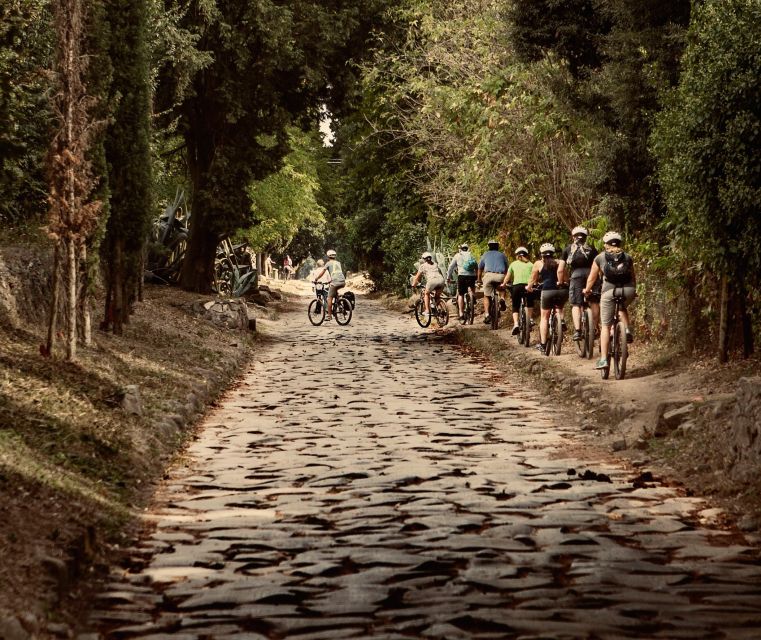
The four-hour tour makes a short stop at a catacomb entrance, with an explanation of the site’s early Christian importance. It does not include an underground visit.
The six-hour version includes a guided visit to the Catacombs of St. Callixtus or St. Sebastian. You go below ground into crypts and corridors, adding a very different experience to the open-air ruins above. If the catacombs are high on your Rome wish list, the longer tour is the better choice. The extra two hours are not simply more cycling. They add a guided historical stop that the shorter outing cannot provide.
The catacomb visit also changes the pace of the day. Instead of riding continuously, you get time on foot in a quiet, enclosed setting before returning to the bike. Check the selected departure and tour version when booking, since the four-hour and six-hour options do not offer the same program.
More E-Bike Tours in Rome
- Rome City Small Group Bike Tour with quality Cannondale EBike
★ 5.0 · 1,380 reviews - Rome by Night – Ebike Small Group Tour – Food and Wine (Option)
★ 5.0 · 1,275 reviews - Rome by Night: E-bike Small Group Tour -Food & Wine (Option)
★ 4.9 · 1,233 reviews - Rome: Standard or E-Bike Highlights Guided Tour
★ 4.7 · 777 reviews
Riding the 2,300-year-old Appian Way
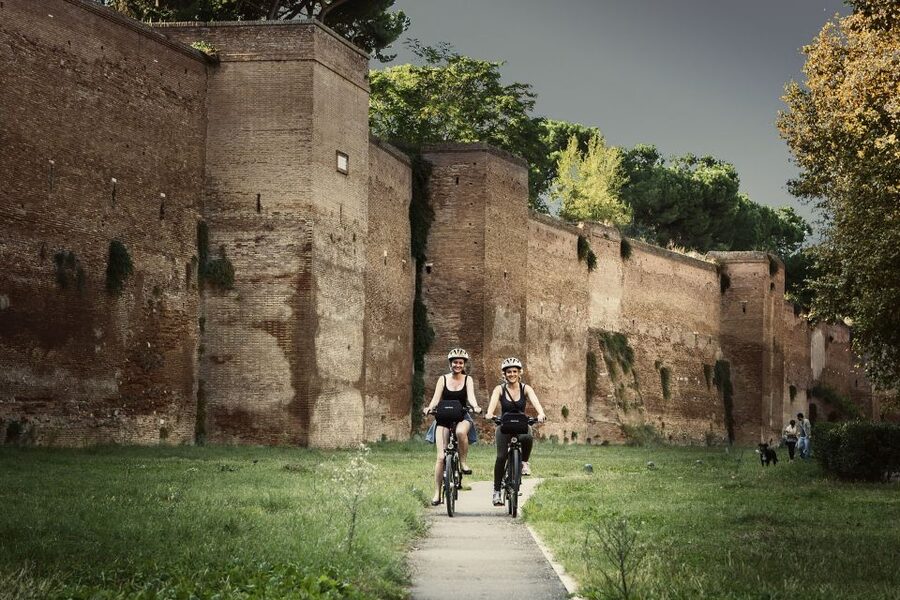
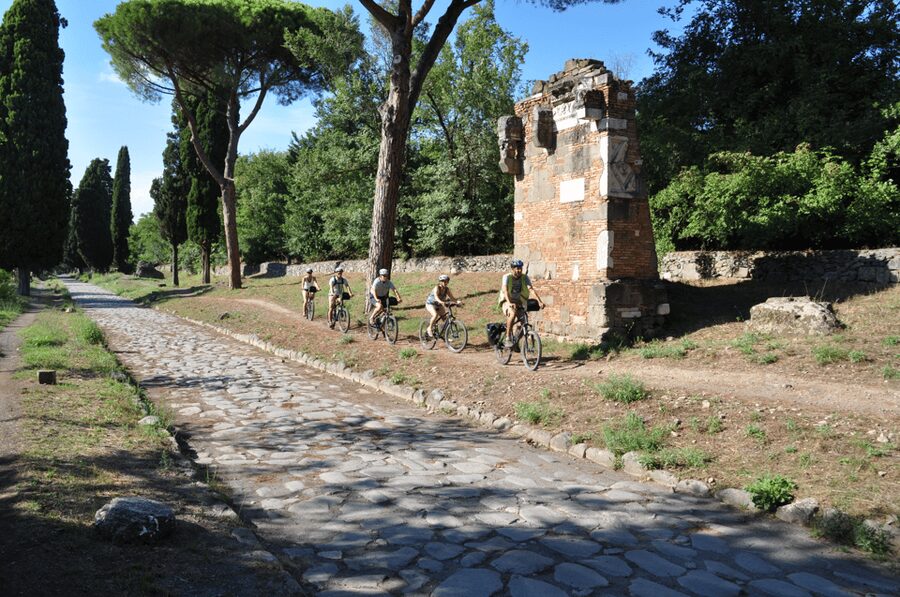
The Appian Way was one of Rome’s great roads, built more than 2,300 years ago to connect Rome with the south of Italy. Today, parts of it feel less like a normal street and more like a long archaeological path.
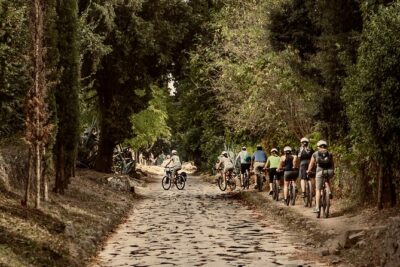
You pass ancient villas, tombs, mausoleums, and memorial stones scattered along the route. The remains are not arranged like a single museum exhibit. They appear beside the road, across grassy plots, and behind low walls, so the guide’s explanations help you understand what you are seeing.
The route includes the Circus of Maxentius, an impressive complex linked to the emperor Maxentius, and the Tomb of Cecilia Metella, one of the Appian Way’s best-known monuments. You also pass the Villa dei Quintili, a large aristocratic Roman property. These stops show how the Appian Way was more than a transport route. It was also a prestigious corridor lined with grand estates and elaborate tombs.
Expect to stop often for short explanations and photographs. That helps keep the ride from becoming a blur of ruins, but the ground can be rough. Gravel and old paving create bumps, and one rider noted that rear suspension would have made the roughest stretches more comfortable. The bikes are solid, but they do not erase every jolt.
The Aqueducts Park is the visual high point
The route eventually reaches the Park of the Aqueducts, where giant arches cross the open countryside. This is the part of the tour most likely to make you stop and simply look. The aqueducts stretch across the grass in long lines, turning Roman engineering into something you can see from a distance.
The scale is the main attraction. In the city, Roman ruins are often hemmed in by buildings and roads. Here, the arches have room around them, and you can appreciate how water infrastructure shaped the growth of Rome.
You follow the aqueducts back toward modern civilization. The ride is mostly free of traffic in the park, which gives you a welcome change after the city connections. Guides usually stop at several points to explain the structures and allow photographs, so you are not expected to pedal past the main sights.
The park is also where the e-bike feels most enjoyable. You can use the assistance to keep a steady pace on the dirt tracks, then reduce it when you want more exercise. The bikes are described as easy to use, but ask your guide to explain the gears and power settings before leaving. First-time e-bike riders have learned the controls quickly with help.
Caffarella Park brings nature into the itinerary
After the aqueducts, the route crosses the green Caffarella Valley. This section adds a rural feel to a tour that could otherwise become a sequence of ruins. You ride among open space and greenery before beginning the return toward the city.
I like this part because it gives the tour breathing room. The Appian Way provides the ancient road and monuments. The Aqueducts Park provides the dramatic structures. Caffarella supplies the quieter setting between them.
Still, weather matters. Summer can be hot, and you should use the water stops wisely. Rain does not necessarily ruin the ride, but paths can feel less comfortable when wet. Wear clothes and shoes that can handle dust, mud, or a sudden change in conditions.
The return includes the Baths of Caracalla
The final stretch heads back toward the starting point and includes the Baths of Caracalla. These enormous imperial bathing complexes help bring the story back toward central Rome.
The baths are a fitting last stop because they show the scale of Roman public life. Earlier, you see roads, tombs, villas, and water systems spread across the countryside. Here, you return to a monumental urban complex built for public use.
The complete loop gives you a broad look at Rome’s infrastructure and power. It also explains why the tour takes four to six hours. The distance is substantial, and the route connects sites that are widely separated.
How difficult is the 27-kilometer ride?
The stated level is intermediate. The route is 27 km, or about 17 miles, and 60% is off-road. That combination makes the ride more demanding than the electric motor alone suggests.
You should be comfortable:
- Starting, stopping, and turning on an e-bike
- Riding over gravel and uneven ground
- Following a guide through city streets
- Keeping a steady pace for several hours
- Handling some bumps without panic
The electric assistance helps with hills and distance, but it does not steer or balance the bike for you. One rider who did not usually ride off-road managed the route but found some sections bumpy. Another advised infrequent cyclists to practice on an e-bike before dealing with Rome’s streets.
Children can join under specific conditions. Ages 1 to 4 ride in a child seat, up to 49 pounds or 22 kilograms, and join free. Ages 5 to 8 use a child extension. Children 9 and older can ride an e-bike independently. The tour notes that the route becomes difficult with a child seat or extension, so families should judge their own comfort rather than assume the motor makes everything easy.
The equipment has a total weight limit of 300 pounds, or 136 kilograms. Infants under 1 year are not suitable for this activity.
Guides make the city riding easier
The history matters, but guide control matters just as much. The group must move through roughly 40% city streets before reaching the quieter parks. A good guide signals clearly, positions the group safely, and warns you about busy sections before they arrive.
Guides including Oscar, Arina, Anna, Bita, Cas, Agnese, Sina, Ali, and Pablo have been singled out for careful pacing, strong Roman history talks, and friendly help with bike technique. Oscar has also been noted for steering groups safely through traffic and suggesting a good lunch stop. Bita is described as especially engaging and attentive, while Agnese is praised for knowing the route thoroughly and looking after every rider.
The guide’s style can shape your day. Some focus on humor and storytelling. Others give more detailed historical explanations. All tours are offered in English, Italian, French, Spanish, German, or Dutch, depending on availability.
Is $85 a fair price?
At $85 per person, the tour is not the cheapest way to see Rome. But the price includes a quality e-mountain bike, helmet, guide, handlebar bag, water, and a route that covers several distant sites in one outing.
The value is strongest if you want the six-hour version. A guided catacomb visit, the Appian Way, Circus of Maxentius, Tomb of Cecilia Metella, Villa dei Quintili, Aqueducts Park, Caffarella Park, and Baths of Caracalla would be difficult to combine independently in a single day without arranging several transport connections.
The four-hour version makes better sense if you mainly want the riding, scenery, and Roman ruins. It gives you the entrance explanation at the catacombs, but not the underground visit. Food is extra, though you can buy something along the way. Several guides have included a pizzeria stop, including one described as a roadside location with good food, but lunch is not a guaranteed inclusion.
You can cancel up to 24 hours ahead for a full refund, and reserve now while paying later. A minimum of four participants applies. If that number is not reached, an alternative or full refund is offered.
Who should book this ride?
I would choose this tour if you have already seen the Colosseum and central Rome and want a different side of the city. It suits adults, families with older children, and anyone who enjoys combining history with time outdoors.
It is also a good fit if you want the Appian Way and Aqueducts Park but do not want to arrange transport between them. The electric bike removes much of the strain, while the small group keeps the experience personal.
I would hesitate if you dislike uneven paths, feel nervous in traffic, or rarely ride a bicycle. The route is safe-minded, but it is not traffic-free. You also need comfortable shoes and enough stamina for several hours of cycling, even with motor assistance.
Should you book the Appian Way e-bike tour?
Book it if you want Rome’s ancient remains with room to breathe. The best reasons are the broad route, the Aqueducts Park, the quiet stretches of the Appian Way, and the chance to see the catacombs on the six-hour option.
Choose the four-hour tour for a shorter ride focused on outdoor ruins. Choose six hours if the catacombs matter to you and you want the fullest program. Either way, arrive ready for 27 km, gravel, bumps, and some urban traffic. If that sounds appealing rather than alarming, this is one of the most useful ways to see Rome beyond its crowded center.
FAQ
How long is the Appian Way e-bike tour?
You can choose a four-hour or six-hour version. The six-hour option includes a guided visit to the catacombs, while the four-hour option includes only a brief explanation at the entrance.
How far do you ride?
The route is 27 km, or about 17 miles. Around 60% of the route is off-road, and about 40% takes place on city streets.
Does the tour visit the catacombs?
The six-hour tour includes a guided underground visit to the Catacombs of St. Callixtus or St. Sebastian. The four-hour tour stops at the entrance for a short explanation but does not include the underground visit.
Is the tour suitable for beginners?
The tour is rated intermediate. The e-bike helps with hills and distance, but you should be comfortable riding a bicycle, handling uneven paths, and managing some city traffic.
Can children join the tour?
Children aged 1 to 4 can ride in a child seat up to 49 pounds or 22 kilograms. Children aged 5 to 8 use a child extension, and children aged 9 or older can ride an e-bike independently. Babies under 1 year cannot join.
What is included in the price?
The price includes a Cannondale e-mountain bike with anti-puncture tires, a professional guide, a helmet, a five-liter handlebar bag, and a biodegradable bottle of water. The catacomb visit is included only with the six-hour tour.
Where does the tour start?
The meeting point is Via Labicana 49. It is about 10 to 15 minutes on foot from the Colosseum Metro station and about 10 minutes from Manzoni Metro station.
Just added around Rome
- Rome’s Best by E-bike: Guided City Tour (Small Group or Private)★ 5.0 · 207 reviews
- Rome: Appian Way, Aqueducts & Catacombs (Small Group or Private)★ 5.0 · 103 reviews
- Private Rome City Bike Tour with quality Cannondale EBike★ 5.0 · 176 reviews
- Rome E-Bike Small Group Tour of the Appian Way with Private Option★ 5.0 · 130 reviews
- Rome: E-Bike Rental with Helmet and U-Lock★ 4.9 · 61 reviews
- Rome: Electric Bike Rental★ 4.6 · 99 reviews
- Bike Rental inside Appian Way Regional Park★ 4.5 · 104 reviews
- Highlights & Hidden Gems Tour with Top E-bike★ 5.0 · 300 reviews
Rome Bike Tours, compared.
Rome EBike Tour: Appian Way, Catacombs & Roman Aqueducts
Read our review →
Top Highlights & Hidden Gems Tour by Cannondale E-Bike
Read our review →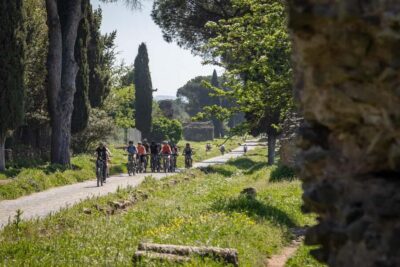
Appian Way & Aqueducts E-Bike Tour (Catacombs & Food)
Read our review →
Rome City Small Group Bike Tour with quality Cannondale EBike
Read our review →
Rome by Night – Ebike Small Group Tour – Food and Wine (Option)
Read our review →
Rome by Night: E-bike Small Group Tour -Food & Wine (Option)
Read our review →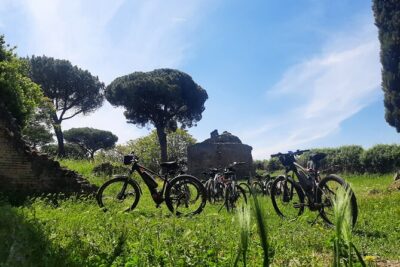
Appian Way Aqueducts Bike Tour (Catacombs & Lunch Option)
Read our review →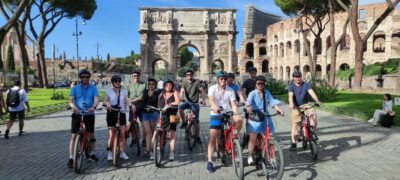
Browse the lists this tour appears in