REVIEW · ITALY
Bologna Guided Bike Tour
Bologna’s most surprising sight may be below your tires: an old network of canals that helped power the city’s medieval economy. This 2.5-hour bike tour gives you a brisk way to connect those waterways with towers, churches, porticoes, and grand squares across the historic centre.
I like two things here. First, you cover far more ground than you would on foot without turning the outing into a hard workout. Second, the route includes useful local details, such as the canal view at Via Piella and the old port district. The main caution is the guide commentary. Some participants found it friendly and enjoyable, while others wanted a clearer structure and more historical detail.
Key points at a glance

- Bologna’s canals: See the Moline Canal through the small opening at Via Piella.
- Historic centre sights: Visit Piazza Maggiore, the Archiginnasio, the Two Towers, and Prendiparte Tower.
- Churches with character: Stop at Santo Stefano, known as the Seven Churches, and San Domenico, home to a work by Michelangelo.
- Practical equipment: A city bike, helmet, basket, radio guide, and insurance are included. Raincoats are available on request.
- Small-group requirement: The tour runs only with at least four participants, so confirm the booking in advance.
- Basic cycling ability required: You need to be comfortable riding a bicycle and should wear sporty, comfortable clothes.
Why a bicycle makes sense in Bologna

Bologna is a city made for walking, but a bicycle adds a useful second gear. The historic centre gathers many major sights within a fairly compact area, and this tour links them in one continuous route instead of treating each monument as an isolated stop.
You get the pleasures of an outdoor tour without committing to a full-day ride. The pace should suit you if you want an introduction to Bologna before exploring particular museums, churches, or food markets on your own.
The bike also helps you see the city beyond its most famous streets. The itinerary includes the Manifattura delle Arti district, the former port area, and Via Piella, places that can be missed if you stick only to Piazza Maggiore and the Two Towers.
You do need to be a competent cyclist. This is not a learn-to-ride session, and the operator specifically says that you must be familiar with bicycles. If you are uneasy on two wheels, Bologna’s walking tours will be a better fit.
More Guided Tours in Italy:
- Milan: Hidden Gems Guided Bike Tour
★ 4.8 · 1,334 reviews - Florence: Guided E-Bike Tour to Piazzale Michelangelo
★ 4.4 · 1,204 reviews - Florence: 2-Hour Guided Sightseeing Bike Tour
★ 4.5 · 1,004 reviews
Piazza Maggiore opens the story
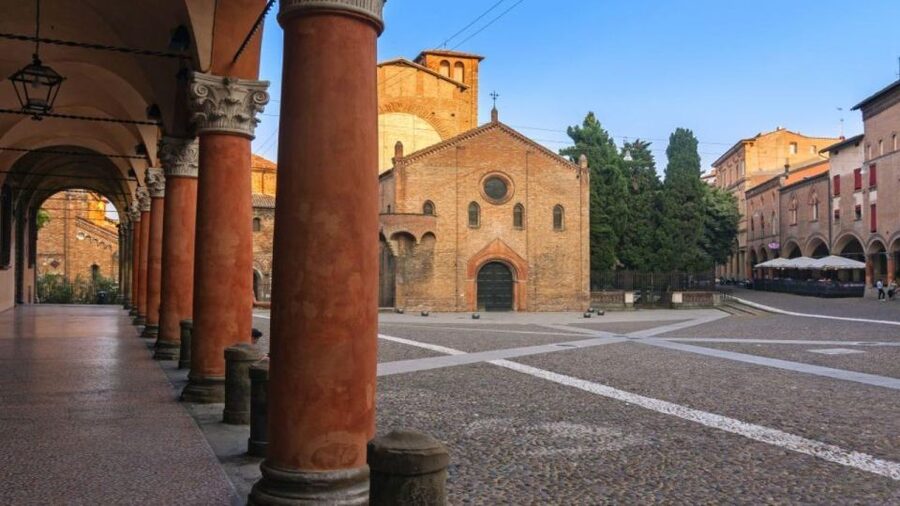
The tour begins at Piazza Maggiore, the city’s central stage. Here, you see the Basilica of San Petronio, Palazzo Re Enzo, and the Neptune Fountain gathered around one broad public square.
This is a sensible opening stop because it gives you Bologna’s visual shorthand right away. San Petronio is the huge church that dominates the square, while Palazzo Re Enzo adds a medieval civic note. The Neptune Fountain provides a clear landmark and makes an easy point for the guide to explain how the centre developed.
A bike tour cannot give every building the same time as a dedicated walking visit. You should expect an overview rather than a long interior visit. The value is the connection between the sights, with the guide helping you understand how the square fits into the larger city.
Piazza Maggiore is also a useful orientation point. After the tour, you can return on foot to spend more time at the monuments that catch your eye.
The Archiginnasio and Bologna’s university tradition

From the main square, the route continues to the Archiginnasio, a building once used by the University of Bologna. The university was founded in 1088 and is described as the oldest in the world.
That fact gives the stop real weight. Bologna is not simply a city of medieval towers and porticoes. It has also been shaped by centuries of study, teaching, and student life.
The tour’s short stop should help you place the university within the city centre rather than leaving it as an isolated fact. If you enjoy academic history, this part may be one of the most interesting moments of the ride.
The limitation is time. A 2.5-hour route has several stops, so you should not expect an extended visit inside every major building. Think of the Archiginnasio as a prompt for further exploration, especially if you want to see more of Bologna’s university heritage later.
Two Towers and Prendiparte Tower
Bologna’s towers give the centre its distinctive outline. The itinerary takes you to the Two Towers, the city’s best-known pair, and to Prendiparte Tower, one of the few towers still standing in the historic centre.
The Two Towers are the obvious headline sight, but Prendiparte adds useful depth. It reminds you that Bologna once had many more towers than the handful visible today. The route therefore gives you both the famous image and a less obvious piece of the city’s medieval character.
A bicycle is especially handy here because you can reach several landmarks without making each transfer a separate walk. You also remain close to the action, moving through the urban fabric rather than simply arriving at a viewpoint.
Do not expect tower access to be part of this activity. The information provided describes exterior stops and guided sightseeing, not climbs or interior entries. If you want a high view of Bologna, check separately for a tower visit.
A few more bike tours around Italy worth a look
- Rome EBike Tour: Appian Way, Catacombs & Roman Aqueducts
★ 5.0 · 1,766 reviews - Rome: Top Highlights & Hidden Gems Tour by Cannondale E-Bike
★ 4.9 · 1,760 reviews - Rome: Appian Way & Aqueducts E-Bike Tour (Catacombs & Food)
★ 4.9 · 1,498 reviews - Rome: Appian Way, Catacombs, & Roman Aqueducts E-bike Tour
★ 4.9 · 1,421 reviews
Manifattura delle Arti and the old port
The Manifattura delle Arti district brings a different side of Bologna into the route. Here, the guide explains the origins of the ancient port and the canals that still run beneath the streets.
This is where the tour gains its strongest sense of place. Bologna’s waterways were not decoration. They played a major role in the city’s economic development during the Middle Ages, and the old port helps explain how goods and work shaped the city.
I like this stop because it moves beyond the standard list of churches and squares. You begin to see Bologna as a working city, not only as a collection of handsome buildings.
The canal story also gives the bike ride a clear theme. You are not just pedaling from one monument to another. You are following clues about how the city functioned, even when much of that water is now hidden below the road surface.
Via Piella and the canal window
Via Piella offers the tour’s most unusual visual detail. Through a small opening, you can see the Moline Canal flowing in the open air.
It is an easy sight to miss, which is exactly why it earns a place on a guided route. The little window turns an ordinary-looking street into a reminder that Bologna’s water system is still present beneath and beside the modern city.
This stop is likely to be brief, but it gives you a strong memory of the tour. You may find it more distinctive than another broad piazza because it reveals something hidden in plain sight.
If you are interested in the canals, pay attention to the guide’s explanation of their role in medieval commerce. The supplied feedback suggests that the quality of information can depend on how the guide organizes the commentary. I would listen closely here and ask a direct question if you want more context.
Santo Stefano, the Seven Churches

The route then reaches the Basilica of Santo Stefano, also called Sette Chiese, or Seven Churches. The name refers to the complex’s unusual group of religious buildings rather than to a single standard church interior.
This is one of the itinerary’s most atmospheric stops. Santo Stefano gives you a different scale and mood from the open space of Piazza Maggiore. Its importance comes from the group of connected sacred spaces and the long religious tradition attached to them.
The tour is designed to show you the site as part of the city’s story, not to provide a full architectural lecture. If you want detailed information about each part of the complex, leave time for a return visit.
The bicycle makes the sequence practical. You can see the church after the central squares and towers without using public transport or retracing a long walking route.
San Domenico and Michelangelo’s work
The final major stop is the Basilica of San Domenico, which houses a work by Michelangelo. The mention of Michelangelo gives this church an immediate artistic hook, especially if you have limited time in Bologna and want to know which religious sites deserve attention.
San Domenico also rounds out the tour’s view of the city. You see civic buildings, university history, medieval towers, canals, and major churches in one outing. That range is the main reason to choose this experience early in your stay.
Again, this is not presented as an art-history tour with extended interior commentary. The guide points out the church and the Michelangelo connection, then the route continues. You should use the stop to decide if you want to come back for a slower visit.
What the guide service is like

The tour is offered in English or Italian, with radio guides included. That equipment matters on a bicycle because it lets you listen while remaining with the group, rather than stopping every few minutes to gather around the guide.
The guide is meant to provide history, fun facts, and local suggestions. The strongest feedback praises the guide’s friendly manner and describes the experience as a good way to discover the city. That personal tone can make a short orientation tour feel relaxed rather than formal.
The weaker feedback points to a real issue: the information may feel too plentiful or poorly organized, while another participant felt there was not enough history. Those comments seem opposite, but they point to the same thing. The experience depends in part on the guide’s delivery and on what you want from the commentary.
If you want a polished lecture with a strict chronological thread, this may not satisfy you every time. If you want a human introduction, local facts, and a route that helps you get your bearings, it has more appeal.
Bikes, clothing, and comfort
The package includes a city bike, helmet, basket, radio guide, and insurance. A raincoat is available on request. The bicycles received positive practical feedback, and good equipment is important here because the tour spends 2.5 hours moving between several parts of the centre.
Wear sporty, comfortable clothing. In summer, bring sunscreen and a hat. In winter, the operator recommends gloves, a scarf, and a cap. These are small choices, but they matter on a bicycle because you feel the weather more directly than you do during an indoor tour.
The tour requires at least four participants. Book at least 24 hours ahead, or call for definite confirmation. This condition is important if you are planning the ride around a tight Bologna schedule, since a last-minute assumption could leave you without a confirmed departure.
Accident insurance is available on request and is separate from the included insurance. Ask about it when booking if that extra protection matters to you.
Is $88 a fair price?
At $88 per person, this is not the cheapest way to see Bologna. The price includes the bicycle, helmet, basket, radio guide, guide service, insurance, and a 2.5-hour route through many central sights.
The value comes from the amount of orientation you get in a short period. Piazza Maggiore, the Archiginnasio, the Two Towers, Prendiparte Tower, the old port district, Via Piella, Santo Stefano, and San Domenico would take more effort to connect on your own.
It is a stronger deal for a first visit than for someone who already knows the historic centre well. You are paying for transport between sights as well as commentary, equipment, and a planned route.
The price is less convincing if your main goal is detailed history or long interior visits. In that case, a focused walking tour or museum visit may give you more information per euro. You can also treat this ride as an orientation, then choose two or three favourite stops to explore independently.
Free cancellation up to 24 hours before the activity and reserve-now, pay-later booking make it easier to fit into a changing itinerary. The four-person minimum remains the key planning point.
Who should book this ride?
I would recommend it to first-time visitors who want to understand Bologna’s layout quickly. It also suits you if you like seeing a city through its less obvious details, especially the old canals and former port area.
It is a good match for confident cyclists, active couples, and small groups who prefer an outdoor introduction to a conventional walking tour. The route includes enough major sights to help you choose where to return later.
You may want another option if you cannot ride a bike, dislike city cycling, or want a highly detailed account of Bologna’s history at every stop. The mixed feedback about the commentary means you should book for the route and broad introduction, not solely for an academic lecture.
My recommendation
Book this Bologna bike tour if you want a practical first look at the historic centre and like the idea of linking famous sights with the city’s underground canal story. The best parts are the range of stops, the good practical equipment, and the unusual Via Piella and Manifattura delle Arti sections.
Before you commit, confirm the minimum of four participants and ask about accident insurance if needed. Choose comfortable clothing, bring weather protection, and keep your expectations clear: this is a lively city overview on two wheels, not a slow, exhaustive history seminar.
FAQ
How long does the Bologna Guided Bike Tour last?
The tour lasts 2.5 hours.
What languages are available?
The live guide is available in English and Italian.
What sights are included?
The route includes Piazza Maggiore, the Basilica of San Petronio, Palazzo Re Enzo, the Neptune Fountain, the Archiginnasio, the Two Towers, Prendiparte Tower, the Manifattura delle Arti district, Via Piella, the Basilica of Santo Stefano, and the Basilica of San Domenico.
Is bicycle equipment included?
Yes. The tour includes a city bike, helmet, basket, radio guide, and insurance. A raincoat is available on request.
Do I need to be an experienced cyclist?
You need to be familiar with riding a bicycle. The activity is not suitable for people who cannot ride.
How far in advance should I book?
Book at least 24 hours in advance, or call for definitive confirmation. The tour starts with a minimum of four participants.
Just added around Italy
- The heart of the 5 Terre: Monterosso and national park ebike tour★ 5.0 · 40 reviews
- E-Bike Val d’Orcia Experience★ 5.0 · 20 reviews
- Wine Tour Ebike Experience★ 5.0 · 175 reviews
- Montecatini Terme cycle and wine tasting visit★ 5.0 · 19 reviews
- 3 Hour E-bike Tour with Parmesan and Balsamic Vinegar★ 5.0 · 36 reviews
- Miles and smiles /// Milan’s ride★ 5.0 · 77 reviews
- Small-group Milan Highlights e-Bike Tour★ 5.0 · 113 reviews
- Private Milan Bike Tour★ 5.0 · 72 reviews
Italy Bike Tours, compared.
Rome EBike Tour: Appian Way, Catacombs & Roman Aqueducts
Read our review →
Top Highlights & Hidden Gems Tour by Cannondale E-Bike
Read our review →
Appian Way & Aqueducts E-Bike Tour (Catacombs & Food)
Read our review →
Appian Way, Catacombs, & Roman Aqueducts E-bike Tour
Read our review →
Rome City Small Group Bike Tour with quality Cannondale EBike
Read our review →
Tuscany Bike Tours Through the Chianti Hills with Wine Tasting
Read our review →