
REVIEW · NAPLES
Central Naples Bike Tour
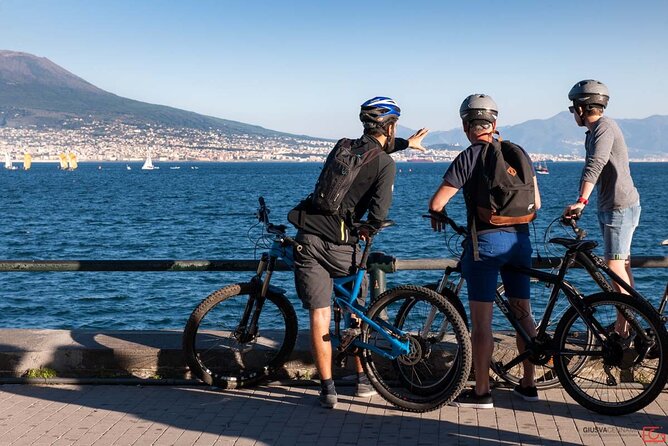
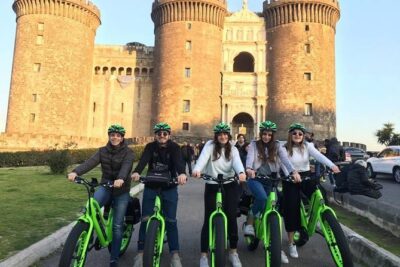
Naples makes you work for its rewards, and this three-hour bike tour puts you right into the action. You pedal from grand Piazza del Plebiscito to Castel dell’Ovo, the old Decumani, Via Toledo, the Spanish Quarter, and the waterfront. With a good guide, the city opens up quickly.
I like the mix of big landmarks and ordinary streets, plus the chance to cover far more ground than you could on foot. Guides such as Paco, Tino, Joseph, Claudio, and Achille are praised for handling traffic, explaining local life, and adjusting the pace. The catch is simple: Naples is not an easy place for a nervous cyclist. Hills, crowds, rough paving, and assertive drivers are part of the deal.
Key points to know before you pedal
- The route links Naples’ main districts: You see royal squares, churches, ancient street lines, shopping roads, seaside promenades, and harbor views in one outing.
- Traffic is part of the experience: The start near the historic center can feel hectic, and crossing busy streets requires attention and trust in your guide.
- An e-bike is worth considering: The standard bicycle is included, but an electric bike costs extra on site. The climb toward Posillipo can be demanding on a regular bike.
- Local guides shape the day: Paco, Tino, Joseph, Claudio, Patricia, Achille, Andrea, Brigida, and others have led this experience, with special praise for safety, local insight, and friendly pacing.
- You get three hours for $64.10: That is fair value if you want a broad introduction to Naples and prefer active sightseeing to a bus or walking tour.
- The group can reach 20 people: Larger groups may feel less personal, although some departures have operated as small or private-feeling rides.
Why a bike works so well in Naples
Naples is spread between the historic center, the royal quarter, the waterfront, and hillier western districts. On foot, you can see a lot, but the distances between major areas eat up time. A bicycle gives you a practical middle ground: quicker than walking, more open than a vehicle, and close enough to notice street life.
You will also see how sharply Naples changes from one block to the next. A formal square can lead to a narrow old lane. A shopping street gives way to a crowded neighborhood. Then the city opens toward the Bay of Naples.
That variety is the best reason to book this experience. It is not only a checklist of monuments. It helps you connect the city’s Greek and Roman street plan with its Spanish, Bourbon, royal, religious, and modern character.
The trade-off is that this is active sightseeing in a busy city. You need to be comfortable braking, starting again, following hand signals, and riding near traffic. One guide may lead you through quieter streets, while another route may include a serious climb. Ask for a clear description of the planned route before you set off.
A few more bike tours around Italy worth a look
- Rome EBike Tour: Appian Way, Catacombs & Roman Aqueducts
★ 5.0 · 1,766 reviews - Rome: Top Highlights & Hidden Gems Tour by Cannondale E-Bike
★ 4.9 · 1,760 reviews - Rome: Appian Way & Aqueducts E-Bike Tour (Catacombs & Food)
★ 4.9 · 1,498 reviews
Starting near the old city at Bicycle House
The meeting point is Bicycle House at Galleria Principe di Napoli, 27/28. This places you beside the historic center, close to the old urban grid and the city’s cultural heart. The tour ends back at the same meeting point, so you do not need to arrange a second pickup.
You receive a bicycle, helmet, and one bottle of water. Food and other drinks are not included. The operator asks for a mobile number with country code and may contact you about the departure time and meeting details, so use a number you will have with you in Naples.
The departure area can be stressful if you arrive by car. Parking is not included, and finding a space near the shop may take patience. Public transport is the better plan if it fits your schedule.
Before riding out, check the bicycle and helmet. A few riders found helmets old and had trouble with a brake or seat adjustments. These problems were not universal, but a quick inspection is sensible. Ask staff to tighten or replace anything that does not feel right.
Piazza del Plebiscito and the royal quarter
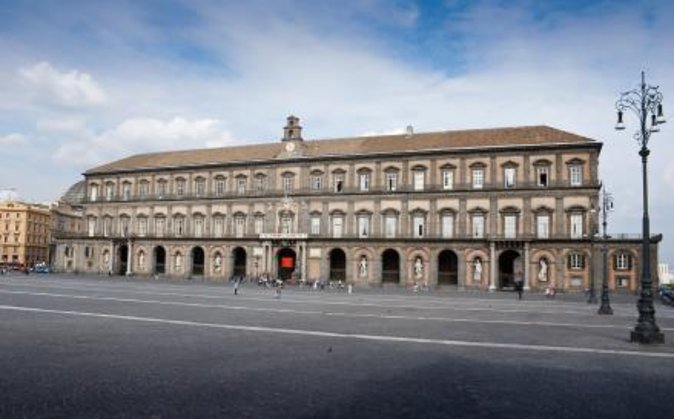
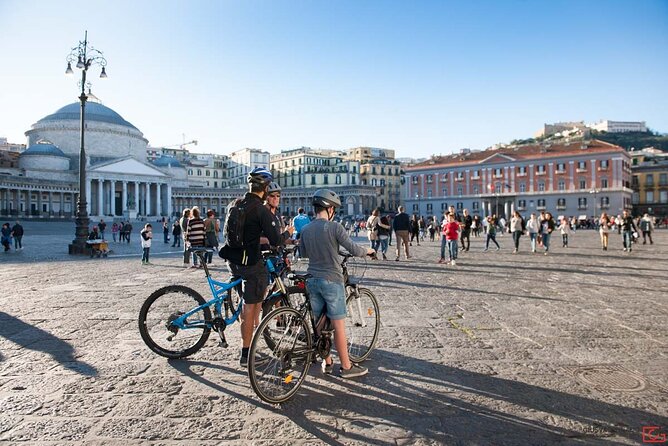
The first stop is Piazza del Plebiscito, one of Naples’ grandest open spaces. It sits between the old center and the sea, making it a useful place to understand the city’s layout before the ride becomes more crowded.
You get about ten minutes here, enough to look across the square and hear why it matters. This is not an extended monument visit, and admission is free. Think of it as a quick orientation stop rather than a detailed architectural lesson.
From here, the route continues toward Palazzo Reale. The Royal Palace began in the early seventeenth century during Spanish rule and served as the seat of power in Naples and southern Italy until 1946. Spanish, Austrian, Bourbon, and Savoy rulers all used the palace.
The facade carries eight statues representing rulers and dynasties connected with Naples. You may hear names such as Roger the Norman, Frederick II, Charles of Anjou, Charles V, Charles III of Bourbon, Murat, and Victor Emmanuel II. The stop itself is brief, about five minutes, so you will view the palace from outside rather than tour its rooms.
This quick rhythm suits the bike format. You get context, see the setting, and keep moving. If the palace is high on your list, plan a separate interior visit on another day.
Castel dell’Ovo and the Bay of Naples
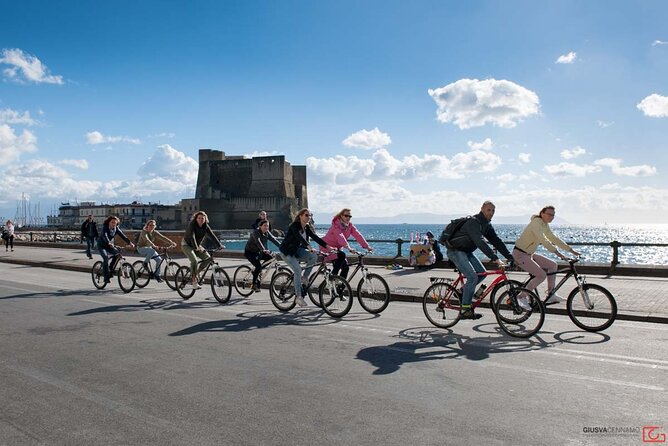
Castel dell’Ovo is one of the most atmospheric stops. The fortress sits on the island of Megaride, linked to the Santa Lucia waterfront. Its name means Castle of the Egg, tied to the old legend that the poet Virgil placed a magical egg beneath the structure. That specific legend is not part of the supplied tour description, so your guide may focus instead on the site’s wider story.
The place reaches back to the earliest chapters of Naples. Greek settlers used the area, and Roman aristocrat Lucullus later had a grand residence here. Monks occupied the island in the fifth century, and the site later became a military position and then a castle under Robert of Anjou.
It also served as a prison. Romulus Augustulus, the last emperor of the Western Roman Empire, was held here, along with Jacobins, Carbonari, and other political prisoners. You get about twenty minutes and free admission.
The real pleasure is the setting. From the waterfront near the castle, you can look across the bay and see Naples arranged between sea and hills. Guides often use this stop to explain the city’s geography, which makes the rest of the ride easier to follow.
Same city, a different ride:
- Rome: Appian Way, Catacombs, & Roman Aqueducts E-bike Tour
★ 4.9 · 1,421 reviews - Rome City Small Group Bike Tour with quality Cannondale EBike
★ 5.0 · 1,380 reviews - Milan: Hidden Gems Guided Bike Tour
★ 4.8 · 1,334 reviews - Tuscany Bike Tours Through the Chianti Hills with Wine Tasting
★ 5.0 · 1,300 reviews
The old Greek grid: Decumani and Cardini
Naples’ historic center still follows the basic grid laid out by the Greeks who founded Neapolis. The three main east-west roads are the Decumani. North-south streets called Cardini cross them.
The main Decumanus, often called Decumano Maggiore, runs from the area of San Pietro a Maiella and the music conservatory toward the cathedral and the former courthouse. Modern streets and alleys follow much of the old plan.
This is one of the most useful parts of the tour because it gives order to what can otherwise feel like a maze. You are not simply weaving through random lanes. You are following a street plan that has guided movement through Naples for more than two thousand years.
The streets can be narrow, crowded, and uneven. You will need to keep a close eye on the guide and leave space for pedestrians. That may limit how much you can listen while riding, so the best explanations usually come during stops.
Gesù Nuovo and the heart of the historic center
Chiesa del Gesù Nuovo is an unusual sight because its exterior began life as a palace. Roberto Sanseverino, Prince of Salerno, built the original structure in the late fifteenth century. Jesuits converted it into a church in the 1580s.
The facade is covered with pointed, diamond-shaped stone blocks. It looks more like a fortified palace than a church, so the building rewards a close look even if you have only a few minutes. Inside, the Baroque decoration uses colored marble to form flowers, masks, and decorative patterns.
The stop lasts about five minutes and is free. That is enough to see the facade and perhaps enter briefly, but not enough for a careful study of the paintings and marble work. If you want a quiet interior visit, return later without the bicycle.
The surrounding Piazza del Gesù Nuovo places you squarely in central Naples. Here, the tour shifts from royal and seaside Naples to the dense religious and civic core. You may find that the guide’s explanation of local customs and street life is as useful as the building itself.
Via Toledo and the Spanish Quarter
Via Toledo is one of the city’s main shopping and walking streets. It cuts through the center and reaches the Spanish Quarter, created in the sixteenth century during the rule of Viceroy Pedro Álvarez de Toledo.
This section gives you a feel for present-day Naples: shops, pedestrians, old facades, and tight side streets. The road can be crowded, so your guide may choose the pace and exact line carefully. Do not expect a relaxed country ride. You are moving through an active city.
The Spanish Quarter grew beside the western edge of the older Greek and Roman city. That means the ride connects two different urban systems: the ancient grid and the later military and residential expansion.
This is also where the value of a local guide becomes clear. Guides including Joseph and Claudio received special praise for getting groups through traffic safely. Claudio helped riders who felt nervous at the start, while Joseph was singled out for calm route management. You still need to ride attentively, but a guide who knows the streets can reduce the strain.
Lungomare Caracciolo and the open sea
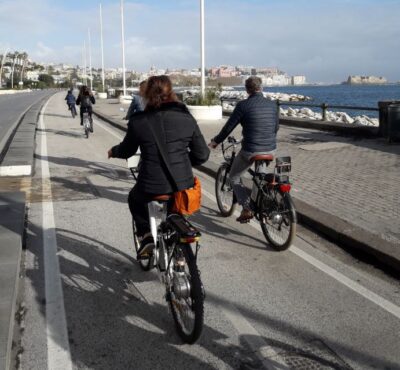
Lungomare Caracciolo is the ride’s most refreshing stretch. The broad waterfront road passes Santa Lucia, the small harbor by Borgo Marinai, Castel dell’Ovo, Villa Comunale, and the Riviera di Chiaia.
After the tight lanes of the historic center, the sea gives you room to breathe. This is where the bicycle feels most natural. You can cover the waterfront at a steady pace, stop for views, and see how Naples turns toward the bay.
The road is tied to Admiral Francesco Caracciolo, a figure connected with the short-lived Neapolitan Republic. The waterfront also leads toward Mergellina and the climb to Posillipo.
Several guides have taken groups farther west and uphill toward Posillipo. That can produce some of the best views of Naples and the bay, but it changes the physical demand of the tour. Some riders found the climb strenuous even with an e-bike, while strong cyclists appreciated the extra distance and the views.
Piazza del Municipio and the modern city above ancient Naples
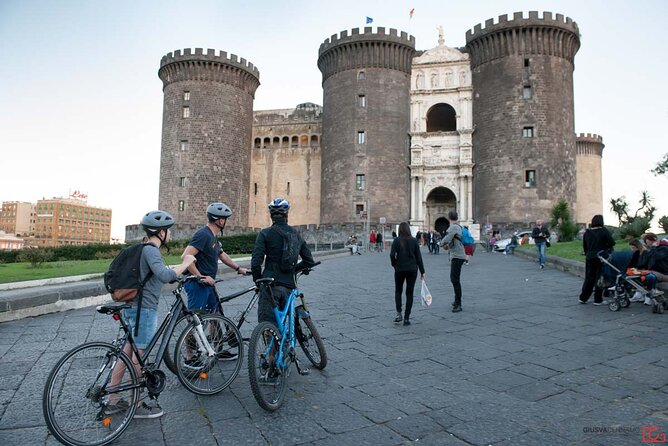
Piazza del Municipio is one of Naples’ largest squares. It lies near the port, Maschio Angioino, Palazzo San Giacomo, Via Toledo, and the Neptune Fountain.
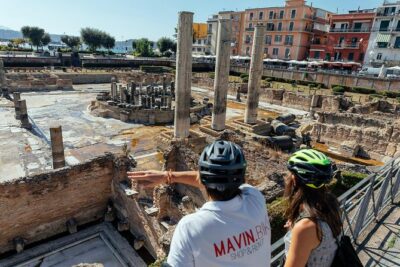
The square also reveals how modern construction can expose older Naples. Work on the metro uncovered thousands of archaeological items, including amphorae, ships, walls, and a Roman complex with baths. The area has helped show the location of the ancient Greek and Roman port.
You spend about ten minutes here. The stop works well at the end of the main sightseeing loop because it brings together the harbor, royal power, transport, archaeology, and modern civic life.
Maschio Angioino, also called Castel Nuovo, is nearby, though the supplied route information does not promise an interior visit. Treat the square as a viewing and explanation stop rather than a castle tour.
Standard bike or e-bike?
The standard bicycle and helmet are included in the $64.10 price. An e-bike costs extra on site, with one price given as 15 euros per person. Confirm the current supplement when booking because the supplied price is not guaranteed to remain unchanged.
I would choose the e-bike if you are not used to hills, if your group has mixed fitness levels, or if the guide plans to ride toward Posillipo. Several riders called the electric option essential for the climbs. It will not remove traffic, crowds, or uneven paving, but it can make the uphill sections manageable.
A regular bicycle can work well if you cycle often and want more exercise. It is less suitable if you rarely ride or feel tense in heavy city traffic. One three-hour route felt closer to a serious workout than a gentle sightseeing ride, with steep sections and fast descents.
Ask two questions before departure: How much climbing is planned, and will the route include Posillipo? Those answers matter more than the general tour label.
Safety, pace, and group size
The maximum group size is 20, and at least two people are needed to book. The guide may be multilingual, and English is offered. Some departures have felt almost private when few people booked, while a full group will naturally require more patience at crossings and stops.
The strongest part of the guiding is traffic management. Joseph, Claudio, and Tino were praised for placing the group carefully, stopping traffic where needed, and watching riders closely. That skill matters in Naples, where the opening streets near the start can feel especially congested.
Still, no guide can make city cycling risk-free. Stay behind the leader, signal clearly, and do not assume cars will behave as they might at home. If you are intimidated by heavy traffic, this may not be the right first cycling tour.
Children must be accompanied by an adult. Most people can take part, but you should be comfortable riding for three hours and handling hills if they are included in your route.
Is $64.10 good value?
The price is reasonable for a three-hour guided ride that includes bicycle use, a helmet, water, and a local guide. You are paying not only for the bike, but also for route planning and help with one of Italy’s more demanding urban cycling settings.
The value rises if you want a broad first look at Naples. In one outing, you can see the royal center, historic churches, ancient street lines, shopping districts, the harbor, and the bay. The price feels less attractive if you mainly want long stops inside monuments, since admission is not included and the listed stops are brief.
The e-bike supplement is the main extra cost to plan for. In my view, it is worthwhile for the hills, especially if you want the western views. If the route stays mainly central and waterfront, a standard bicycle may be enough for a confident rider.
Free cancellation is available up to 24 hours before the start time. Changes or cancellations inside that window are not refunded, and poor weather may lead to a different date or a full refund.
Who should book this Naples ride?
Book it if you want to understand how Naples fits together, not just photograph one monument. It suits active sightseers, confident urban cyclists, families with older children, and anyone who wants a local introduction before exploring the city on foot.
You will get the most from it if you are open to a little sweat, noise, and unpredictability. Guides such as Paco, Tino, Achille, Patricia, Brigida, and Andrea have brought different strengths, from historical explanation to patient pacing and local restaurant suggestions.
I would skip it if you dislike riding near cars, cannot manage a possible hill, or want a slow tour with long interior visits. In that case, a walking tour or museum plan may fit better.
For everyone else, this is a lively and useful way to meet Naples. Choose the e-bike if you have doubts about hills, arrive by public transport rather than car, inspect the equipment before leaving, and ask about the exact route. Do that, and the ride can show you a side of Naples that is hard to grasp from a taxi window or a single central square.
FAQ
How long does the Central Naples Bike Tour last?
The tour lasts approximately three hours.
How much does the tour cost?
The listed price is $64.10 per person. An e-bike requires an additional fee paid on site.
What is included in the price?
The price includes a local guide, bicycle use, a helmet, and one bottle of water.
Where does the tour start and finish?
It starts at Bicycle House, Galleria Principe di Napoli, 27/28, 80135 Napoli. The activity ends back at the same meeting point.
Is an e-bike included?
No. The standard bicycle is included, while an e-bike costs extra on site. One supplied price states an additional 15 euros per person.
Is the tour suitable for children?
Children must be accompanied by an adult. Most people can participate, but the ride may include heavy traffic and hills.
What happens if the weather is bad?
The experience requires good weather. If it is canceled because of poor weather, you will be offered another date or a full refund. You can cancel for a full refund up to 24 hours before the start time.
Just added around Italy
- Tasting and Biking Parma★ 5.0 · 218 reviews
- Rent road bike★ 5.0 · 118 reviews
- Full Carbon Road Bike Rental★ 5.0 · 34 reviews
- Rent a Carbon or Aluminum Road Bike in Sicily★ 5.0 · 85 reviews
- Road Bike Rental in Palermo with Suggested Itinerary★ 5.0 · 37 reviews
- E-bike tour in Orvieto in small group: history, culture with lunch or dinner★ 5.0 · 71 reviews
- Orvieto by Evening: Small Group e-Bike tour with Dinner★ 4.5 · 21 reviews
- Small Group E-bike Experience from Orvieto to Civita with Lunch★ 5.0 · 103 reviews
Naples Bike Tours, compared.
Naples Scenic E-Bike Ride to a Local Vineyard with Meal
Read our review →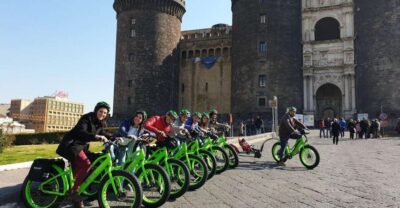


Browse the lists this tour appears in