
REVIEW · SEVILLE
Seville: Historic Center Bike Tour
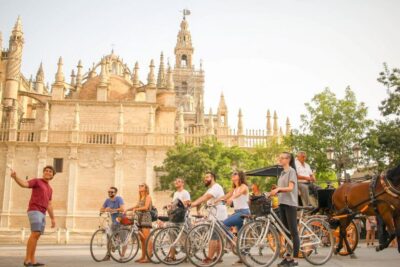
Seville’s old defensive route gives this bike tour a clear sense of place. Instead of simply moving from one famous building to the next, you follow the city’s former walls and gates, where trade, carriages, conflict, and daily life once passed through. The Roman origins, Almoravid walls, and 1868 riots give the ride a useful historical spine.
I like the 2.5-hour length, which is long enough to cover a good portion of the center without using up your whole day. I also like the focus on Puerta Carmona, Puerta Osario, and Puerta Triana, three gates that help you understand how Seville worked as a fortified city. The main drawback is that one recent customer found the bikes near the end of their useful life, so the equipment may not be equally polished every day.
Key points to know before you book
- Follow Seville’s former defensive line: The route includes surviving sections of the walls and important gates tied to the city’s past.
- See more than the main sights: Macarena, Puerta de Córdoba, the Alcázar, and several historic gateways are part of the ride.
- Hear Seville’s story in order: The guide covers Tartessians, Carthaginians, Romans, the Almoravids, and the Glorious Revolution of 1868.
- Choose from three tour languages: Live guiding is available in Spanish, English, and French.
- Expect personal guiding: Luca, Daniel, and Sébastien received especially warm praise for clear explanations, care, and strong command of the city.
- Budget-friendly pricing: At $35 per person, the tour includes the bicycle, water bottle, map, and bilingual guide.
Why Seville’s walls make a good bike route

Seville can feel like a collection of grand plazas, churches, palace buildings, and narrow streets. A bike tour along the old defensive route connects these sights with a practical question: how did people enter, protect, and move through the city?
That question makes the ride more interesting than a basic monument loop. The walls were not just scenery. They marked the limits of Seville, controlled access, and helped shape the city’s growth. As you cycle between surviving sections and former gates, you get a sense of the city as a protected urban center rather than just a pretty place to photograph.
The route also covers a long stretch of time. You hear about the Tartessians and Carthaginians, then the Romans who settled in the area, followed by the Almoravid period, when Seville became known as one of Europe’s best-walled cities. The tour then moves into the 1868 riots and the Glorious Revolution, giving you a link between medieval defenses and modern political change.
I find this broad time span useful early in a Seville visit. You may not remember every date, but you will begin to see why the city has so many different architectural styles and why its gates mattered.
More Historic and Landmark Bike Tours in Seville:
- Party Bike Private Party Up To 14 People in Old Town Scottsdale
★ 5.0 · 3,541 reviews - Guided Bike Tour of Old Town Key West
★ 5.0 · 2,611 reviews - Historical Singapore Bike Tour on Full-Sized Bicycles
★ 5.0 · 1,421 reviews
Starting at Centerbici on C/ Espronceda

The meeting point is Centerbici Store at C/ Espronceda, 5, 41004 Sevilla. You meet the guide there, collect your bicycle, and begin the tour of the historic center.
The experience includes bike rental, a water bottle, and a map. Children can rent a helmet, which is a useful detail for families, though the activity is not suitable for people with mobility impairments. The available live languages are Spanish, English, and French.
You should check the start time when booking, since several departure times may be available depending on the date. The ride lasts 2.5 hours, so allow a little extra time before the start to reach the store and get ready.
The activity information also describes skip-the-ticket-line access. Since this is a cycling tour rather than a museum visit, the main practical benefit is that you are not planning the ride around ticket queues for the route itself. Do not expect the bike tour to replace a full interior visit to Seville’s major monuments.
From Roman settlement to Almoravid walls
The opening history lesson reaches back to the earliest known peoples connected with the area. You hear about the Tartessians, the Carthaginians, and the Romans, who settled in Seville and helped establish its importance.
That sequence matters because Seville’s location made it valuable long before its later palace buildings and churches appeared. The tour does not treat the city as a frozen medieval set. It shows how different powers used the same strategic location over time.
The Almoravid period is especially important to the route. Seville became one of Europe’s best-walled cities under the Almoravids, and the surviving sections of those defenses are among the most meaningful sights on the ride. You are not simply looking at old masonry. You are seeing the remains of a system that once controlled the city’s edges.
This is where a guide adds real value. Walls can look like disconnected fragments when you walk past them alone. With the historical explanation, the fragments become part of a larger defensive plan.
Macarena and Puerta de Córdoba
The ride includes sections of the old walls around Macarena and Puerta de Córdoba. These places help you see how the defensive route worked and how parts of it survived after the city changed.
Macarena is one of the named highlights of the route, while Puerta de Córdoba offers a direct link to Seville’s former entrances. The focus is not only on the appearance of the structures, but also on their role in controlling movement into the city.
You may find this section especially useful if you have already seen Seville’s most famous central monuments and want a different angle. The route shifts attention from palace interiors and grand façades to the practical structure of the city.
The tour also points out what remains after the 1868 riots. That detail adds a sharper edge to the ride. Seville’s built past was not preserved untouched, and the losses and surviving pieces are part of the story.
More History Tours in Seville:
- Barcelona: 2.5-Hour Bike or E-Bike Historical Tour
★ 4.5 · 1,262 reviews - Asheville Historic Downtown Guided Electric Bike Tour with Scenic Views
★ 5.0 · 1,234 reviews - Historic Athens: Small Group Electric Bike Tour
★ 4.9 · 966 reviews - Bordeaux: Historic Center & Chartrons District Bike Tour
★ 4.8 · 709 reviews
The Alcázar and Seville’s changing architecture
The Alcázar is included among the historic structures seen along the route. The tour does not replace a proper visit inside the palace complex, but viewing it as part of the city’s defensive and political history gives the building a broader setting.
You will also see a mix of architectural styles across the historic center. That variety reflects the different peoples and periods covered by the guide, from Roman settlement to the Almoravid walls and later changes to Seville.
This is one of the better reasons to choose a bike rather than a walking tour. You can cover more ground between landmarks, while still stopping at key places for explanation. The bicycle keeps the tour moving, but the route is organized around specific historical points rather than a fast ride with little context.
The pace should suit you if you want an overview before deciding which buildings deserve more of your time. If your main goal is a long, detailed look inside the Alcázar or another monument, you will still need a separate visit.
Three gates with three different stories
Puerta Carmona, Puerta Osario, and Puerta Triana are central to the route. Each gate helps explain how people entered Seville, how carriages were handled, and how news, trade, and mystery moved through the city.
Puerta Carmona is associated with the movement of carriages and the activity around one of Seville’s former entrances. Puerta Osario adds another piece to the city’s defensive network. Puerta Triana brings the route toward a different side of Seville, with its own stories and connections.
The tour description promises accounts of carriages being stopped, mysteries being unraveled, and stories unfolding at these gates. That wording points to a storytelling-based tour rather than a technical architecture lesson. You should expect historical anecdotes alongside dates and structures.
I like the choice of gates because they make the city’s old boundaries easier to imagine. A wall is a long, silent line. A gate is where something happened. It is where goods entered, travelers were checked, and the city met the outside world.
The guide can shape the experience
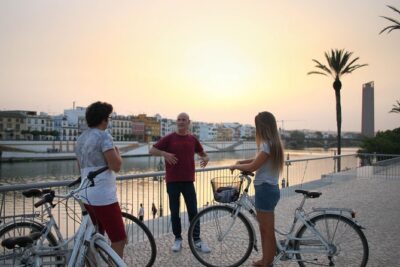
The most praised part of this activity is the guiding. Luca was described as especially attentive and able to speak French, Italian, and Spanish, with English also available. Daniel and Sébastien were also singled out for being strong guides, with clear explanations and a generous approach to the time spent showing the city.
One French-speaking customer had an English tour and found that the guide worked hard to make the explanations clear, even using a phone translation when needed. That suggests some flexibility if your preferred language is not available for a particular departure, although you should book the language you need rather than count on an improvised arrangement.
The activity is described as bilingual, with Spanish, English, and French available. Since the historical material covers several periods and political changes, language clarity matters. A good guide can turn a list of names into a story you can follow while riding.
This is also a tour where the guide’s knowledge of Seville’s streets matters. The route includes gates, wall sections, and structures that are easy to pass without noticing. A guide such as Luca, Daniel, or Sébastien can help you connect them.
What the bicycles are like
The price includes the bicycle, and the ride is the main way you move between stops. One recent assessment found the bikes somewhat worn, though not unusable. That is the main equipment concern to keep in mind.
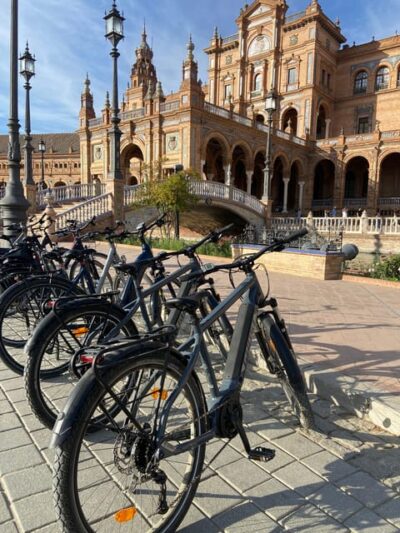
I would arrive with a few minutes to spare so you can check the bicycle before setting off. If something feels wrong with the seat, brakes, or general fit, mention it before leaving the store. The supplied information does not promise a particular bicycle type or electric assistance, so you should expect a standard bike rental unless the provider tells you otherwise.
The ride is not suitable for people with mobility impairments. That restriction is important because the experience requires you to cycle for 2.5 hours and manage the bicycle between stops. Families should also confirm helmet arrangements directly if children need more than the listed children’s helmet rental.
A water bottle is included, which is a small but useful touch in Seville. You also receive a map, giving you something practical to keep after the tour when you want to revisit a gate or find your way through the historic center.
Is $35 a fair price?
At $35 per person, I consider this a solid value if you want both transport and interpretation. You receive a bicycle, a water bottle, a map, and a live guide for 2.5 hours. A self-guided ride may cost less, but it will not give you the same organized route or explanations about the defensive walls and gates.
The value is strongest at the start of a Seville visit. You cover a wide area, learn how the historic center fits together, and collect ideas for later visits. The tour can save you from spending your first day wandering without a plan.
The price is less compelling if you only want to see the Alcázar or one particular monument. This is a city overview, not an entry ticket or a full interior tour. You are paying for the route, the bicycle, and the guide’s interpretation.
The flexible booking terms also reduce the risk of committing too early. You can reserve now and pay later, and cancellation is available up to 24 hours before the activity for a full refund. Check the exact terms at booking, since the timing matters.
Who will get the most from this ride?
I would choose this tour if you like history but do not want to spend the whole morning indoors. It suits first-time visitors who want a clear introduction to Seville, as well as returning visitors who want to see the old city from the viewpoint of its walls and gates.
It is also a good fit if you enjoy moving at a steady pace and stopping often for stories. The route gives you a practical sense of distance between districts and monuments, something that a map cannot always provide.
French speakers have a particularly good reason to consider it, since the tour is offered in French and Luca has been praised for speaking it fluently. English and Spanish speakers also have clear language options.
I would think twice if you dislike cycling, need step-free access, or want a slow architectural study at every stop. The 2.5-hour format must keep moving, and the bicycle condition may vary.
Final verdict: book it for orientation and context
Book this Seville bike tour if you want a reasonably priced introduction to the city’s defensive route, historic gates, and layered past. The focus on Macarena, Puerta de Córdoba, Puerta Carmona, Puerta Osario, Puerta Triana, and the Alcázar gives the ride more purpose than a generic sightseeing loop.
The strongest reason to book is the guide. Luca, Daniel, and Sébastien have been praised for clear explanations, warmth, language skills, and attention to the people in their groups. The main caution is the occasional report of aging bicycles.
For $35, this is a useful first-day activity for an able cyclist who wants to understand how Seville grew from ancient settlement to fortified city and modern cultural center. Pair it with separate visits inside the Alcázar and other major buildings, and you will get a fuller picture of the city.
FAQ
How long is the Seville historic center bike tour?
The tour lasts 2.5 hours.
How much does the tour cost?
The listed price is $35 per person.
Where does the tour begin?
The meeting point is Centerbici Store at C/ Espronceda, 5, 41004 Sevilla.
Which languages are available?
The live guide can conduct the tour in Spanish, English, or French.
What is included in the price?
The tour includes the Seville sightseeing route, bicycle rental, a bilingual guide, a water bottle, and a map. Helmet rental is listed for children.
Which historic places are included?
The route includes sections of Seville’s former defensive walls, Macarena, Puerta de Córdoba, the Alcázar, Puerta Carmona, Puerta Osario, and Puerta Triana.
Can I cancel the booking?
You can cancel up to 24 hours in advance for a full refund. The activity also offers reserve now and pay later booking.
Just added around Seville
- Seville: Relaxing Electric Bike tour with Tour Guide★ 4.8 · 31 reviews
- Seville City Bike Tour: Top Seville’s Monuments★ 4.7 · 28 reviews
- Seville: Dutch Cycling Highlights Tour with local guide★ 4.7 · 163 reviews
- Seville: Electric Stand-Bike Tour★ 5.0 · 18 reviews
- Sevilla: 100% Nederlandstalige Highlights Tour op E-BIKE★ 4.9 · 54 reviews
- Seville: Electric Bike City Tour★ 4.7 · 188 reviews
- Seville: Bike Rental for a Day★ 4.1 · 72 reviews
- Seville: Bike Rental★ 4.2 · 29 reviews
Seville Bike Tours, compared.
Browse the lists this tour appears in