
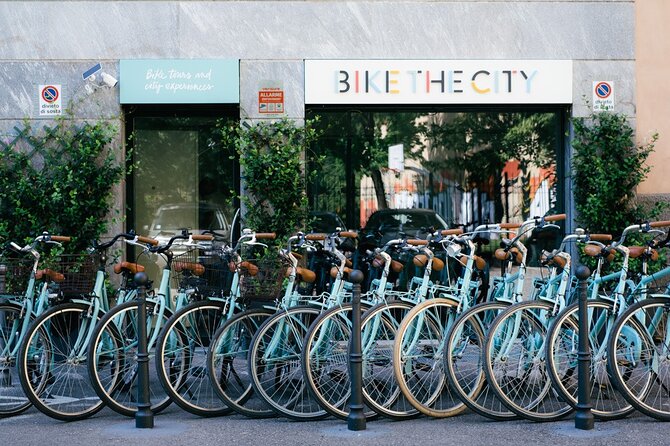
REVIEW · MILAN
Highlights and hidden gems of Milan Bike Tour
Milan reveals itself quickly from a bicycle. In just over three hours, you move from the old Roman columns at San Lorenzo to the Duomo, fashion streets, medieval castle walls, and the glass towers of Porta Nuova. It is a smart way to get your bearings fast before spending more time at the sights that catch your eye.
I like the wide sweep of the route and the fact that equipment is included, so you are not paying extra just to ride. I also like the guides, especially Paolo, Sandra, and Angelo, who are praised for clear local stories, careful pacing, and attention to safety. The main caution is that Milan is not always a smooth cycling city: narrow streets, cobblestones, pedestrians, and rough bike paths can make a large group feel awkward.
Key points to know before booking
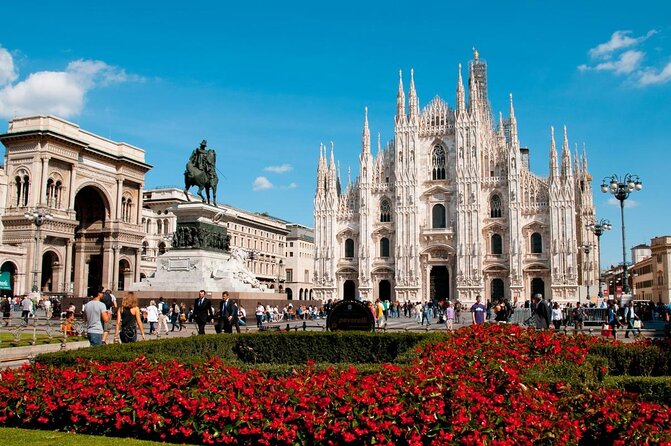
- A citywide introduction in 3 hours 15 minutes: See Milan’s Gothic center, old neighborhoods, castle, parks, Roman remains, and modern skyline in one morning.
- Classic Dutch-style bikes and helmets included: E-bikes cost an extra €15 and depend on availability.
- English-speaking guides with different strengths: Paolo is often praised for history and humor, while Sandra and Angelo receive strong marks for care and safety.
- The route mixes famous sights with local districts: Brera, Ticinese, Darsena-area streets, and Porta Nuova give the ride more range than a simple Duomo tour.
- Good for riders age 9 and up: Children between 135 and 155 centimeters need a suitable bike arranged in advance.
- Milan’s streets require basic bike confidence: The ride is not strenuous, but cobbles, pedestrians, and traffic demand attention.
Why a bicycle works so well in central Milan
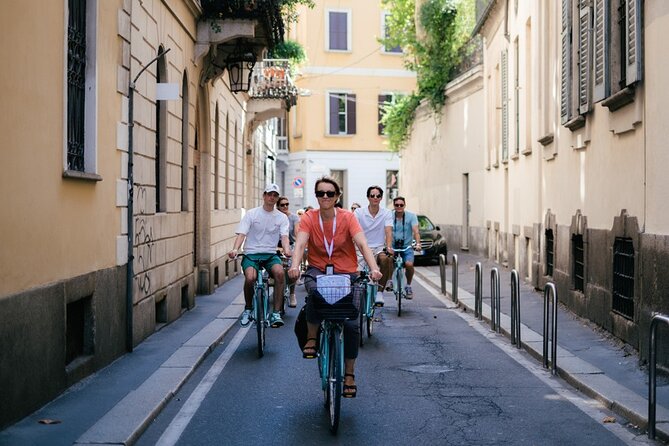
Milan is flat and spread out enough that walking between its major sights can eat up much of your day. A bicycle lets you cover the distance between the Duomo, Brera, Sforza Castle, Porta Nuova, and San Lorenzo without turning the morning into a march.
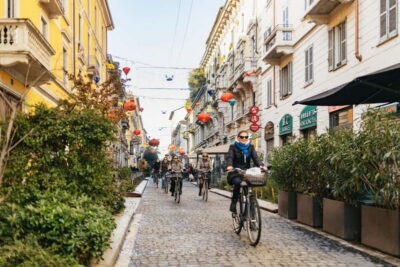
The route also gives you a useful contrast between Milan’s eras. One moment you are passing fashion houses and polished apartment buildings. Soon after, you are rolling through old streets toward a fortress or ancient Roman columns. That change is one of the best reasons to choose this tour instead of seeing only the central cathedral square.
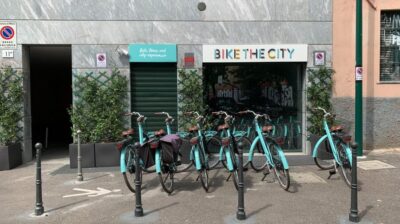
The ride starts at Via Vetere 11, near public transportation, at 10:00 in the morning. After a short safety briefing, you receive a classic Dutch-style bicycle and helmet. Bags can be carried in bicycle bags, which is handy if you have a light daypack or a few small items.
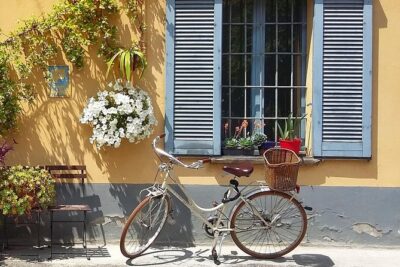
The standard bikes are basic, including single-gear bicycles, but that is not a serious drawback on a mostly easy route. You can request an e-bike for an additional €15, although availability is not guaranteed. I would consider one if you dislike cycling, but most riders who are comfortable on a bicycle should manage the regular bikes.
More City Bike Tours in Italy
- Rome: Top Highlights & Hidden Gems Tour by Cannondale E-Bike
★ 4.9 · 1,760 reviews - Florence: 2-Hour Guided Sightseeing Bike Tour
★ 4.5 · 1,004 reviews - Naples: City Highlights Guided Bike Tour
★ 4.7 · 850 reviews
Porta Ticinese gives the ride an old Milan starting point
The tour begins in Porta Ticinese, an old and bohemian part of the city named for its historic gate. This is a better starting point than a generic bike shop on the edge of town because you begin among streets with a strong sense of Milanese character.
The first 15 minutes help you settle into the bicycle and the group. You are not thrown straight into a long ride. The guide sets the tone, explains how the group will move, and begins connecting the streets around you with the city’s past.
This is also where the practical side of the tour becomes clear. You are riding in a real city, not on a closed cycling track. Keep your attention on the guide, watch for pedestrians, and do not assume every surface will be smooth.
The Duomo is the grandest photo stop
The Duomo di Milano is the tour’s biggest landmark, and you see it with time to take photographs and hear how the cathedral was built. The stop also includes views of the Royal Palace, the Museo del Novecento, and the Galleria Vittorio Emanuele II.
The route does not include entry inside the cathedral, so you should plan a separate visit if you want to see the interior or climb to the rooftop. That is not a flaw in this experience. The purpose here is orientation and context, allowing you to understand where the Duomo sits within Milan’s civic and cultural center.
You have about 20 minutes around this part of the route. That is enough for photos and an explanation, but not enough for a full museum visit. If the cathedral is a top priority, schedule it for another time, preferably before or after the bike tour.
La Scala adds Milan’s polished cultural side
At Piazza della Scala, the group pauses outside Teatro alla Scala for about five minutes. The opera house is one of Milan’s most famous cultural addresses, and the guide explains the singers, conductors, and stories tied to its stage.
This is a short stop, but it works well after the Duomo. The cathedral represents Milan’s grand religious center, while La Scala shows the city’s long connection with opera and high culture. You do not go inside, so this is another exterior introduction rather than a full attraction visit.
The five-minute pause also keeps the overall route moving. This tour is designed to give you a broad view, not to spend half the morning at one monument.
More City Highlights Bike Tours in Italy:
- Rome: Standard or E-Bike Highlights Guided Tour
★ 4.7 · 777 reviews - Rome: City Highlights E-Bicycle Tour
★ 4.9 · 740 reviews - Verona e-Bike Tour: City Center and Panoramic Views
★ 4.9 · 708 reviews - Milan: Highlights and Hidden Gems E-Bike Tour
★ 4.7 · 558 reviews
Brera slows the pace with smaller streets
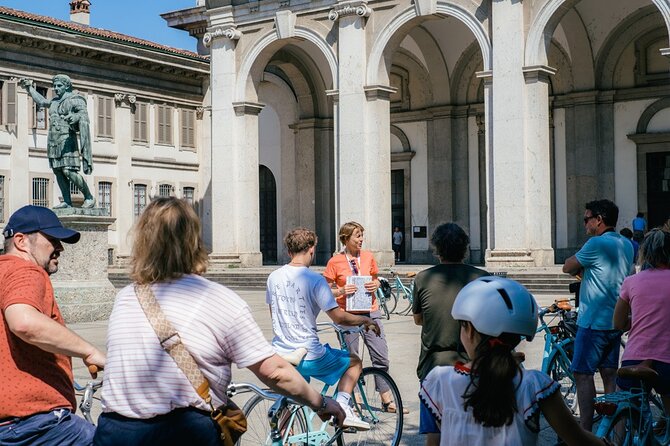
From La Scala, you pedal into Brera, one of the most appealing parts of central Milan. The neighborhood is associated with the city’s art gallery, the Pinacoteca, and its streets are lined with old Milanese buildings, churches, and small artisan workshops.
Brera is where the tour becomes less about major monuments and more about atmosphere. The narrow streets and preserved façades give you a closer look at the city’s everyday character. You can also note places to return to on foot later, perhaps for an art visit or a slower wander.
The stop lasts about 15 minutes. That is enough to hear the story and look around, but not enough to visit the Pinacoteca. If art is central to your Milan plans, treat this part as a preview and return separately.
Porta Nuova shows Milan looking forward
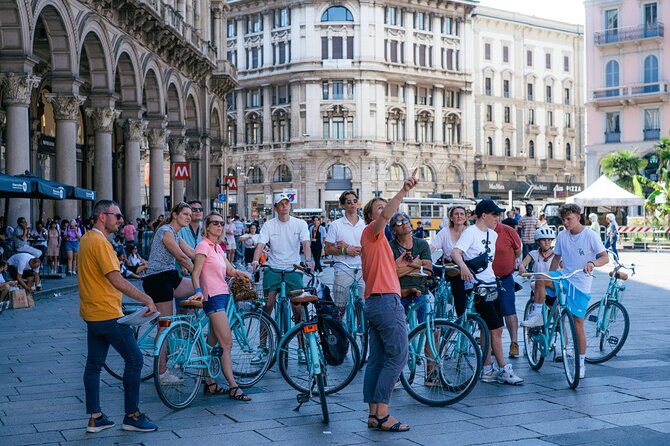
Porta Nuova makes a sharp change from Brera’s older streets. Here, you see newer architecture, including the Unicredit tower, Palazzo Lombardia, Biblioteca degli Alberi, and Bosco Verticale.
This section is especially useful because Milan is often reduced to the Duomo and fashion. The modern district shows a city that is also investing in new public spaces, offices, towers, and residential design. The contrast with the medieval and Roman stops gives the tour a clear visual rhythm.
You spend about 15 minutes in this area. Architecture fans will get the most from it, but even if modern buildings are not your main interest, the shift helps explain Milan’s place as a business and design center.
Sforza Castle is the longest history stop
The ride then reaches Castello Sforzesco, one of Milan’s strongest historical landmarks. This late medieval and Renaissance fortress was built for Milan’s first duke in the 14th century, and its story includes work by major architects and designers, including Leonardo da Vinci during his Milan years.
The castle stop lasts about 25 minutes, making it the longest pause on the route. You enter the courtyards rather than taking a full museum tour. That gives you time to understand the fortress as a defensive structure and civic symbol without stopping the entire morning for its museum collections.
I find this part valuable because it connects Milan’s political past with its artistic reputation. The castle is not simply a photogenic wall. It helps explain the power of the dukes who shaped the city and the setting that later drew artists such as Leonardo.
Parco Sempione offers a welcome break
After the castle courtyards, the group rides into Parco Sempione, Milan’s large central green space. The pace slows for about 10 minutes, with the neoclassical Peace Arch providing a strong focal point.
This is the natural rest point in the tour. Several hours on a bicycle can feel different from several hours walking, especially when you are stopping often and paying attention to city traffic. The park gives you a chance to breathe, drink water, and reset before the final section.
The break may not always feel long if the group starts late or needs extra time at earlier stops. Bring water, and do not count on a lengthy café stop. The tour is designed to keep moving.
San Lorenzo brings the ride back to Roman Milan
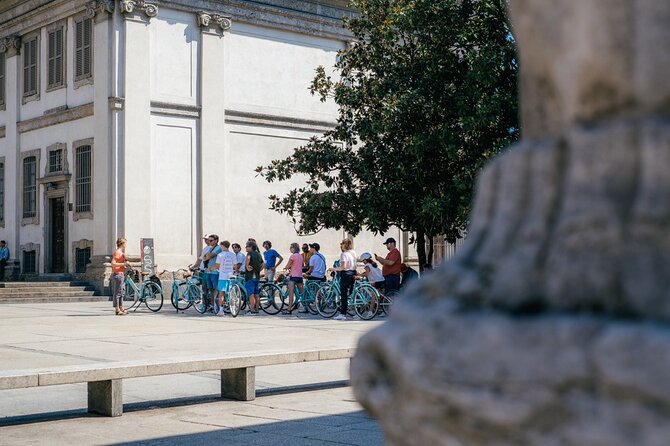
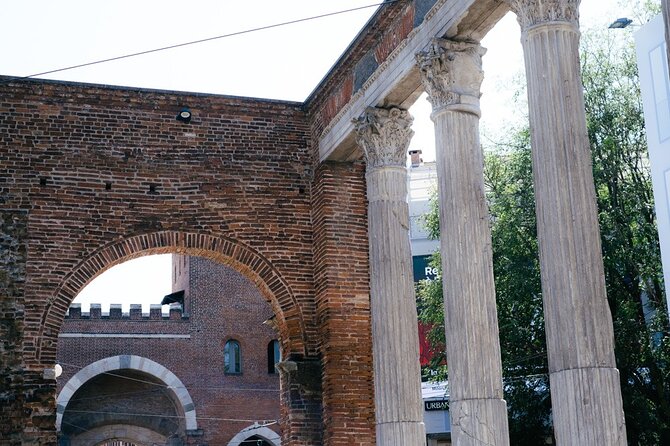
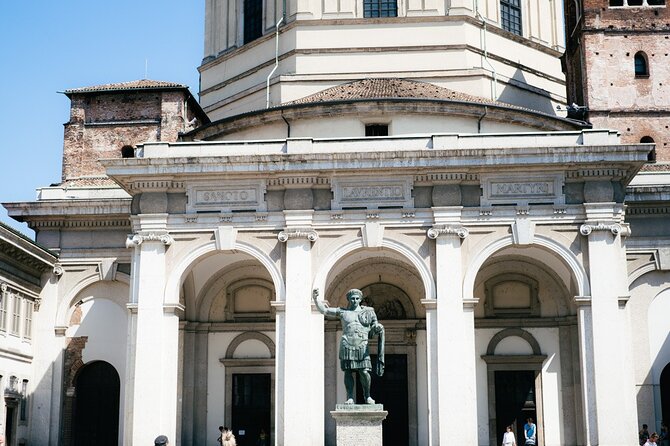
The final major stop is Colonne di San Lorenzo, where ancient Roman columns remain beside the Basilica of San Lorenzo. The area recalls the period when Milan served as a capital of the Roman Empire, with a palace, circus, amphitheater, and other major structures once occupying the city.
You spend about 15 minutes here before returning to the starting point. It is a fitting ending because the route has moved through so many layers of Milan: Roman, medieval, Renaissance, royal, industrial, fashionable, and modern.
The columns are also a good reminder that Milan’s most interesting stories are not all gathered around the Duomo. You can see the cathedral on your first afternoon, but places such as San Lorenzo give you a broader understanding of the city’s age and changing role.
What the cycling feels like on Milan’s streets
The physical effort is modest. The route is described as easy, and the ride covers a lot of ground without demanding steep climbs. Families with children have managed it, including children aged 11 and 14, provided they can ride confidently.
The bigger issue is street conditions. Some sections use cobblestones or brick surfaces, and even parts of the cycling route may feel rough. You can expect vibration through the handlebars, along with narrow passages and pedestrians in busy central areas.
A group of up to 30 people can also affect the experience. A smaller group will move more easily through tight streets. A large group may need to wait at crossings, gather after narrow sections, or slow down around pedestrians.
You should already know how to ride a bicycle in city conditions. This is not a lesson for a complete beginner. The guides place strong emphasis on safety, but you still need to control your bike, follow instructions, and remain alert.
The guides shape the experience
The route is fixed, but the guide has a large effect on the morning. Paolo is often singled out for making history easy to follow and for answering questions. Sandra receives particular praise for watching over families, keeping the pace comfortable, and adding water stops in shaded places. Angelo is noted for safe riding and a strong overview of the city.
Other guides, including Marco and Simone, have also led the experience. English is offered, but accents and speaking styles can vary. If you need very clear, slow English, stay close to the guide during explanations and ask questions at the stops rather than trying to listen while riding.
The strongest part of the guiding is the link between places. You are not simply cycling past a list of monuments. The guide explains why a theater, castle, Roman ruin, modern tower, and fashionable district all belong in the same picture of Milan.
Price, timing, and who gets good value
At $47.16 per person, the tour is fairly priced for a guided morning that includes the bicycle and helmet. You are paying for the equipment, route planning, local narration, and the chance to see far more ground than you could cover on foot in the same time.
The value is best if you have one or two days in Milan. You can use the tour to mark the places you want to revisit, then return later to the Duomo interior, La Scala, the Pinacoteca, or the castle museums.
It is also useful at the start of a longer stay because it gives you a mental map. If your schedule is already full of museum visits and you prefer to move slowly, the tour may feel too quick. It is an overview, not a series of long monument visits.
The experience is recommended by 96 percent of participants and carries a 4.8 rating from 491 ratings. Those figures fit the main pattern: the guides, route, easy pace, and range of sights are the main strengths, while group size and rough streets are the main concerns.
The tour ends back at Via Vetere 11. It requires good weather and can be canceled if the minimum number does not sign up. You can cancel for a full refund up to 24 hours before the 10:00 start time. If poor weather cancels the ride, you are offered another date or a full refund.
Should you book the Milan bike tour?
I would book this if you want a broad first look at Milan and feel comfortable riding in city streets. It is especially useful for a short stay, families with cycling children aged 9 or older, and anyone who wants history, architecture, and light exercise in the same morning.
I would think twice if you dislike cobblestones, feel uneasy around pedestrians, or want a small, quiet group. The maximum group size is 30, and even a smaller group can feel large in central Milan.
For most visitors, the route earns its price by showing the old and new city in one sweep. Choose the regular bike if you ride with ease, request an e-bike if available for €15, and reserve the tour early since it is often booked about 20 days ahead.
FAQ
How long does the Milan bike tour last?
The tour lasts approximately 3 hours and 15 minutes, beginning at 10:00 in the morning.
Where does the tour start and finish?
It starts at Via Vetere 11, 20123 Milano MI, Italy, and finishes back at the same meeting point.
Are bikes and helmets included?
Yes. Bike and helmet rental are included in the price. E-bikes cost an additional €15 per person and depend on availability.
What is the minimum age for the tour?
The minimum age is 9 years. Children between 135 and 155 centimeters tall need a suitable bicycle arranged by email before the tour, and availability is limited.
Is the tour offered in English?
Yes. English is the offered tour language.
Can I cancel the tour for a refund?
You can cancel at least 24 hours before the local start time for a full refund. Cancellations or changes made less than 24 hours before the start are not accepted for a refund.
Just added around Italy
- Amalfi coast: E-bike tour from Sorrento to Positano★ 4.9 · 12 reviews
- Alghero: Small Beaches E-Bike Tour with Aperitivo★ 5.0 · 12 reviews
- Alberobello: E-Bike Tour with Focaccia and Wine★ 4.9 · 70 reviews
- Alghero: E-bike tour inside the Natural Park of Porto Conte★ 4.7 · 38 reviews
- Alberobello: e-bike tour and orecchiette class★ 5.0 · 13 reviews
- Florence: 2.5 hour Audio Guided Bike Tour led by Tour Leader★ 4.7 · 36 reviews
- Verona e-bike tour: city center and panoramic views★ 5.0 · 270 reviews
- Small-group Amarone Wine e-Bike Tour from Verona★ 5.0 · 144 reviews
Milan Bike Tours, compared.
Milan’s Hidden Gems: Unique Bike Tour (ENG, NL)
Read our review →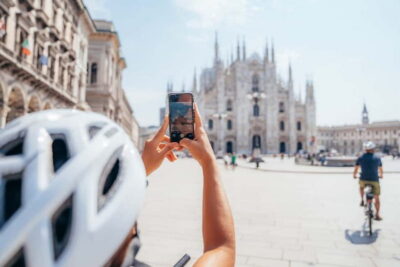
Browse the lists this tour appears in