REVIEW · MARRAKECH
Cycling Adventure in Marrakech
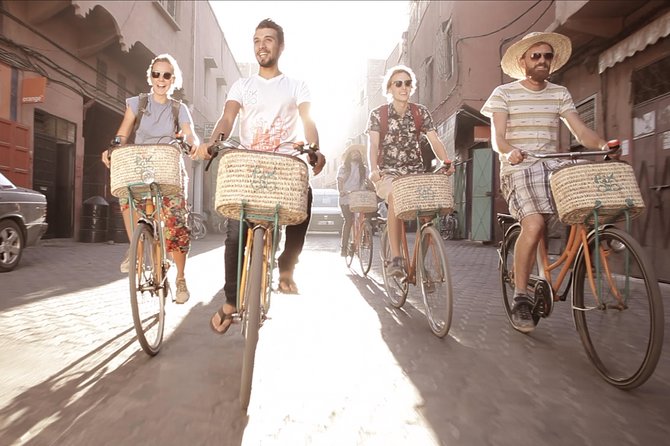
Marrakech makes far more sense from a bicycle seat. With Pikala Bikes, you move beyond the Koutoubia and palace walls into bakeries, workshops, neighborhood streets, and the everyday city. Guides such as Yasser, Hamit, Khawla, and Zouhair bring personal stories about family, religion, and growing up in Morocco.
I like the mix of major sights and ordinary places, especially the public bakery, traditional hammam, secondhand market, and zellij workshop. I also like that your fee supports a local nonprofit project that trains young Moroccans as cycling guides. The catch is traffic: riding through the Medina can feel chaotic, and a few riders found the bicycles less than ideal.
Key points at a glance
- The Medina is the main event: Expect narrow lanes, pedestrians, scooters, carts, and traffic from several directions.
- Local life matters more than monuments: The route includes a public bakery, hammam, market, and craft workshop.
- Guides add real character: Yasser, Hamit, Khawla, Zouhair, and other Pikala guides explain family life, religion, and modern Morocco.
- You see old and new Marrakech: The ride links the historic Medina with Gueliz, the newer part of the city.
- Small treats are included: Juice, sweets, bottled water, and a stop at Café Clock are part of the experience.
- Cycling confidence matters: Most people can participate, but you should be comfortable steering and braking in crowded streets.
Why a bicycle changes Marrakech
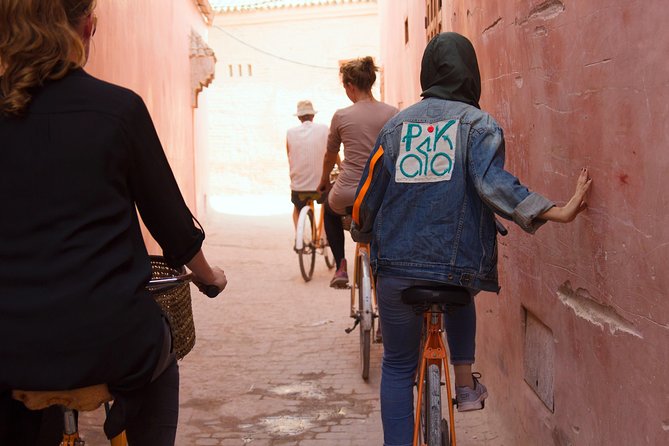
Walking through Marrakech gives you time to notice doorways, food stalls, tilework, and old walls. A bicycle adds range. In three hours, you can cover the Medina, the Kasbah, the Agdal gardens, and Gueliz without spending the whole morning in a taxi or on foot.
The bigger gain is access. Pikala is not simply a sightseeing ride between famous buildings. The route is designed to show you how the city works at street level. You may pass a place where bread is baked for local families, see a traditional bathhouse from the outside or inside as arranged by the guide, and stop in parts of the city that do not appear on a first-time itinerary.
I like this approach because Marrakech is more than its headline sights. The Koutoubia and royal areas matter, but a bakery or neighborhood market can tell you just as much about daily life. Your guide helps connect these places to Moroccan customs and social life rather than leaving you to guess what you are seeing.
The nonprofit side is also worth considering. Pikala trains young Moroccans to guide bicycle tours. The experience therefore gives you a local introduction while supporting a social project. That does not make the ride perfect, but it gives the price more purpose than a standard city loop.
A few more bike tours around the world worth a look
- Lion City Bike Tour of Singapore
★ 5.0 · 6,211 reviews - Big Bike tour Amsterdam – See all in 3 unforgettable hours
★ 4.7 · 4,929 reviews - 3-Hour Porto Highlights on a Electric Bike Guided Tour
★ 5.0 · 4,392 reviews
Starting near Riad Laarous
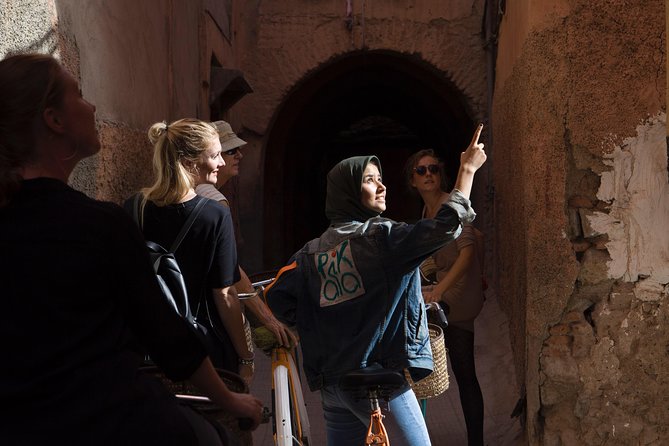
The meeting point is at 29 Rue Riad Laarous in Marrakech. The tour returns to this same spot, which makes planning easier if you are staying in or near the Medina.
You can choose a morning or afternoon departure. I would think about the timing in practical terms. An afternoon ride may give you a more relaxed start to the day, while a morning ride can be a good choice if you prefer to handle the busiest sightseeing before the heat and street activity build. The supplied details do not promise a particular route variation by time of day, so choose the slot that best fits your plans.
The group can include up to 20 people. That is small enough for a guide to manage but not so small that every stop will feel private. You should arrive ready to listen for instructions, since the ride may move through areas where pedestrians, scooters, bicycles, and other vehicles share very limited space.
Koutoubia, Kasbah, and the city’s famous face
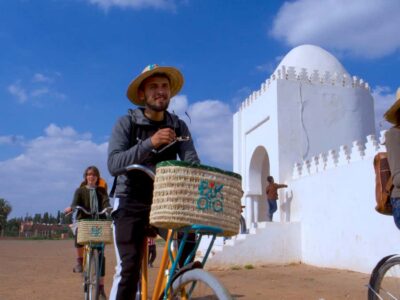
The tour includes several of Marrakech’s well-known sights, including the Koutoubia, Kasbah, and Agdal gardens. These landmarks give you a useful frame for the less familiar stops that follow.
The Koutoubia is an easy visual anchor in Marrakech. Seeing it during a bicycle ride helps you understand how the city’s old center is organized, while the Kasbah adds a look at another historic quarter. The Agdal gardens bring a different setting and show the city beyond its tightest lanes.
Do not expect a monument-heavy tour with long stops at every major attraction. This is a moving city tour, and the famous places are part of a wider route. You will likely pause for photos and explanations, but the real point is the transition between grand landmarks and ordinary streets.
That balance suits me. You get enough of the classic Marrakech sights to feel oriented, then move on before the ride becomes a checklist of photo stops.
Pedaling through the Medina
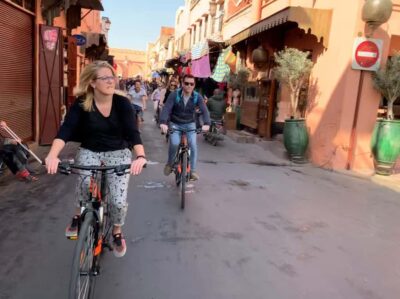
The Medina is where the ride becomes most demanding and most memorable. Narrow streets can carry people, carts, scooters, and bicycles at the same time. Traffic may come from several directions, so you need to keep your eyes up and follow the guide closely.
The route is not aimed at riders who want a quiet recreational path. It is an urban ride through a busy old city. Some people describe the experience as exhilarating, while others warn that it is not for the faint-hearted. Both reactions make sense.
You do not need to be a racing cyclist, but you should be able to steer, brake, and make quick decisions. If you are nervous on a bicycle, crowded streets may take away from the fun. If you are comfortable in city traffic, this is exactly the kind of ride that lets you feel part of Marrakech rather than looking at it from behind a car window.
Pikala guides are important here. They lead the group through the maze and help create gaps when possible. Khawla, Hamit, Yasser, Zouhair, and other guides have been praised for giving clear explanations and adjusting to the group. One guide reportedly split a group to help a family with language needs, a useful sign of practical leadership.
Same city, a different ride:
- Ninh Binh Full-Day Tour from Hanoi to Hoa Lu, Tam Coc & Mua Cave Via Boat & Bike
★ 5.0 · 4,384 reviews - Small Group Guided Bike Tour of Amsterdam’s Hidden Gems
★ 5.0 · 3,936 reviews - 3-hour Complete Prague Bike Tour
★ 5.0 · 3,674 reviews - Party Bike Private Party Up To 14 People in Old Town Scottsdale
★ 5.0 · 3,541 reviews
The public bakery and traditional hammam
Two of the strongest stops are places tied to daily routines: a public bakery and an old traditional hammam.
A local bakery helps explain how food moves through a neighborhood. Bread is not just a snack in Morocco. The process of preparing and baking it is part of ordinary family life, so this stop gives you a more useful picture of the city than another palace courtyard would.
The hammam offers a look at a traditional bathhouse and the social role such places can play. The visit is not presented as a spa session. Think of it as a cultural stop where your guide explains a Moroccan institution and how it fits into local life.
The tour may also include a zellij workshop or demonstration of tile making. Moroccan zellij is known for carefully cut geometric pieces, and seeing the craft process helps you notice the tilework around Marrakech with sharper eyes. Details can vary by guide and route, so treat these as parts of the planned experience rather than guaranteed long demonstrations.
These stops are valuable because they ask you to look at the city as a place where people work, wash, bake, shop, and make things. You are not just passing through an old quarter. You are seeing some of the systems that keep it running.
Markets, snacks, and Café Clock
The route includes a large secondhand market. This adds another useful contrast to the polished image of Marrakech. A market like this is about reuse, trade, bargaining, and practical shopping, not only souvenirs made for visitors.
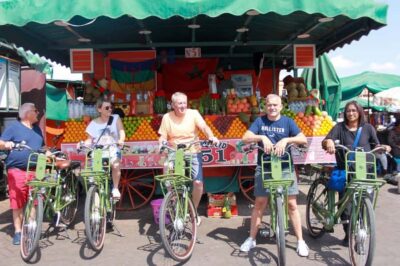
You will also stop for refreshments. Juice, sweets, bottled water, bread, cookies, and iced tea are mentioned as part of the route, with Café Clock serving as a memorable cross-cultural café stop. At least one version of the experience includes time to play cards there, which gives the group a chance to slow down and talk.
The food is not the reason to book this tour, but it makes the three-hour ride more comfortable. A cold drink and a small sweet matter when you have been concentrating on traffic and pedaling. It also gives you a chance to ask your guide about places you have passed.
Café Clock is a particularly good pause because it breaks up the movement. You are not rushed from one sight to the next. The stop creates room for conversation, and guides often use these pauses to explain Moroccan customs in a more personal way.
From old Marrakech to Gueliz
The contrast between the Medina and Gueliz is one of the ride’s clearest lessons. In the old city, streets can feel tight, layered, and difficult to read. In Gueliz, the streets are easier to cycle and the setting feels more open and modern.
That change helps you understand that Marrakech is not one single historic zone preserved for sightseeing. It is also a living city with newer districts, changing habits, and a mix of old traditions and modern life.
Guides are encouraged to talk about growing up in Morocco, the importance of family, religion, and modernization. These subjects are handled best through conversation rather than a formal lecture. You can ask how customs fit into present-day life and hear an answer from someone who lives that reality.
I would pay close attention during this part of the ride. The monuments tell you what Marrakech was. The transition to Gueliz helps explain what it is becoming.
The guide makes or breaks the ride
The most praised part of this experience is the guiding. Yasser has been singled out for his stories about local life. Hamit is described as friendly and willing to give people time to look and ask questions. Khawla has earned praise for sharing childhood stories and bringing warmth to the ride. Zouhair is noted for his English, cycling skill, and quick decisions.
Guides are young Moroccans trained by Pikala, so the tone can feel more personal than a standard history tour. You may hear about family expectations, religious practice, social norms, and the pressure of modern change. That is more useful than memorizing dates you will forget by dinner.
Guide quality can naturally vary from one departure to another. Still, the structure of the project gives the ride a strong foundation. The guide is not only pointing at buildings. The guide is helping you read the city and explaining why a bakery, hammam, workshop, or market matters.
Ask questions. This tour gives you more when you treat it as a conversation rather than a procession.
Bikes, traffic, and comfort
The bicycles receive mixed attention. Some riders found them modern and easy to use. Others felt the bikes were not in the best condition or did not suit them well. That means you should check your bicycle before setting off and tell the guide at once if the seat, brakes, or fit feels wrong.
The traffic is the bigger issue. You need confidence in tight spaces and patience when the group slows or stops. The ride can feel chaotic, particularly in the old city, but that is also why it offers such a close look at local movement.
Wear practical clothing and shoes that work for pedaling. Bring a sense of humor. You may need to stop often, wait for a gap, and accept that the ride will not move at a steady pace.
Most people can participate, and the maximum group size is 20. Still, the phrase most people should not be read as a promise that every rider will feel comfortable. If you are not an active cyclist or have trouble handling crowded streets, choose a walking tour instead.
Is $33.28 a fair price?
At $33.28 per person, this is reasonably priced for a three-hour guided experience that includes a bicycle, a local guide, stops across several districts, refreshments, and a social purpose.
The value is strongest if you want context rather than a quick circuit of famous buildings. You are paying for access to a local route, an interpreter of daily life, and the chance to cover more ground than you could comfortably walk in the same time.
It is less useful if you want a gentle ride, a private group, or a detailed visit inside every major monument. The group can reach 20 people, and the route has an urban, active feel.
Free cancellation is available if you cancel at least 24 hours before the start time. Changes or cancellations inside that window are not accepted for a refund, so keep the local cutoff in mind when making plans.
Who should book the Pikala ride?
Book this experience if you want to see Marrakech through its neighborhoods, trades, markets, and conversations. It suits confident cyclists, curious first-time visitors, and anyone who wants a better feel for the relationship between the Medina and Gueliz.
I would especially recommend it early in a stay. The guide can help you understand the city before you spend later days exploring on foot. You may also discover areas to revisit at a slower pace.
Think twice if you dislike traffic, need a perfectly adjusted bicycle, or want a calm sightseeing outing. This is not a polished ride on a quiet path. It is an active encounter with a crowded city.
For me, the strongest reason to choose it is the combination of movement and human detail. You see the Koutoubia, but you also see where bread is baked. You pass historic quarters, then ride through newer streets. You get a local guide, a drink, a few snacks, and a clearer sense of how Marrakech works.
FAQ
Where does the cycling tour start?
The tour starts at 29 Rue Riad Laarous, Marrakesh 40000, Morocco.
Where does the tour finish?
The activity ends back at the meeting point.
How long does the cycling tour last?
The tour lasts about three hours.
What areas of Marrakech does the route cover?
The route covers parts of the historic Medina and the newer Gueliz district. It also passes the Koutoubia, Kasbah, and Agdal gardens.
What local places can I visit during the ride?
The experience includes visits or stops connected with a local public bakery, a traditional hammam, a secondhand market, and a zellij tile-making workshop or demonstration.
Are food and drinks included?
Juice, sweets, and bottled water are included. The route also includes snack stops such as bread, cookies, or iced tea, depending on the specific stop and guide.
Can I choose a morning or afternoon departure?
Yes. The tour offers a choice of morning or afternoon departure.
How many people can join the tour?
The maximum group size is 20 people.
Can I cancel for a full refund?
Yes, if you cancel at least 24 hours before the experience starts. Cancellations or changes made less than 24 hours before the start time are not accepted for a refund.
Just added around the world
- Barcelona: Bike Rental for 2 – 24 Hours★ 4.7 · 33 reviews
- Barcelona: 3-Hour Bike Tour with Spanish Tapas★ 4.9 · 14 reviews
- Barcelona: 4-Hour Off-the-Beaten-Track Small Group Bike Tour★ 4.8 · 63 reviews
- Barcelona: Private 5 Neighborhoods Tour by Electric Bike★ 4.9 · 17 reviews
- Barcelona: 4-Hour E-Bike Photography Tour★ 4.8 · 36 reviews
- Barcelona: 3.5-Hour Street Art Tour by Bamboo Bike★ 5.0 · 56 reviews
- Thai culture and Bangkok local life guided bike tour★ 4.9 · 32 reviews
- Barcelona Beach 3-Hour Bike Tour★ 4.8 · 65 reviews
Marrakech Bike Tours, compared.