REVIEW · TOURS
Bike Tour of the 4 Scales of Lucio
Brasília makes more sense from a bicycle seat. This seven-hour ride connects Lucio Costa’s four urban scales with Niemeyer’s famous buildings, quiet residential superquadras, parks, cultural halls, and the grand civic core. You get the city as a working place, not just a collection of postcard buildings.
I like the mix of big monuments and ordinary city life, from the Cathedral and Three Powers Square to pharmacies, shops, schools, and apartment courts. I also like the model superquadra at SQS 308, where Costa’s planning and Burle Marx’s landscaping become easy to read on the ground.
The main drawback is the length. Seven hours on a bike is a serious outing, and the bicycle selection has not suited every rider, especially shorter adults. Ask about fit before setting off, and remember that lunch is not included.
Key points to know before you ride
- Brasília beyond the monuments: The route includes government buildings, residential courts, shopping areas, cultural venues, and everyday streets.
- A full seven-hour circuit: You return to the starting point, with many short stops and a few longer explanations.
- A useful design lesson: SQS 308 and SQS 302 show how Lucio Costa organized Brasília’s residential scale.
- Strong guiding matters: Guides named in past tours include Larissa, Romain, Rui, and Daniel, with praise for clear explanations, traffic help, and photos.
- Bike fit deserves attention: You can test the bicycle before departure, but the available range of sizes may be limited.
- Good practical value, with one extra cost: The $97.03 price includes the bicycle, two 500 ml bottles of water, and a helmet, but not lunch.
Why a bicycle is the right way to read Brasília
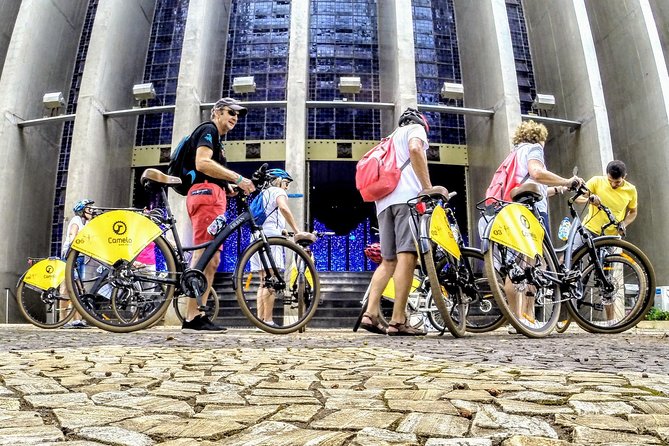
Brasília was planned on a scale that can frustrate walkers. Major buildings sit far apart, residential blocks follow broad open spaces, and the city’s four urban scales are easier to understand when you move through them in one continuous ride.
A car can carry you between landmarks, but it tends to turn the city into a sequence of parking stops. On a bicycle, you can pass through a superquadra, pause beside a church, roll through a park, and reach a government square without losing the connection between each part.
This is not a fast cycling challenge. The route has frequent stops, and the listed visits range from five minutes at the National Museum and Supreme Federal Court to 45 minutes at the model superquadra. Still, you should be comfortable spending much of the day outdoors and in the saddle.
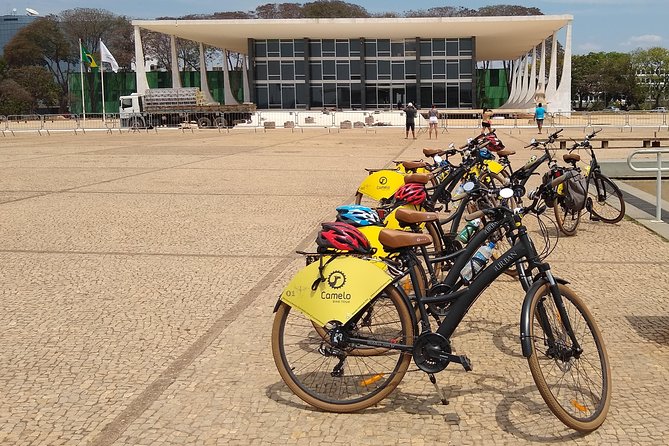
The tour begins at Camelo Bike Tour in the Brasil 21 business center in Asa Sul. The group is limited to 15 people, a sensible size for city riding and explanations. The company supplies a bicycle, two 500 ml bottles of mineral water, and a helmet. Helmet use is not mandatory in Brazil, but I would use one.
A few more bike tours around the world worth a look
- Lion City Bike Tour of Singapore
★ 5.0 · 6,211 reviews - Big Bike tour Amsterdam – See all in 3 unforgettable hours
★ 4.7 · 4,929 reviews - 3-Hour Porto Highlights on a Electric Bike Guided Tour
★ 5.0 · 4,392 reviews
Television Tower and the first view of Brasília
The Television Tower pilotis is the opening stop. It gives the tour a useful starting point because you are immediately looking at one of Brasília’s major modern structures rather than easing in with a long transfer.
The nearby TV Tower Craft Fair adds a more everyday note. The schedule describes passing by the fair rather than giving it a formal visit, so do not expect a long shopping stop. Think of it as an early reminder that Brasília is both a planned capital and a lived-in city.
The first stop lasts about 30 minutes. That is enough time to get oriented, settle onto the bike, and begin seeing how the city’s open spaces connect.
Clube do Choro and Brasília’s musical side
Clube do Choro is one of the most appealing early stops because it adds music to a tour that could otherwise focus only on architecture. Oscar Niemeyer designed the concert hall, which holds about 500 people, and the Choro School operates there.
The school teaches instruments including cavaquinho, mandolin, tambourine, guitar, saxophone, flute, accordion, harmonica, violin, and viola caipira. It is described as the first music school of its kind in Brazil, with more than a thousand students learning there.
You get about 20 minutes at the club. That is a short visit, so the value comes mainly from the guide’s explanation and the chance to connect the building with Brasília’s music culture. The venue also became a memorable part of the city’s recent cultural story after Paul McCartney gave a surprise intimate concert there on November 28, 2023.
Parque da Cidade and the city’s leisure scale
Parque da Cidade Sarah Kubitschek is one of the world’s largest urban parks. The 25-minute stop shows a side of Brasília that is easy to miss if you focus only on the monumental axis and ministries.
This is where the city’s planned open space feels less abstract. A park of this size helps explain how recreation fits into Costa’s plan. You are not simply looking at a famous building. You are seeing how Brasília made room for daily exercise, leisure, and time outdoors.
The route also passes Renato Russo Hall, a cultural venue associated with Brasília’s artistic life. The schedule does not promise a formal interior visit, so treat it as a passing point rather than a performance stop.
Same city, a different ride:
- Ninh Binh Full-Day Tour from Hanoi to Hoa Lu, Tam Coc & Mua Cave Via Boat & Bike
★ 5.0 · 4,384 reviews - Small Group Guided Bike Tour of Amsterdam’s Hidden Gems
★ 5.0 · 3,936 reviews - 3-hour Complete Prague Bike Tour
★ 5.0 · 3,674 reviews - Party Bike Private Party Up To 14 People in Old Town Scottsdale
★ 5.0 · 3,541 reviews
SQS 308, the clearest lesson in the residential scale
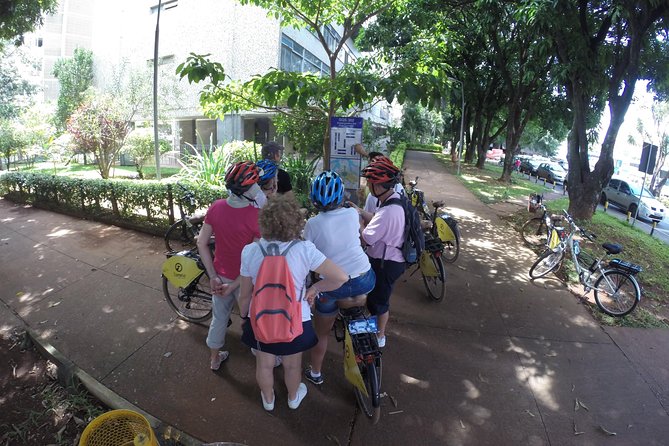
SQS 308 in Asa Sul is the longest stop, at about 45 minutes, and rightly so. This is the model superquadra, designed by Lucio Costa, landscaped by Roberto Burle Marx, and built by Banco do Brasil. It opened on February 19, 1962.
Here, the planning ideas become much easier to grasp. The apartment buildings, local shops, schools, and leisure areas work together as a neighborhood unit. You can see how the residential scale was meant to avoid a simple grid of isolated buildings.
This is also a good place to ask your guide questions. The stop has enough time for more than a quick photograph, and a guide such as Romain can make the architectural logic much clearer. His explanations of Brasília’s design and history were singled out as a strong part of the experience.
The superquadra may be the most important stop for anyone who wants to understand Brasília rather than merely photograph it. The monument-heavy center gets the attention, but the residential courts explain how the city was intended to function every day.
Igrejinha and SQS 302
Nossa Senhora de Fátima Church, known as Igrejinha, takes about 20 minutes. It opened in June 1958 and was the first church in the residential sector. The church was built at the request of Dona Sarah Kubitschek after her daughter recovered from an illness.
The exterior tiles by Athos Bulcão are the main visual detail. Their stylized doves and Star of the Nativity make the small church easy to recognize and give it a more personal scale than Brasília’s grand civic buildings.
At SQS 302, you get another look at the superquadra idea, this time in a configuration similar to the model court but not at the original model site. The 15-minute stop helps you compare the planned residential pattern with what you saw at SQS 308.
Taken together, these stops show that Brasília’s design was not limited to monumental avenues. It also shaped churches, apartment blocks, local commerce, green areas, and neighborhood movement.
Itamaraty, the Sanctuary, and the Cathedral

Palácio Itamaraty, also called the Palace of the Arches, is the home of Brazil’s Ministry of Foreign Affairs and one of Niemeyer’s best-known works. The stop lasts about 10 minutes. That is enough for an exterior look and an explanation, but not a full exploration of the building.
The Sanctuary of Saint John Bosco follows, with about 15 minutes. It honors Brasília’s patron saint and shifts the architectural mood from the open civic spaces to a more enclosed religious setting.
The Metropolitan Cathedral receives another 15-minute stop. Designed by Niemeyer, it marked an important moment in modern architecture and remains one of Brasília’s most recognizable buildings.
The short timings here are worth noting. This is a survey ride, not a series of long museum visits. You see many places in one day, but you should not expect extended interior time at every landmark.
South Commercial Sector and the city at work
The route passes Rua das Farmácias, a commercial street known for its concentration of pharmacies because of the nearby medical and hospital sector. It is a small detail, but it helps you see how Brasília’s sectors developed around practical needs.
Praça do Povo in the South Commercial Sector was renovated in 2021. Its new design supports skateboarding, shows, and kiosks, and it won a regional award from the Brazilian Institute of Architects in the urbanism, planning, and cities category.
The South Commercial Sector receives about 30 minutes. During the week, it is one of the city’s major pedestrian areas, helped by its closeness to the bus station and the Esplanade of Ministries. This is the part of the ride where Brasília feels less like a diagram and more like a place of work, errands, movement, and social exchange.
The route also passes the Sarah Hospitals Network. Its first unit is a rehabilitation center focused on locomotion and orthopedic illnesses. Architect João da Gama Filgueiras Lima, known as Lelé, worked with Niemeyer and Costa and designed buildings that use natural light, ventilation, colorful open areas, terraces, and flexible construction systems.
That stop adds another architect to the story. Brasília is not only Costa and Niemeyer. Lelé’s work shows how design can soften the experience of a hospital and respond to construction methods and patient needs.
Museums, civic squares, and the center of power
The National Museum of the Republic is part of the Cultural Complex planned into Brasília’s original plan. Niemeyer received the project in the 1970s. The formal stop is only about five minutes, so you are mainly seeing the exterior and placing it within the city’s cultural axis.
The route then reaches Praça dos Três Poderes, inaugurated on April 21, 1960, the same day Brasília became Brazil’s federal capital. Costa created the civic plan and Niemeyer designed the main architectural elements.
This is the symbolic heart of the ride. The square brings together the country’s three branches of government and gives you a clear sense of Brasília as a purpose-built capital. The Pantheon of the Fatherland adds another short stop, about five minutes, while the National Congress appears as a major visual marker at the start of the Esplanade of Ministries.
Espaço Lucio Costa is especially useful for understanding the plan. This underground space, opened in 1992 for Costa’s 90th birthday, contains a model of Brasília and a tactile model of the Plano Piloto. Fifteen minutes here can help you connect the broad avenues and sectors you have just ridden through.
You also pass the Supreme Federal Court, the Planalto Palace area where the president conducts official business, Brasília Classic Mall, the National Library, and the National Theatre. The National Theatre is another Niemeyer work and one of the city’s important cultural buildings.
The route includes Cultura Inglesa, Aliança Francesa, Praça 21 de Abril, and Espaço Cultural Renato Russo in 508 Sul. The latter contains rooms, galleries, and two theaters, including Teatro Galpão and the renovated Teatro de Bolso. These brief pass-by points add cultural detail without turning the day into an indoor museum tour.
Burle Marx Garden and the final sweep
Near the end, the route passes Burle Marx Garden and the Esplanade of Ministries. The garden brings the landscape design back into view, while the Esplanade offers Brasília’s famous long civic axis.
The ride finishes at the original meeting point. By then, you have seen all four types of urban space that give the experience its name: monumental areas, residential courts, everyday commercial districts, and open green or recreational spaces.
The sequence can feel dense. There are many stops, and some are brief. That is the tradeoff for covering so much of Brasília in one day.
Is the $97.03 price fair?
At $97.03 per person, this is not a cheap casual bike rental. The price includes the bicycle, helmet, two bottles of water, a guide, and a carefully connected seven-hour route. It also saves you the trouble of planning a route through a city whose distances and sectors can be hard to judge on foot.
I see the value in the guide more than in the bicycle itself. A strong guide explains why SQS 308 matters, points out Lelé’s work, connects the Cathedral to Niemeyer’s larger body of work, and helps you read the four scales instead of merely ticking off buildings.
The bicycle quality may vary. One account praised the guiding but found the bikes could be in better shape, while another noted that two shorter women had difficulty finding suitable bicycles. Test the fit carefully before departure. If you need a child’s setup, an articulated tandem passenger trailer or bike is available for children from about four to 10 or 12 years old, but you need to ask in advance.
The tour is usually booked about 22 days ahead, which is a useful sign to plan early if your dates are fixed. The group maximum is 15 people, and confirmation is normally issued at booking, subject to availability for bookings made within two days of departure.
Who should book this ride?
I would choose this tour if you want to understand Brasília’s planning, not just see its famous buildings. It suits active visitors who can handle a long day outdoors and who enjoy moving between architecture, public space, music, religion, commerce, and ordinary neighborhoods.
It is also a good choice for repeat visitors who have already seen the Cathedral or Congress and want more context. The model superquadra, South Commercial Sector, Sarah Hospitals Network, and Clube do Choro give the route more range than a standard monument circuit.
I would hesitate if you dislike long bike rides, need a very specific bicycle size, or want slow interior visits at major buildings. Lunch is not included, and the schedule is packed enough that you should plan around the full seven hours. The tour also requires good weather. If poor weather cancels it, you can receive a different date or a full refund.
Should you book the Bike Tour of the 4 Scales of Lucio?
Book it if you want Brasília explained as a city system. The best parts are not only the grand views at Praça dos Três Poderes or the Cathedral. They are the links between a model superquadra, a pharmacy street, a park, a music school, a hospital, and the monumental axis.
Before paying, contact Camelo Bike Tour about bicycle fit, especially if you are short or need a child trailer. If the bike suits you, $97.03 buys a full day of guided access to parts of Brasília that are difficult to connect on your own. Guides such as Larissa, Romain, Rui, and Daniel have brought warmth, safety help, architectural explanations, and even useful photographs to the ride.
FAQ
How long is the Bike Tour of the 4 Scales of Lucio?
The tour lasts approximately seven hours and ends back at the meeting point.
Where does the tour begin and end?
It begins and ends at Camelo Bike Tour, SHS Quadra 06 Conjunto A, Bloco A, Loja 17, Centro Empresarial Brasil 21, Asa Sul, Brasília.
What is included in the tour price?
The price includes use of a bicycle, two 500 ml bottles of mineral water, and a helmet. Helmet use is not mandatory in Brazil.
Is lunch included?
No. Lunch at a restaurant is not included.
How many people can join the tour?
The maximum group size is 15 people.
Can children join the bike tour?
Most people can participate, and an articulated tandem passenger trailer or bike is available for children from about four to 10 or 12 years old. Ask the company in advance.
Does the tour visit Brasília’s main government buildings?
The route includes Praça dos Três Poderes, the Supreme Federal Court, the National Congress area, the Planalto Palace area, Itamaraty Palace, the Esplanade of Ministries, and other civic sites. Several stops are exterior visits or short pass-by points.
What happens if the weather is bad?
The experience requires good weather. If it is canceled because of poor weather, you can be offered another date or a full refund.
Just added around the world
- Napier: Cycle to Wineries – Half Day, self-guided★ 4.0 · 12 reviews
- Napier Bike Hire★ 5.0 · 40 reviews
- Guided Bike Tour – Downtown Naples Florida★ 4.5 · 22 reviews
- Independent Hassle-free Bike Rental in Sonoma★ 5.0 · 62 reviews
- Healdsburg Cycling Wine Tour★ 4.5 · 14 reviews
- Full-Day Electric Bike Rental★ 5.0 · 38 reviews
- Sonoma Valley Pedal Assist Bike Tour★ 5.0 · 32 reviews
- Behind-the-Scenes Food and Wine E-Bike Tour★ 5.0 · 68 reviews
Tours, compared.
Big Bike tour Amsterdam – See all in 3 unforgettable hours
Read our review →
3-Hour Porto Highlights on a Electric Bike Guided Tour
Read our review →
Ninh Binh Full-Day Tour from Hanoi to Hoa Lu, Tam Coc & Mua Cave Via Boat & Bike
Read our review →
Small Group Guided Bike Tour of Amsterdam’s Hidden Gems
Read our review →