
REVIEW · QUEBEC CITY
Historical Lower Town & Neighborhoods Bike Tour
Quebec City’s Lower Town is easiest to understand when you move through it slowly, then cover enough ground to see how the old streets connect with the river parks beyond them. I like the way this small-group ride combines Place-Royale and Petit Champlain with quieter paths along the St. Charles River. I also like the stop at Le Grand Marché, where the city’s food culture gets a turn.
The route is mostly flat and bike-friendly, but you should still be comfortable riding about eight miles. The chief drawback is the weather: this is an outdoor activity, and a cold, wet day can make the history stops less comfortable. If you need an e-bike, contact the shop ahead of time, since it costs extra and must be prepared in advance.
Key points at a glance
- A compact route with real variety: Ride from the Old Port and French colonial streets to river paths, parks, neighborhoods, and a farmers market.
- A maximum of eight people: The small group makes it easier for the guide to adjust the pace and answer questions.
- Strong local guiding: Guides including Guy, Annabelle, Raymond, Simon, Luc, and Yves are praised for history, humor, safety, and personal attention.
- Mostly easy riding: The route is described as relatively flat, though you need enough stamina to ride roughly eight miles.
- Useful extras included: You get a city bike or an e-bike for an added charge, helmet, water, snacks, and a small handlebar bag.
- A practical first-day activity: Three hours on two wheels can help you understand Quebec City’s layout before exploring on foot.
Why a bicycle works so well in Lower Town
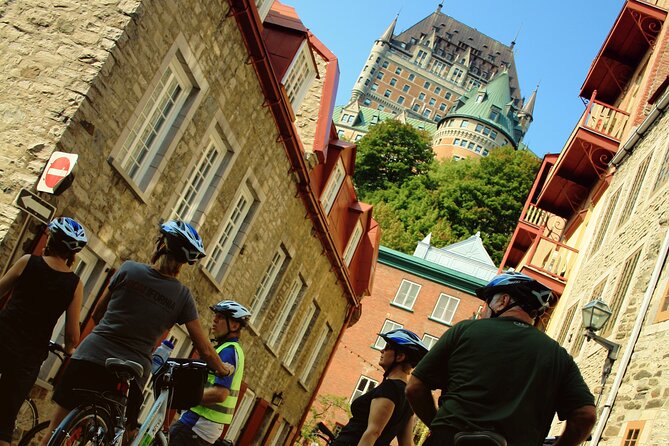
Old Quebec can feel like two cities stacked together. The Upper Town sits above the river, while Lower Town spreads through the old port, Place-Royale, Petit Champlain, and the neighborhoods farther west and north. Walking is rewarding, but the hills and distances can make it hard to connect the pieces in one outing.
A bicycle gives you a better sense of the whole area. You can pause in the historic center, then pedal away from the busiest streets toward the St. Charles River. That change is the heart of this tour. It shows you the postcard version of Quebec City, then adds parks, trails, local streets, and a market.
The ride lasts about three hours and has a maximum of eight participants. That size matters. A guide can keep an eye on slower riders, pause when someone needs a better view, and change the pace without managing a large procession. Guides such as Guy, Annabelle, Raymond, Simon, Luc, and Yves are repeatedly praised for clear explanations, humor, and attention to different riding abilities.
You meet at the bike shop at 285 QC-136 in Lower Town. After a bike and helmet fitting, the guide gives a short safety briefing. The activity ends back at the same meeting point, which makes it easy to continue exploring Lower Town or return to a cruise ship area afterward.
More Historic and Landmark Bike Tours in Canada:
- Party Bike Private Party Up To 14 People in Old Town Scottsdale
★ 5.0 · 3,541 reviews - Guided Bike Tour of Old Town Key West
★ 5.0 · 2,611 reviews - Historical Singapore Bike Tour on Full-Sized Bicycles
★ 5.0 · 1,421 reviews
Place de la FAO and the first look at Lower Town
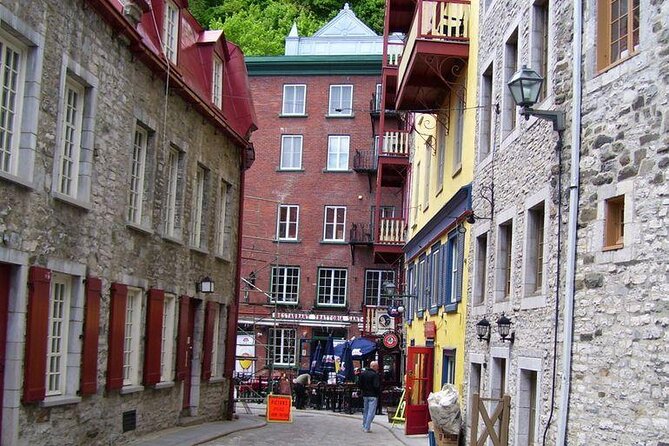
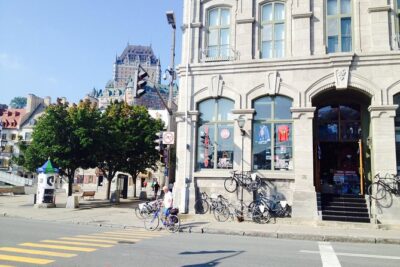
The opening ride takes you through narrow streets with the typical architecture of old Quebec. This is a short stop, about five minutes, but it helps set the tone. Instead of beginning with a long lecture, you start moving through the historic core and noticing the stone buildings, tight lanes, and changing street views.
Your guide’s commentary is important here because the details can blur together when you first arrive. A good guide helps you read the city as you ride, pointing out how the older streets fit into modern Quebec City.
The route is not a race. Several guides have adjusted their speed for people who do not ride often, and the company has worked with families and riders who needed extra help getting comfortable. That makes the tour more approachable than a high-speed city ride.
Still, you should be able to ride independently for much of the route. Children need to manage approximately eight miles on their own. Children ages five to seven can use a trail-a-bike pulled by an adult.
Place-Royale and the oldest French settlement
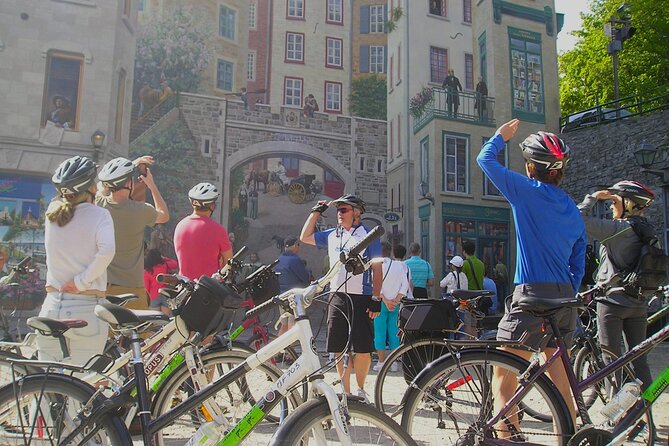
Place-Royale is the historical center of the ride. This was the first permanent French settlement in North America, and the square remains one of the clearest places to see Quebec City’s colonial character.
You stop for about ten minutes at Place-Royale, where the guide discusses the Mural of Quebecers and Notre-Dame-des-Victoires. The church is identified as the oldest in Quebec City. The square is compact, so you can take in the buildings and listen without spending too much time off the bike.
This is one of the tour’s strongest history stops because the setting does much of the teaching. You are not looking at a distant monument in an open plaza. You are surrounded by old façades, narrow streets, and the commercial heart of Lower Town.
The tradeoff is that Place-Royale and nearby Petit Champlain can be busy. You may need to walk your bike in tighter areas or wait for pedestrians. That is normal in this part of Quebec City, and it is one reason the guide’s safety instructions matter.
Petit Champlain, cobblestones, and the Old Port
From Place-Royale, the ride continues toward Quartier Petit Champlain. This is described as the oldest commercial district in North America, with stone buildings, boutiques, cafés, and restaurants lining cobblestone streets.
Petit Champlain is attractive but not the easiest place to cycle. The streets are narrow and pedestrian-heavy, so this section is better treated as a slow pass or a short walk with the bicycle. You get the architecture and atmosphere without having to rush through it.
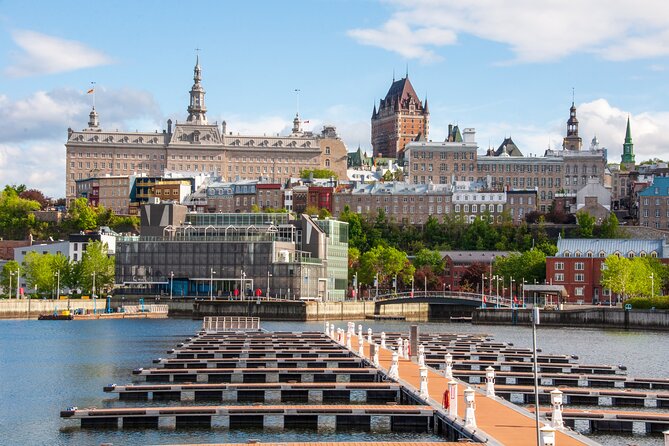
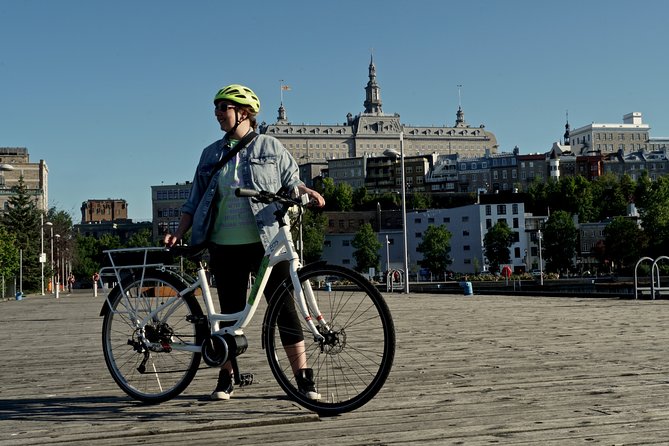
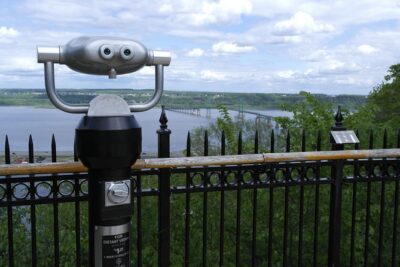
The Old Port offers a different view. The stop lasts about five minutes and looks toward the St. Lawrence River, Château Frontenac, and the fortified walls of Old Quebec. It is a good place to understand Quebec City’s position beside the water and to see how the old town rises above the riverfront.
I like this pairing of stops. Petit Champlain gives you street-level detail, while the Old Port gives you distance and orientation. Together, they explain why Quebec City feels both European and distinctly North American.
The nearby Musée de la Civilisation is also part of the ride through the waterfront area. You do not enter the museum on this activity, but the location helps place one of Quebec City’s leading cultural institutions within the old port district.
More History Tours in Canada:
- Barcelona: 2.5-Hour Bike or E-Bike Historical Tour
★ 4.5 · 1,262 reviews - Asheville Historic Downtown Guided Electric Bike Tour with Scenic Views
★ 5.0 · 1,234 reviews - Historic Athens: Small Group Electric Bike Tour
★ 4.9 · 966 reviews - Bordeaux: Historic Center & Chartrons District Bike Tour
★ 4.8 · 709 reviews
The St. Charles River trail and Cartier-Brébeuf
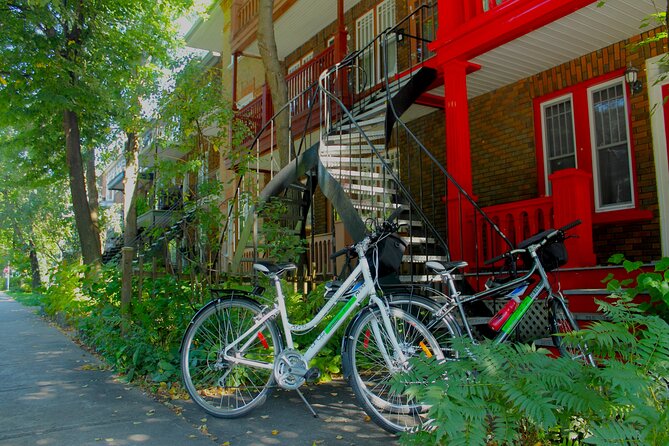
The most refreshing part of the route comes when you leave the densest historic streets and follow the green St. Charles River bike trail. The path is presented as an oasis close to downtown, and it gives you a chance to ride at a more comfortable pace.
This section is valuable because it broadens your idea of Quebec City. You see more than churches, stone walls, and tourist streets. The river path connects parks and neighborhoods, offering a calmer side of the city. The route is also one of the reasons many riders describe the tour as relaxing rather than strenuous.
The stop at Cartier-Brébeuf National Historic Site lasts about five minutes. Here, the guide explains the arrival of French explorers and the site’s place along the river. It is a city park in the Limoilou district, so the stop combines a short historical explanation with open space and greenery.
You should not expect a long visit at each stop. The tour is designed to give you a broad introduction, not to replace a museum visit or a full historical walking tour. That is a strength if you want to see several parts of the city in one morning or afternoon. If you prefer long periods at each monument, the schedule may feel quick.
Le Grand Marché and a taste of local Quebec
The final major stop is Le Grand Marché de Québec, where you spend about 20 minutes. Your guide introduces you to local producers, bakeries, artisans, and regional products.
This is more than a convenient refreshment break. A market gives you a glimpse of what people eat and make in the area, and it adds a present-day layer to a tour otherwise centered on old streets and colonial history. One family had time for a frozen strawberry drink here, which gives you an idea of the relaxed, informal feel of the stop.
Twenty minutes is enough for an introduction, but not enough for a full market visit. If you want to shop or browse every stall, return on your own after the tour. The market is a useful place to note down foods or products you would like to try later.
Snacks and water are included throughout the activity. You may bring your own reusable bottle, which is sensible for a three-hour ride.
What the guides add to the experience
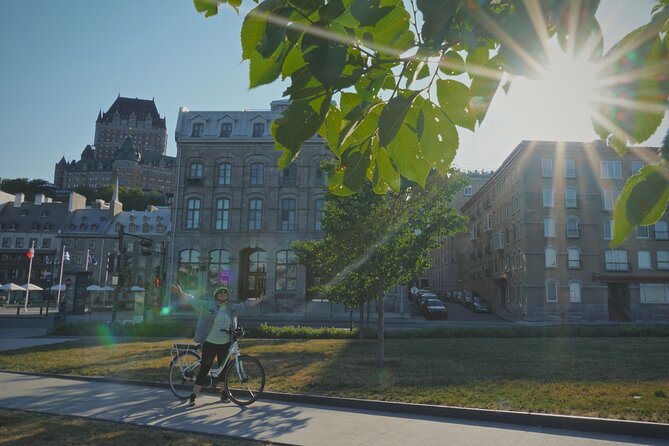
The route matters, but the guide can determine whether the history feels lively or rushed. This company uses several guides, including Guy, Annabelle, Raymond, Simon, Luc, Denny, Denis, Robert, Uli, Mark, and Yves.
Guy is repeatedly singled out for his history knowledge, humor, and ability to set a comfortable pace. Annabelle is described as especially passionate about the city. Raymond is noted for explaining Quebec’s personality as well as its past, while Simon has helped slower riders and offered local suggestions, including a recommendation for La Barbarie microbrewery.
That range is useful to know. You are not booking a scripted ride with one guaranteed personality. Your guide will vary by date, but the consistent qualities to expect are local history, safety supervision, and an effort to match the group’s speed.
The experience is also flexible within limits. One guide offered a choice between riding farther and spending more time at sights. Another adjusted the route for a rider who was not accustomed to cycling. You should not assume a private tour, but the small group gives the guide room to respond to the people in front of them.
Bikes, e-bikes, and the effort required
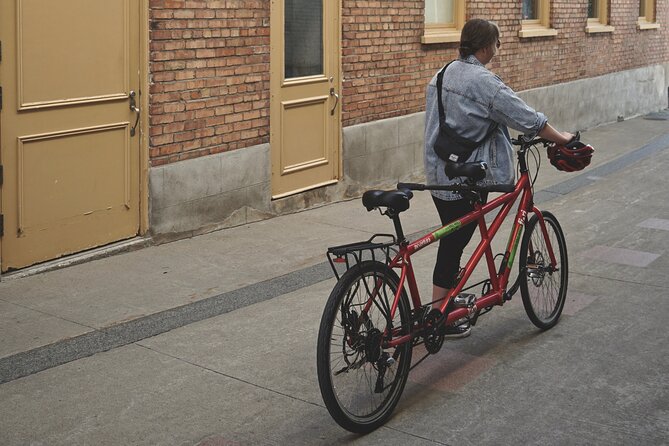
The standard booking includes an urban bicycle, helmet, water, snacks, and a small handlebar bag for personal items. The bag is useful for a phone, wallet, sunglasses, or a light layer, but it is not intended for large luggage.
An e-bike is available for an additional charge, and riders must be at least 18 years old to use one. The extra cost has been reported as $30, and the shop needs advance notice to configure the bike. Contacting the shop before arrival is the sensible move if you want electric assistance.
The route is mostly flat and described by several riders as easy to navigate. That does not mean you can treat it as a completely effortless outing. The distance is about eight miles, and the weather may affect how comfortable you feel. Wear clothing suited to the forecast, and remember that even a mild day can feel cooler beside the river.
Families can take part if children can ride the required distance. The experience has worked well for children ages nine, ten, thirteen, and fourteen, while younger children between five and seven can use the trail-a-bike arrangement. The guide can help with pacing, but basic bike confidence is still necessary.
Is $138.94 a fair price?
At $138.94 per person, this is not a cheap way to rent a bicycle. You are paying for a three-hour guided experience, a small group, equipment, safety support, local commentary, water, and snacks.
The value is strongest if you want an organized introduction to Quebec City and would otherwise struggle to connect Lower Town, the Old Port, the river trail, Cartier-Brébeuf, and Le Grand Marché in one outing. You also save the effort of arranging a bike, helmet, route, and navigation on your own.
The price is harder to justify if you mainly want casual cycling or plan to spend the whole day inside the old center. You could explore Place-Royale and Petit Champlain on foot without paying for a tour. This activity earns its price by taking you beyond those famous streets and by adding a guide who explains what you are seeing.
The booking pattern suggests that many people reserve about 38 days ahead. That is worth noting if your schedule is fixed, especially during a busy season. The maximum group size is eight, so the small-group format may fill before larger activities do.
Weather, timing, and who should book
The tour requires good weather. If poor conditions cancel it, you are offered another date or a full refund. You can cancel for a full refund up to 24 hours before the start time, but late cancellations and changes are not accepted.
I would book this early in a Quebec City visit. The route helps you understand the city’s shape, and the guide’s suggestions can point you toward places to revisit later. It also suits cruise passengers and anyone staying near Old Quebec because the meeting point is in Lower Town and the activity returns there.
This is best for:
- Couples who want history without spending three hours indoors
- Families with children who can ride independently
- Friends who enjoy light exercise and local food stops
- First-time visitors who want both major sights and less central paths
- Riders who appreciate a relaxed pace and a guide who can answer questions
I would think twice if you dislike cycling, have trouble riding for several miles, or want long, unhurried visits inside individual sights. The tour passes many places but does not provide extended admission time at them.
Should you book the Lower Town bike tour?
Book it if you want a clear, active introduction to Quebec City that reaches beyond the postcard streets. The best parts are the contrast between Place-Royale, Petit Champlain, the Old Port, and the quieter St. Charles River trail, plus the market stop at Le Grand Marché.
Before paying, decide whether you need an e-bike and contact the shop ahead of time. Check the forecast, allow enough time for an eight-mile ride, and expect a broad overview rather than deep visits at each stop.
For most reasonably active visitors, this is a smart use of three hours. It gives you history, city views, river paths, local food, and practical orientation in one compact outing.
FAQ
How long is the Historical Lower Town and Neighborhoods Bike Tour?
The tour lasts approximately three hours and finishes back at the meeting point in Lower Town.
Where does the tour begin?
You meet at the bike shop at 285 QC-136, Québec, QC G1K 3W6, Canada.
What does the tour include?
The price includes a qualified guide, an urban bike, helmet, water, snacks, and a small handlebar bag. An e-bike is available for an additional charge.
Can children join the tour?
Yes. Children must be able to ride a bike for approximately eight miles by themselves. Children between five and seven can use a trail-a-bike pulled by an adult.
How many people can join the tour?
The activity has a maximum of eight participants.
What happens if the weather is poor?
The tour requires good weather. If it is canceled because of poor conditions, you can choose another date or receive a full refund.
Just added around Canada
- Banff: Mountain Lakeside Guided E-Bike Tour★ 4.9 · 19 reviews
- Banff Townsite: E-Bike Explorer★ 5.0 · 32 reviews
- Banff: Bow River E-Bike Tour and Sundance Canyon Hike★ 4.9 · 36 reviews
- Quebec City : Bike Excursion to Montmorency Falls★ 5.0 · 141 reviews
- Quebec City: Electric Bike Tour★ 4.5 · 124 reviews
- Stanley Park & Downtown – Vancouver Bike Tours★ 5.0 · 243 reviews
- Vancouver: Stanley Park Bicycle Tour★ 4.9 · 194 reviews
- Edmonton’s #1 Food Bike Tour: The Best Local Food Tour on E-Bikes★ 5.0 · 48 reviews
Quebec City Bike Tours, compared.
Browse the lists this tour appears in