
REVIEW · SWITZERLAND
Basel: Fancy a bike tour through 3 countries in 60 minutes?
Cycling through three countries in 60 minutes is the clever hook here, but the real appeal is seeing how Basel changes at its edges. You ride from a leafy Swiss park to the Rhine, cross into France, pedal through Germany, then return past working docks and alternative cultural spaces.
I like the route’s mix of river views and everyday city life. The Dreiländerbrücke and Dreirosenbrücke give you memorable views, while the harbor and Holzpark Klybeck show a less polished, more authentic side of Basel. The main consideration is the short format: 10 kilometers and one hour give you a lively snapshot, not a full city tour.
Key points to know before you book
- Three countries in one short ride: Start in Switzerland, cycle through France and Germany, and finish back in Basel.
- A mostly flat 10-kilometer route: The pace suits a wide range of cycling abilities, including families and casual riders.
- Small groups capped at six people: Guides can adjust the pace and give more personal attention.
- The bridges are the visual highlights: Ride across the Dreiländerbrücke and finish with broad Rhine views from the Dreirosenbrücke.
- A practical price for a guided outing: At $28 per person, the fee includes a bicycle, helmet, local guide, and Basel tips.
- Bring your passport: You cross three national borders, so valid identification is essential.
Why this one-hour Basel ride works
Many city tours ask you to choose between monuments and local life. This ride gives you a bit of both, though it does so at bicycle speed. You will not spend long at any one stop, but you will cover ground that is awkward to explore on foot in the same amount of time.
The route follows the Rhine and nearby streets rather than sticking to Basel’s historic center. That matters. You see the city as a border hub, port, and modern business center, not only as a collection of old buildings.
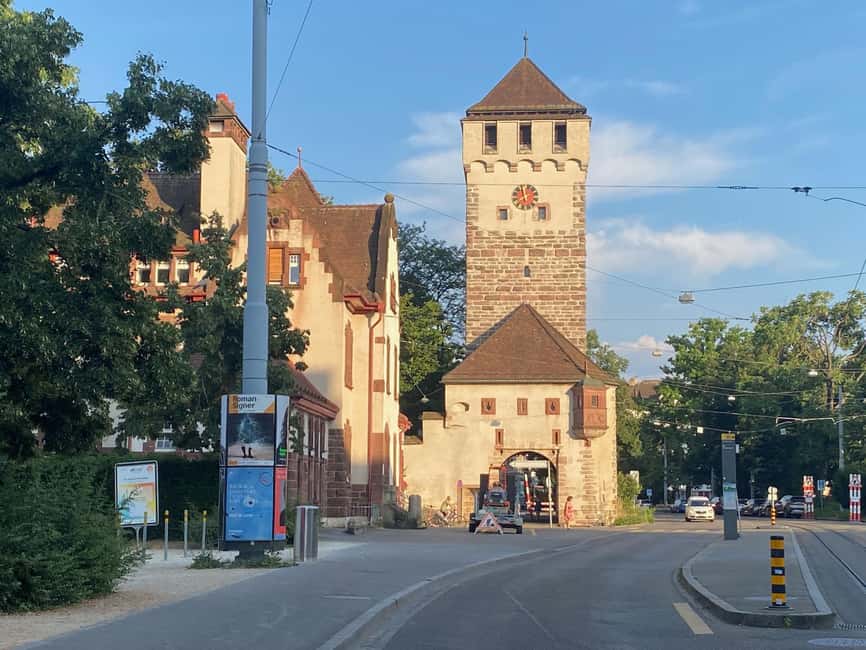
The ride starts in Switzerland at St. Johann Park, a green meeting point near the St. Johanns-Tor tram stop. From there, the route heads toward the Rhine and the Novartis campus before reaching the French border. It then enters France, crosses into Germany, returns to Switzerland, and ends with a bridge ride above the river.
I like this structure because every section feels different. The ride begins calmly in a park, moves into a cross-border river corridor, passes working infrastructure, and ends with a city panorama. You get a clear sense of Basel’s position at the meeting point of Switzerland, France, and Germany.
The tour costs $28 per person. That is a fair price for a one-hour guided activity because the bicycle, helmet, and guide are included. You are also paying for the local route knowledge and for the ease of crossing several borders without having to plan the route yourself.
Still, keep the time limit in mind. If you want detailed historical commentary, long photo stops, or a close look at Basel’s old town, choose a longer city tour instead. This experience is best understood as a fast, scenic introduction to the city’s border region.
More One-Hour Experiences in the world:
- Lisbon: 1-Hour Beer Bike Tour with Draft Beer & Sangria Ride
★ 4.2 · 260 reviews - Paris Evening Bike Tour with 1-hour Seine River Cruise
★ 4.5 · 210 reviews - Lisbon: 1-Hour Beer, Sangria or Wine Bike Sightseeing Tour
★ 4.3 · 110 reviews
Starting in St. Johann Park
Meet your guide opposite the St. Johanns-Tor tram stop, at the entrance to the park. Look for a guide wearing a Basel Bike Adventures shirt. The meeting point is easy to reach on tram line 11 toward Saint-Louis Grenze, with direct access from Basel SBB, Barfüsserplatz, and Marktplatz.
The park gives you a relaxed place to begin. You are not starting beside a busy station platform or on a crowded commercial street. The green setting also helps the first few minutes feel unhurried while you receive your bicycle and helmet.
The bicycles are described as new or good quality, and guides take time to fit the bikes and helmets before setting off. That small step matters, especially if you are riding with children or have not cycled recently.
The group limit is six people. In practice, that makes a difference. A guide can keep an eye on the front and back of a family group, adjust the pace, and stop for questions without holding up a large crowd. Giuanna and Marco have led family groups together, while Yomo has also guided individual riders.
The ride can be conducted in German and English. If your group includes both language groups, expect the commentary to use both languages. That may make the spoken information a little less streamlined, but it also allows the tour to run for mixed groups.
Along the Rhine and past the Novartis campus
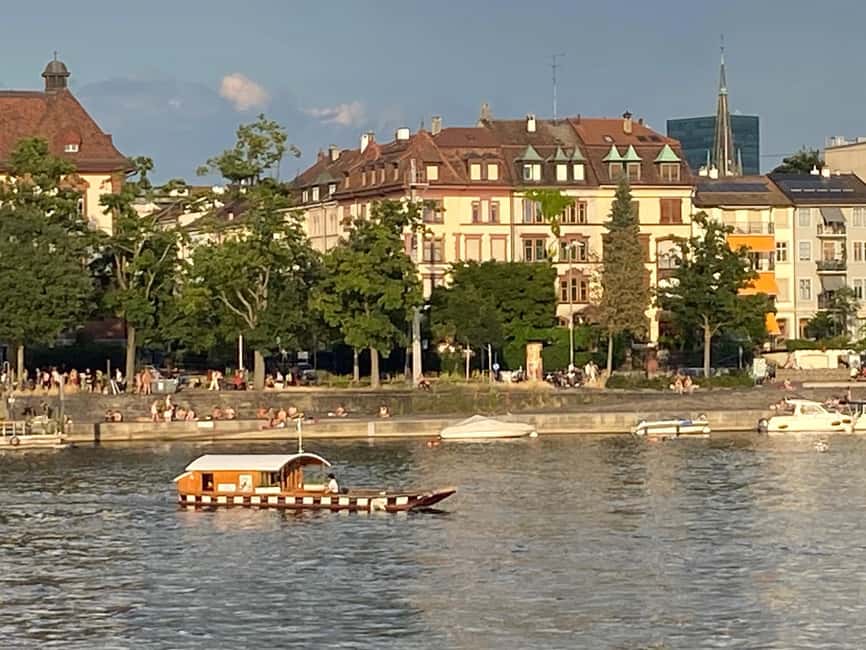
The first section follows the Rhine from St. Johann Park. You pass the Novartis campus, an impressive modern development beside the river, before reaching the French border.
This part gives you a useful introduction to Basel’s modern side. The route is not simply a parade of old streets and famous façades. Instead, you see the relationship between the river, international business, transport links, and neighboring countries.
The ride covers about 10 kilometers in total and is mostly flat. That makes it suitable for people who want to cycle without treating the activity as a workout. One guide rides at the front and another can stay behind a family group, a helpful arrangement for riders with different levels of confidence.
The short route also means you can fit the tour into a busy day. It works well before dinner, after sightseeing, or as an evening activity. Several departures have been scheduled in the evening, and the route can finish around sunset depending on the time of year and starting time. Exact departure times depend on availability.
Entering France through Saint-Louis
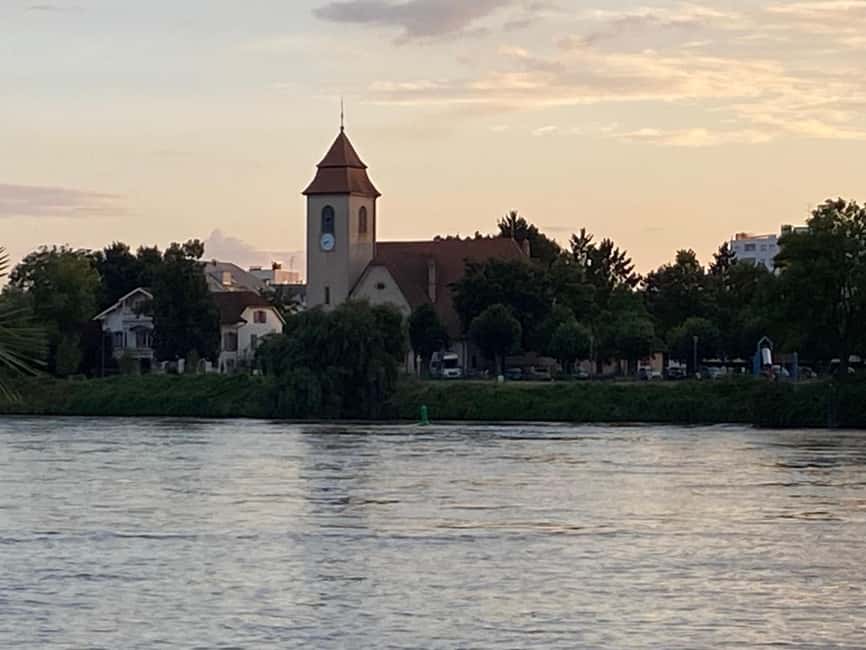
At the French border, you continue on French soil along the Quai du Rhin. The change is quick, but it gives the ride its central appeal. You are not merely looking at a border marker from a distance. You are cycling across it and continuing through a neighboring country.
The route passes through Saint-Louis, a French town directly connected to Basel. This section offers a different feel from the Swiss starting point, though the tour moves too quickly for a full town visit. Think of it as a cross-border ride with brief glimpses of local streets and riverfront life.
You then pass the Canal de Huningue. The canal adds a quieter, more pastoral stretch to the route, giving you a break from the city and transport corridors. It is one of the spots where a short pause for photographs makes sense.
Do not expect a long stop with time to explore cafés or museums. The value here is the contrast. Within minutes, the ride moves from Swiss urban development to French streets and a canal-side setting.
A few more bike tours around the world worth a look
- Lion City Bike Tour of Singapore
★ 5.0 · 6,211 reviews - Big Bike tour Amsterdam – See all in 3 unforgettable hours
★ 4.7 · 4,929 reviews - 3-Hour Porto Highlights on a Electric Bike Guided Tour
★ 5.0 · 4,392 reviews - Ninh Binh Full-Day Tour from Hanoi to Hoa Lu, Tam Coc & Mua Cave Via Boat & Bike
★ 5.0 · 4,384 reviews
Crossing the Dreiländerbrücke into Germany
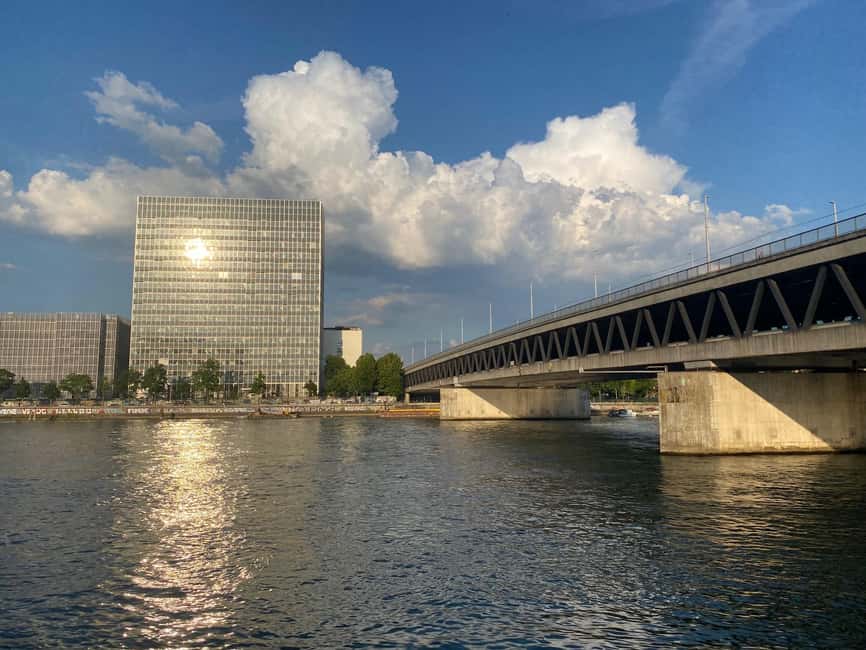
The Dreiländerbrücke is one of the tour’s main visual moments. It is described as the longest cantilevered pedestrian and cycle bridge in Europe, and it carries the route from France into Germany.
The crossing gives you a clear sense of the Rhine as a connector rather than a barrier. From the bridge, you can look along the water and see how the three-country region fits together. It is also a natural place for photographs, though the group’s pace and time limit may keep the stop brief.
This bridge is a strong reason to choose the tour instead of simply taking a local bike ride. You are not only cycling beside the Rhine. You are using a major piece of cross-border infrastructure and changing countries again on two wheels.
The route then reaches Weil am Rhein in Germany. For a first visit to the region, this can be a satisfying geographical moment. You have crossed from Switzerland into France, crossed a major bridge into Germany, and are still only partway through a one-hour circuit.
Returning through Kleinhünigen harbor
From Germany, the route crosses back into Switzerland and enters the Kleinhünigen harbor area. This is one of the most distinctive parts of the experience because it shows Basel as a working river port.
The harbor area is in transition, with industry, logistics, and urban development meeting in the same space. You may find the surroundings rougher and less polished than the park or bridge sections, but that is precisely the point. This is a working edge of the city, not a staged sightseeing district.
I like including this section because it adds context. Basel is often presented through art, architecture, and the old town, yet its location on the Rhine has long shaped trade and transport. Cycling through the port area gives you a quick look at the city’s practical, industrial side.
There may be tracks, road crossings, and changing surfaces along parts of the route. The guides set the pace and explain what to expect, but you should remain attentive. The ride is considered manageable, yet it is still a city bicycle tour rather than a completely separated recreational path.
The Dreiländereck border monument
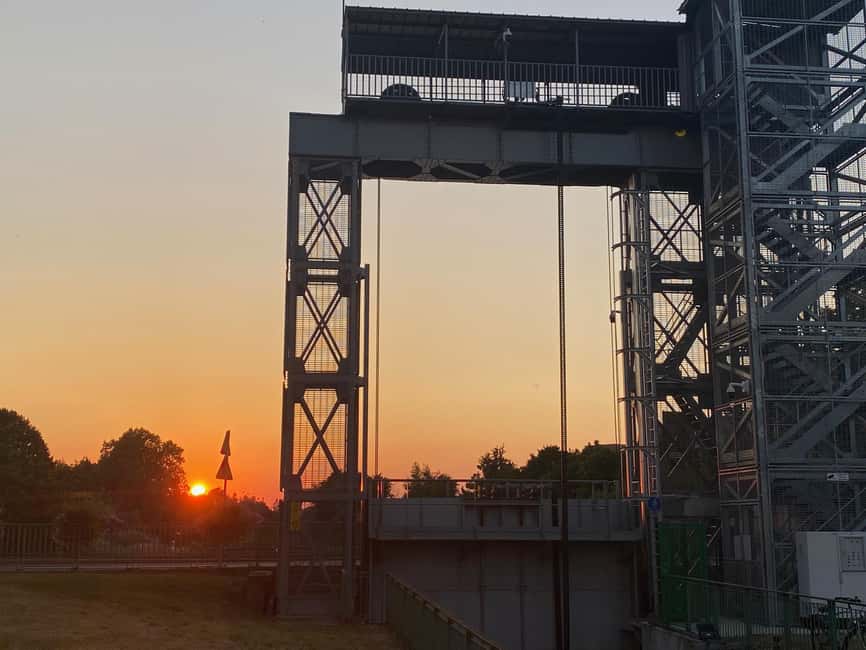
Shortly after the harbor, you reach the Dreiländereck monument, the symbolic point where Switzerland, Germany, and France meet. This is the clearest physical expression of the tour’s theme.
The monument is more than a quick photo stop. It helps explain why Basel feels different from a typical Swiss city. The French and German borders are close, and the region functions as a shared urban area even though national boundaries remain important.
You will probably spend only a short time here, but it is a useful place to pause and take in the route you have just completed. By this point, you have crossed all three countries and seen several different sides of the Rhine corridor.
For families, the border triangle also gives children a simple, memorable story to take home. You can point to the map and say that the group cycled through three countries before the hour was over.
Holzpark Klybeck and Basel’s alternative edge
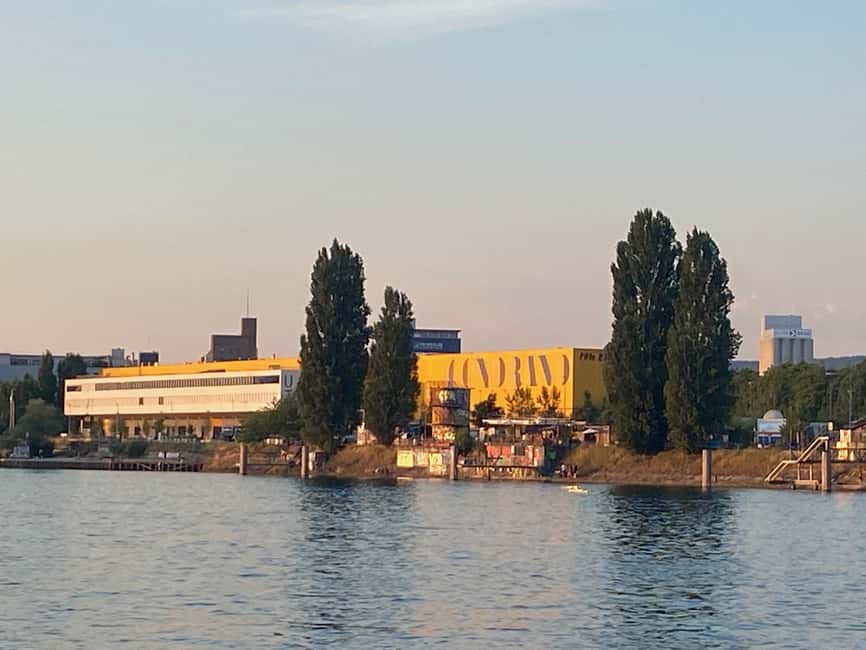
On the return leg, you follow the Rhine upstream and pass Holzpark Klybeck. This creative open-air area brings alternative culture into the route, with informal spaces and cultural offerings in a former industrial setting.
The stop helps break up the polished image of Basel. You see a city where old industrial land is being reconsidered and reused. The atmosphere can feel informal and experimental rather than formal or historic.
This section is especially useful if you prefer local texture to a list of famous sights. The tour does not simply point out monuments. It also shows spaces connected to current urban change.
Again, the short duration limits how much time you have to explore. You will pass through the area rather than settle in for a full visit. If Holzpark Klybeck interests you, note it as a place to return to on your own.
The final view from Dreirosenbrücke
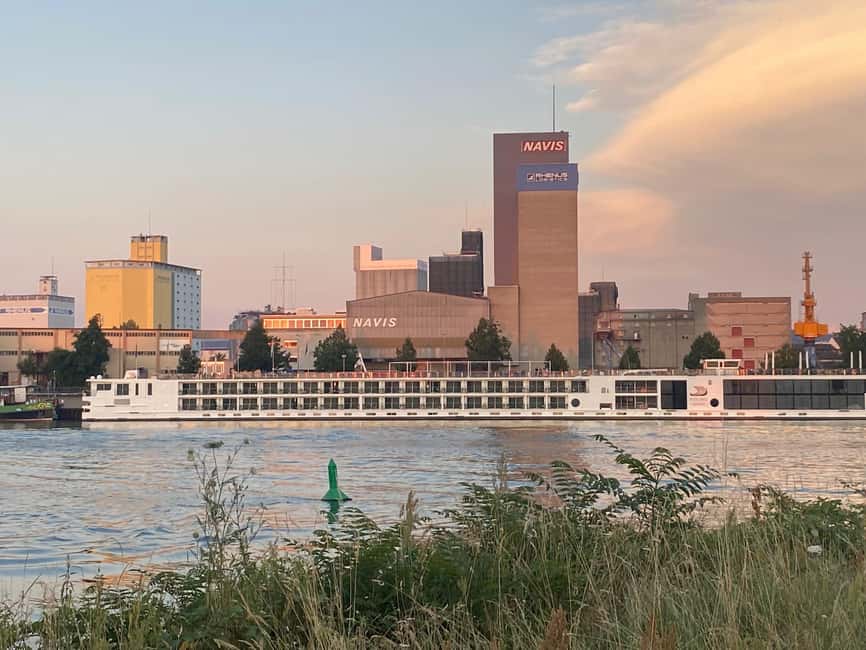
The ride ends with a crossing of the Dreirosenbrücke. From the bridge, you get a broad view of the Rhine, Basel, and the surrounding French and German sides of the region.
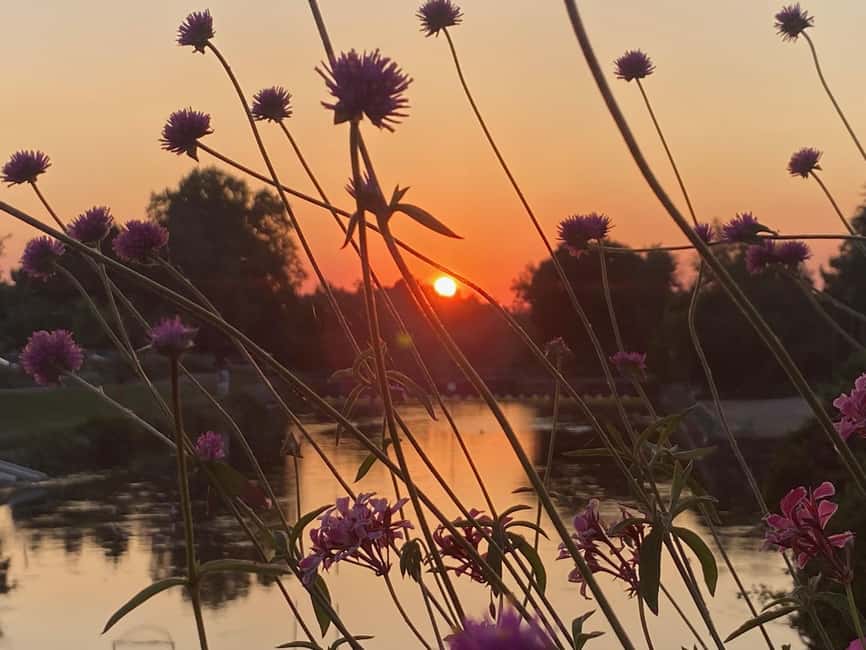
This is a smart finish. After moving through parks, streets, a canal, a bridge, and the harbor, you end above the river with a wide view that ties the route together. An evening departure can make the final crossing particularly attractive as the light changes.
The bridge also gives you a chance to understand the geography at a glance. Instead of hearing that three countries meet here, you can see the connected river corridor and the built-up areas on either side.
Do not expect a long sunset session every time. Timing depends on the date and departure slot, and the tour remains only one hour. Still, the final bridge ride gives the experience a proper finish rather than ending abruptly back at the starting point.
Guides, bikes, and the small-group advantage
The guides are one of the strongest parts of this experience. Giuanna and Marco have guided families together, and Yomo has been praised for sharing information in a friendly way. The guiding style is informal, with time for questions and local suggestions for the rest of your stay.
That personal touch is valuable on a route with several borders. You can ask about Basel, the river, the port, or places to visit after the tour. The guides also offer to take photographs, which is useful when you want a picture of the whole group on the bridges.
The small-group limit of six is important for safety and comfort. A family with teenagers can receive help with bike and helmet fitting, and the guides can ride at a pace that does not leave a less confident cyclist behind.
Helmets are included and disinfected after each use. The bicycles are described as new or good quality. You should still check the fit before leaving and tell the guide if the saddle or handlebars feel wrong.
The route is suitable for different cycling levels, but you should be comfortable riding in an urban setting. Some roads, bridges, and tracks require care. One young rider had a minor fall after a tire caught beside a train track, and the guides responded with first aid. That is a reminder to pay attention around rail lines and uneven edges, even at a slow pace.
Who should book this Basel bike tour?
I would recommend it to first-time visitors who want a quick orientation beyond the old town. It is also a good fit for families, couples, solo riders, and small groups looking for an easy evening activity.
You will get the most from it if you enjoy:
- Short guided rides with frequent changes of scenery
- River views and bridges
- Border regions and everyday urban life
- Informal local commentary
- A relaxed pace rather than athletic cycling
It may not suit you if you want a detailed museum-style tour, a long stop in Saint-Louis, or extensive time at each landmark. The tour is designed for movement and variety.
At $28, the value is strongest for people who would otherwise need to rent bikes, plan a route, navigate three countries, and work out the border crossings alone. The cost is less compelling if you already have a bicycle and only want to ride beside the Rhine, but the guide and route design still add convenience.
Bring your passport or valid identification. EU and EFTA citizens can use a valid ID card or passport. People from the United States, Canada, the United Kingdom, and Australia need a valid passport, and some other nationalities may need a Schengen visa. Check your own entry requirements before booking.
Free cancellation is available up to 24 hours before the tour for a full refund, and you can reserve now and pay later. These policies are useful if your Basel plans are still shifting.
Should you book it?
Book this tour if you want a compact, friendly way to see Basel as a cross-border city. The route gives you three countries, two major bridges, the Rhine, a working harbor, a creative urban area, and the Dreiländereck monument in about an hour.
I especially like it for families and first-time visitors because the ride is mostly flat, the group is small, and the guides take care with bike fitting and pace. Just keep your expectations clear: this is a scenic sampler, not a full historical tour.
If you have only one free hour and want an activity that feels specific to Basel, this is a strong choice. If you have several hours and want deeper city coverage, consider a longer guided ride after using this tour as your introduction.
FAQ
Where does the bike tour start?
It starts opposite the St. Johanns-Tor tram stop at the entrance to St. Johann Park in Basel. The guide wears a Basel Bike Adventures shirt.
How do I reach the meeting point?
Take tram line 11 toward Saint-Louis Grenze and get off at St. Johanns-Tor. You can board at Basel SBB, Barfüsserplatz, or Marktplatz.
How long is the tour?
The tour lasts one hour.
How far do you cycle?
The route covers about 10 kilometers.
Which countries does the route visit?
You cycle through Switzerland, France, and Germany before returning to Switzerland.
Do I need to bring identification?
Yes. Bring a valid ID card or passport because the route crosses national borders.
What languages are available?
The live guide speaks German and English. Depending on the group, the tour may use both languages.
Is a bicycle included?
Yes. A bicycle and helmet are included in the price. Helmets are disinfected after each use.
How many people are in each group?
The tour is limited to six participants.
Can I cancel the booking?
You can cancel up to 24 hours in advance for a full refund. You can also reserve the tour and pay later.
Just added around the world
- Santorini e-bike guided tours★ 4.9 · 31 reviews
- Santo Domingo: City Highlights Guided Bike Tour★ 4.9 · 72 reviews
- Santiago: Highlights, Parks and Politics Bike Tour★ 4.6 · 75 reviews
- Santiago: Markets Bike Tour★ 4.8 · 107 reviews
- Santander: Guided Tour by Electric Bike★ 4.7 · 16 reviews
- LA: Santa Monica & Venice Beach Guided Bike or eBike Tour★ 4.4 · 24 reviews
- Bike Tour in San Sebastian★ 4.4 · 93 reviews
- Santa Monica: Full Day Bike Rental★ 4.7 · 42 reviews
Switzerland Bike Tours, compared.
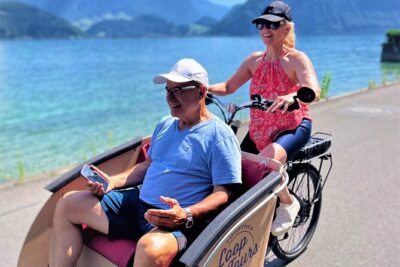
Lucerne’s Hidden Secrets by Electric Cargo Bike
Read our review →
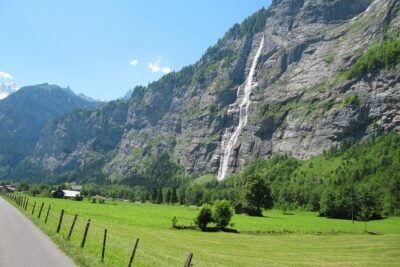
Lauterbrunnen Valley Waterfalls E-bike Tour with Swiss Picnic
Read our review →
Geneva: United Nations, Old Town and Lake E-Bike Tour
Read our review →
Interlaken: 72 Waterfalls Valley & Lauterbrunnen E-Bike Tour
Read our review →
Geneva Countryside And Art Museum At A Castle Wine By E-Bike
Read our review →
Browse the lists this tour appears in