

REVIEW · FLORENCE
Bike Tour of Florence in Small Group
Florence reveals more of itself on two wheels, especially when the route crosses the Arno and climbs toward Piazzale Michelangelo for that famous city view. In about two hours, you’ll pass the Duomo, San Lorenzo, Ponte Vecchio, Santa Croce, Palazzo Pitti, and Santo Spirito without spending the whole day on foot.
I like the small maximum of 15 riders, which gives the guide a better chance to keep the group together. I also like the included luggage deposit, a useful touch if you are changing hotels or arriving before check-in. The main caution is that bike quality, electric assistance, and guide commentary may not be entirely consistent, so arrive ready to ask questions before setting off.
Key points to know before you book

- Piazzale Michelangelo may be the tour’s best payoff, with broad views over Florence from above.
- You cover both sides of the Arno, including central landmarks and quieter areas near Borgo Ognissanti.
- The group is limited to 15 riders, a comfortable size for a guided city ride.
- The bikes may vary, from simple three-speed cruiser bikes to e-bikes, depending on the day.
- Luggage storage is included, which helps if you are between accommodations.
- Rain changes the format, since the experience becomes a walking tour for safety.
Why a bike works so well in Florence

Florence is compact, but its famous sights are spread across several districts. Walking from the Duomo to Santa Croce, then across the river to Santo Spirito and Palazzo Pitti, is perfectly possible. Still, it takes time, and you will often be stopping to cross crowded streets or find your way through busy squares.
A bike gives you a quick first look at the city. You can see major monuments, cross the Arno, and reach higher ground in one outing. That makes this especially useful near the start of a Florence visit, when you want to understand how the city fits together before returning to individual museums and churches.
The pace is not a long countryside ride. Expect frequent stops and starts, short stretches through the city, and pauses for explanations. One account describes the route as including the hills above Florence, while another specifically praises the ride to Piazzale Michelangelo. That climb is important to understand: the view is excellent, but reaching it requires effort if your bike has no working electric assistance.
The listed price is $43.37 per person. For two hours with a guide, a bike, and luggage storage, I consider that a fair price if you value orientation and convenience. It is less attractive if you already know Florence well or prefer to stop for long periods at each monument.
A few more bike tours around Florence worth a look
- Tuscany Bike Tours Through the Chianti Hills with Wine Tasting
★ 5.0 · 1,300 reviews - Florence: Guided E-Bike Tour to Piazzale Michelangelo
★ 4.4 · 1,204 reviews - Florence: 2-Hour Guided Sightseeing Bike Tour
★ 4.5 · 1,004 reviews
Starting near the Duomo on Via de’ Martelli
The tour begins at Via de’ Martelli 33R, close to the Duomo. This is a practical starting point because you are already in the heart of Florence, near public transportation and within easy reach of several major sights.
Expect some initial organization before the ride begins. The equipment may include standard three-speed cruiser bikes or e-bikes, and the exact setup may not be obvious at first. One account describes confusion over who had an e-bike and who had a regular bike, while another says a promised upgrade did not happen. I would clarify your bike type, adjust the saddle, and test both brakes before leaving.
That check matters. A separate report describes loose adjustments and a brake problem, while another describes a malfunctioning e-bike. These are not details to ignore. If anything feels wrong, tell the guide immediately and ask for another bike or a repair before the group moves into traffic.
You may also want to ask how the guide will communicate while riding. One account found the sound system difficult to hear. In a city with traffic, pedestrians, and frequent stops, being able to hear instructions and commentary makes a real difference.
Duomo Square and San Lorenzo
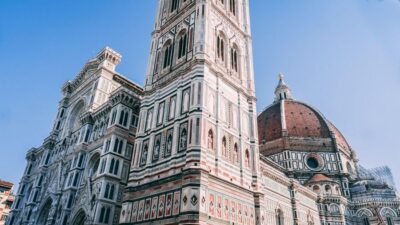
The first part of the route places you among Florence’s greatest symbols. Duomo Square brings together the cathedral, Giotto’s bell tower, and the Baptistery in one tight space. You will not have time to visit the interiors during this tour, but seeing the buildings together gives you a useful introduction to Florence’s religious and artistic center.
From there, the route continues toward San Lorenzo. This district is tied to the Medici family and to Florence’s long history of banking, politics, and art. The stop works well in a bike tour because you can see the setting quickly, then save a return visit for the Medici chapels or the market area if those interest you.
Do not expect a full lecture at every monument. The quality of the commentary appears to depend greatly on the individual guide. Dimitri, named in one account, is praised for explaining Florence’s past and the formation of Italy. Other accounts found the historical detail too light, with buildings named but little context added.
That difference is worth keeping in mind. If you want a lively, story-filled introduction, the guide can make the ride memorable. If you require detailed art history, you may find the two-hour format too brief.
Signoria Square and Republic Square

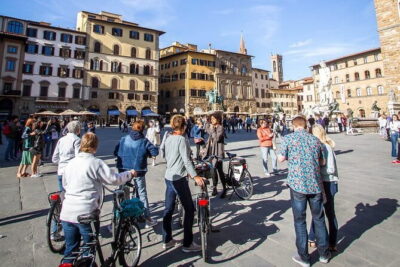
Signoria Square gives you a quick look at Florence’s political center. The Palazzo Vecchio dominates the square, and the outdoor sculpture display makes this one of the easiest places in town to connect public space with Florence’s artistic power.
Republic Square offers a different mood. Its broad shape and elegant buildings reflect later changes to the city, including the period when Florence served as Italy’s capital. Seeing both squares in one route helps you compare old Florence with the more formal city that developed later.
These stops are mainly orientation points. You will pause, hear an explanation, and continue. That is a benefit if you want to keep moving, but it can disappoint you if your ideal tour means standing still for ten minutes at each site.
The ride also involves repeated stopping and starting. That is normal in central Florence, where pedestrians and narrow streets shape the route. You should be comfortable balancing at low speed and restarting often.
Same city, a different ride:
- Private Self-Guided E-Bike Ride in Tuscany with Vineyard Visit
★ 5.0 · 775 reviews - Florence: 2-Hour Guided Bike Tour
★ 4.7 · 646 reviews - Florence Vintage Bike Tour–guided, small group or private option
★ 4.5 · 524 reviews - Florence: Guided Bike Tour in Small Group
★ 4.6 · 432 reviews
Ponte Vecchio and the two sides of the Arno

Ponte Vecchio is one of the tour’s natural highlights. Its medieval shops and unusual structure make it unlike Florence’s other river crossings. From a bike, you get a fast impression of the bridge and the relationship between the historic center and the Oltrarno district.
Crossing the Arno adds real value. Many first-time visitors spend most of their time north of the river, around the Duomo and Uffizi. This ride carries you into areas with a different feel, including Borgo Ognissanti, Santo Spirito, and the streets around Palazzo Pitti.
Borgo Ognissanti is a useful inclusion because it is easy to miss when you focus only on the major museums. The tour does not promise an extended visit, but passing through gives you a wider view of the city beyond its postcard sights.
The route’s quick pace can also help you decide where to return later. You might see a square or church that deserves a second look, then come back on foot when you have more time.
Santa Croce, Palazzo Pitti, and Santo Spirito

Santa Croce is one of Florence’s most important churches and a major artistic landmark. From outside, you will see the grand facade and the large square in front. The bike tour cannot replace an interior visit, but it points you toward a site worth scheduling separately if you want art, tombs, and detailed history.
Across the river, Palazzo Pitti gives the route another major architectural marker. The former palace is linked with the Medici court and now houses museum collections. Again, this is a passing introduction rather than a museum visit. You will need a separate ticket and several hours if you want to explore the palace properly.
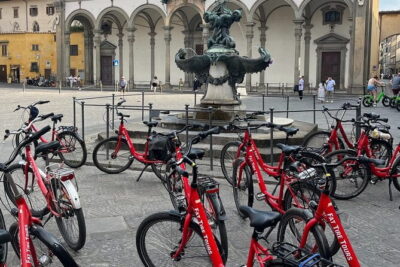
Santo Spirito adds a more everyday Oltrarno setting. Its church and square offer a useful contrast with the monumental spaces near the Duomo. I like this part of the route because it shows that Florence is not only a collection of grand facades. It is also a lived-in city with neighborhood streets and local gathering places.
The tour’s value here is breadth. You see many districts in one sweep, but you trade away long stops and close study. That is a good bargain for a first visit, less so for someone returning to Florence for a slower look.
The climb to Piazzale Michelangelo

Piazzale Michelangelo is not listed in the formal route description, but several accounts describe reaching it, and the view is clearly one of the most praised parts of the experience. From the terrace, Florence spreads out below you, with the Duomo and Palazzo Vecchio easy to pick out across the city.
This is the point that separates a basic central-city ride from a more rewarding outing. You get a sense of Florence’s shape, the Arno’s path, and the hills beyond the historic center. The view also helps explain why Florence can feel compact at street level but much larger from above.
The climb is the practical issue. If you receive an e-bike and it works properly, the ascent may be manageable. If you have a standard cruiser bike, you should expect more effort. One account describes having to pedal manually uphill because the electric assistance failed.
Ask before departure if Piazzale Michelangelo is planned for your departure time and what type of bike you have. The route may vary, and the supplied details do not guarantee the viewpoint on every outing. Still, if the climb is included, it is likely the most memorable part of the ride.
Bikes, safety, and guide quality

The bicycles are not described as high-end touring equipment. Standard bikes may be simple beach-cruiser-style models with three gears, similar to the practical bikes used around town. That is fine for a short city ride, provided the saddle, wheels, gears, and brakes are working correctly.
Helmet use is not required according to one account, but you should decide what makes you comfortable. More important is a careful equipment check. Test the brakes, make sure the wheels and saddle are secure, and tell the guide if the bike continues moving after you stop or if the electric motor behaves oddly.
There is also a serious traffic concern in one account, including a report of a guide riding through red lights and part of the group becoming separated. I cannot treat that as a routine feature of the tour, but it is a fair reason to ride defensively and stay within sight of the guide. Do not follow unsafe instructions simply because you are in a group.
The guide can make or break the experience. Dimitri receives particular praise for clear stories about Florence and the creation of Italy. Other accounts describe guides as pleasant but less energetic, or short on anecdotes. You should book this for the chance of a good introduction, not on the promise of an in-depth seminar.
Who will get the most from this ride
I would choose this tour if you have only a short time in Florence, want to cover several neighborhoods quickly, or find a full day of walking tiring. It also suits families and active couples who prefer movement over long indoor visits.
It is useful for people changing accommodations because luggage storage is included. You can leave bags at the meeting point and return there when the ride ends, though the supplied details do not specify the storage process or size limit. Ask the operator if you have unusually large luggage.
You should think twice if you are uncomfortable cycling in city traffic, need a guaranteed e-bike, or want every stop explained in depth. The tour is offered in English, and it is limited to 15 people, but the individual guide and equipment can shape the experience.
The ride lasts about two hours and ends back at the starting point. That makes it easy to pair with a museum visit, lunch, or an afternoon walk through the historic center.
Price, timing, and weather planning
At $43.37, the tour costs more than simply walking through Florence, but you are paying for a bike, a guide, a planned route, and the chance to reach the hills. I think the price works best when the ride is used as a city introduction rather than a substitute for museum visits.
The experience is often booked about 30 days ahead, so I would reserve early if your schedule is fixed. You receive confirmation at booking, and the mobile ticket is convenient for a phone-based itinerary.
Rain changes the plan. For safety, the activity becomes a walking tour if weather makes cycling unsuitable. If poor weather causes cancellation, you can receive a different date or a full refund. You can also cancel for a full refund up to 24 hours before the start time. If the minimum number of participants is not reached, the operator offers another date, another experience, or a full refund.
Should you book the Florence bike tour?
Book it if you want a brisk introduction to Florence, like the idea of seeing both sides of the Arno, and would value a high viewpoint such as Piazzale Michelangelo. The small group, included luggage deposit, and central route make it a practical first-day activity.
I would be more cautious if you need a dependable e-bike, polished equipment, or consistently detailed commentary. Ask about the bike type, the hill route, and the audio system at the start, then inspect the bike before riding.
For most active first-time visitors, this is a worthwhile way to get oriented quickly. Just treat it as a broad city sampler, not a replacement for walking back through the places that catch your eye.
FAQ
Where does the bike tour start?
It starts at Via de’ Martelli 33R, 50129 Florence, Italy. The tour also ends back at this meeting point.
How long does the tour last?
The activity lasts approximately two hours.
What sights does the route include?
The route includes Duomo Square, San Lorenzo, Signoria Square, Republic Square, Ponte Vecchio, Borgo Ognissanti, Santa Croce, Palazzo Pitti, and Santo Spirito church. Some outings also reach Piazzale Michelangelo.
Is the tour offered in English?
Yes. The tour is offered in English.
How many people can join the group?
The tour has a maximum of 15 participants.
What happens if it rains?
For safety, the tour becomes a walking tour in rainy conditions. If poor weather causes the activity to be canceled, you can choose another date or receive a full refund.
Just added around Florence
- Private Tuscany Cycling Tour from Florence★ 5.0 · 68 reviews
- Fiesole: Tuscan Countryside Half Day E-Bike Tour & Farm visit★ 5.0 · 85 reviews
- Florence Night Bike Tour with Wine and Aperitivo Picnic included★ 4.5 · 61 reviews
- E-bike Chianti Classico & Tuscany tour with Wine & Lunch at Farm★ 5.0 · 38 reviews
- Full-Day Tuscan Countryside Bike Tour★ 4.5 · 26 reviews
- Full-Day Tuscany and Chianti Hills Bike Tour With Lunch at Farm★ 5.0 · 45 reviews
- Private Secrets of Florence Electric Bike Tour★ 5.0 · 73 reviews
- Florence to Michelangelo Square by E-bike with Wine and Food stop★ 5.0 · 18 reviews
Florence Bike Tours, compared.
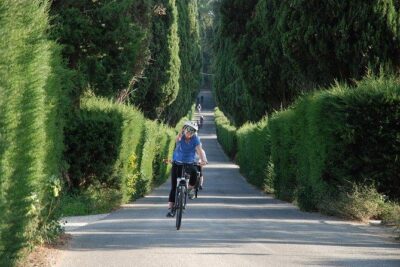
Tuscany Bike Tours Through the Chianti Hills with Wine Tasting
Read our review →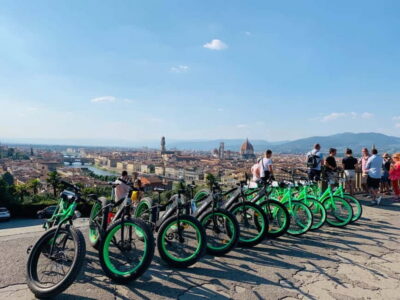
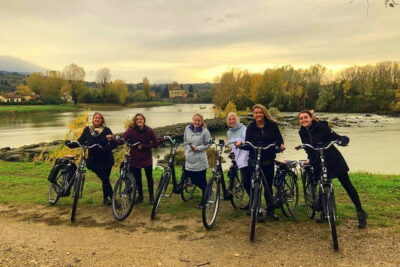
Private Self-Guided E-Bike Ride in Tuscany with Vineyard Visit
Read our review →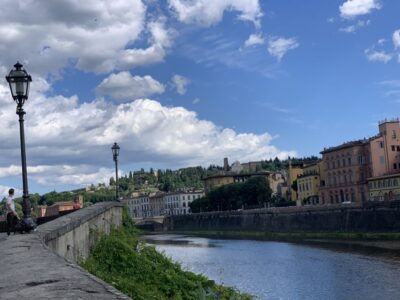
Florence Vintage Bike Tour–guided, small group or private option
Read our review →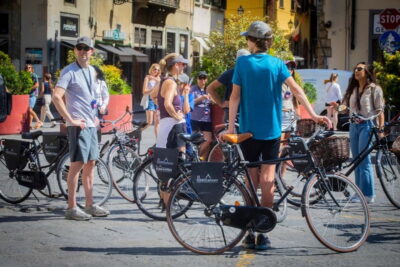
Browse the lists this tour appears in