
REVIEW · BARCELONA
Barcelona E-Bike Guided Tour with Montjuic Hill
Montjuïc is the star of this ride. An e-bike takes you from Barcelona’s old streets and waterfront up toward hilltop gardens, Olympic sites, and the National Palace without turning the climb into a major workout. You get a quick, useful look at several parts of the city in one morning or afternoon.
I like the wide mix of sights and the way a guide such as Marina, Pablo, Pierre, or Bella can add context as you ride. I also like the practical setup: an e-bike, helmet, insurance, bottled water, and basic instruction are included, so you can start riding without prior e-bike experience.
The main caution is pace. Thirteen stops fit into roughly three hours, so most pauses are brief, often about five minutes. The bikes have received mixed comments, and Montjuïc still includes a real incline even with electric assistance.
Key things to know before you ride

- Montjuïc gives you the biggest payoff: Expect hilltop viewpoints, gardens, Olympic landmarks, and the National Palace area.
- You cover a lot of ground: The route links Arc de Triomf, Ciutadella Park, Port Vell, the old dockyards, Montjuïc, and Avenida del Paralelo.
- The e-bike helps, but it is not magic: Assistance levels run from 1 to 5, and some riders may still want to walk briefly on a steeper section.
- Guides shape the experience: Marina, Pablo, Pierre, Alex, Dani, Luba, Etienne, and Bella are among the guides praised for safety, local context, flexibility, and humor.
- Pack light: Bikes may have bottle holders but no baskets, so a small crossbody bag or fanny pack works better than a large day bag.
- It is best for orientation, not long sightseeing stops: You will see many places, but entry to museums, meals, and hotel transfers are not included.
Why an e-bike works well in Barcelona

Barcelona is a good city for a guided bike ride because its major areas are spread out. The old center, harbor, Ciutadella Park, Montjuïc, and the broad avenues near the waterfront do not all sit within an easy walking loop. A bike links them neatly.
The electric motor matters most when the route turns uphill. Montjuïc rises sharply from the city, and the motor lets you reach viewpoints and gardens with less strain. You still pedal, and you still need to handle the bike, but you are not spending the afternoon fighting the hill.
You do not need previous e-bike experience. Instruction and bike rental are included, and the assistance can be adjusted from settings 1 through 5. I would begin on a lower setting in a quiet area, then increase it once you feel comfortable with the controls.
The bikes have drawn different reactions. Some riders found them powerful and comfortable. Others found them heavy and clunky. That difference may come down to the individual bike, your own cycling habits, and how much help you expect from the motor. If you are nervous, tell the guide before setting off. Marina was especially praised for giving a hesitant rider time to practice and making it clear there was no pressure to continue.
Barcelona cycling still demands attention. You will ride near traffic, pedestrians, traffic lights, and other bikes. One useful piece of advice is simple: stay alert. A guide can manage the route and keep the group together, but you remain responsible for steering, braking, and watching the road.
More E-Bike Tours in Barcelona
- Barcelona 3-hour Bike or E-Bike Tour: Highlights and Hidden Gems
★ 5.0 · 1,429 reviews - Barcelona: 2.5-Hour Bike or E-Bike Historical Tour
★ 4.5 · 1,262 reviews - Barcelona: Sagrada Familia or City Tour by Bike or eBike
★ 4.8 · 928 reviews
Starting at Arc de Triomf and Ciutadella Park
The meeting point is on Passeig de Lluís Companys, near Arc de Triomf. This is a convenient place to begin because the broad promenade gives you a clear visual landmark and a little room to get used to the bike.
Arc de Triomf was built for the 1888 Barcelona Universal Exposition. Its reddish brick and decorative panels make it one of the city’s most recognizable gateways. You will not spend long here, but it is a good first photo stop and an easy place for your guide to explain the city’s connection with major international fairs.
The route then moves into Parc de la Ciutadella. The park was once connected with the 1888 exposition and now provides a welcome break from the stone streets of the old center. The schedule includes both the park and the Cascada Monumental, an ornate fountain and sculptural feature.
Expect short stops rather than a long park visit. Five minutes is enough to look around and take a quick picture, but not enough to wander through the grounds or study every detail. If Ciutadella interests you, mark it for a return visit on foot.
From the old harbor to Reials Drassanes
The ride continues toward Port Vell, Barcelona’s old harbor. This section changes the mood of the tour. You move from formal city avenues and park paths to open waterfront views, boats, promenades, and the working edges of the port.
Port Vell is one of the most pleasant parts of the route for simply riding. It gives you room to look outward, and the waterfront helps you understand Barcelona’s connection to the Mediterranean. One rider singled out the coastline as a favorite part of the experience, which makes sense: the open view offers a break from city traffic and tight urban streets.
The next stop is Reials Drassanes, the former royal shipyards, now associated with the Museu Marítim de Barcelona. The Gothic shipyard structure is important in its own right, but this tour treats it as a short exterior stop. Museum admission is not included, and the schedule does not leave time for a full visit.
That is a recurring point here. The ride is designed to show you where things are and explain why they matter. It is not a museum tour. I see this as a strength if you have only 48 hours in Barcelona and want a quick orientation. It is a limitation if you prefer to spend twenty minutes inside each attraction.
Climbing toward Montjuïc and Poble-sec

From the waterfront, the route heads toward Mirador del Poble Sec. This viewpoint area helps connect the lower city with Montjuïc. You begin to feel the change in elevation here, and the e-bike earns its keep.
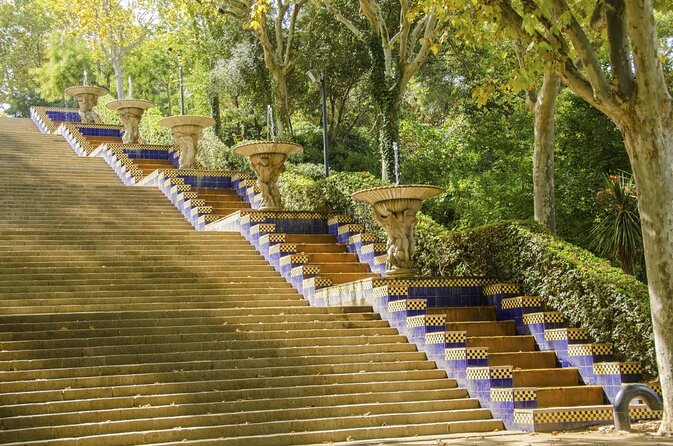
The route then reaches the Jardins de Joan Brossa, named for the Catalan poet and artist. These gardens occupy former amusement park grounds on Montjuïc and offer a quieter setting among trees, paths, and open spaces. The short stop is useful for a breath and a view, though it will not allow much time to explore the gardens in detail.
Parc de Montjuïc follows. This is not one single attraction but a large hilltop area containing gardens, cultural sites, viewpoints, and major public spaces. The guide’s value is especially clear here. A good guide can help you understand how the hill fits into Barcelona’s story instead of treating it as just another photo stop.
Do not assume the ride reaches every highest point of Montjuïc. One dissatisfied rider expected to go all the way to the top and found that the route did not do so. The supplied details also confirm that some uphill sections can be challenging even with the strongest motor setting. If reaching a specific summit is essential to you, ask about the exact route before departure.
More E-Bike Tours in Spain
- Barcelona E-Bike Photography Tour
★ 5.0 · 843 reviews - Barcelona: E-Bike Tour with Montjuic Cable Car & Boat Ride
★ 4.6 · 817 reviews - Barcelona e-Bike Tour: Gaudí & Old Town Small Group
★ 5.0 · 769 reviews - Barcelona E-Bike Small Group Tour with Tapas & Wine Tasting
★ 5.0 · 638 reviews
Joan Miró, Olympic Barcelona, and the National Palace

The Fundació Joan Miró is the next major landmark. Joan Miró was one of Catalonia’s best-known modern artists, and the foundation holds a substantial collection of his work. On this ride, you should expect to see the building and learn about its place on Montjuïc, not take a full museum visit. Admission is not included.
The Anella Olímpica, or Olympic Ring, gives the tour a different kind of context. Barcelona’s 1992 Olympic Games changed this part of the city and helped reshape how the world saw Barcelona. The stadium and nearby structures show the scale of that project.
This is a strong part of the route for photographs, especially if you like modern architecture and wide city views. It also gives you a useful contrast: Barcelona is not only medieval lanes and Gaudí buildings. Its late twentieth-century transformation is part of the city you see today.
The Palau Nacional, home to the Museu Nacional d’Art de Catalunya, is one of the most dramatic stops. Its grand position above the city makes it a natural viewing point toward Barcelona and, in the distance, the sea. The building itself is a major sight even if you do not enter the museum.
The schedule allows only a short pause at each location. You will get an introduction, a chance to take pictures, and a clear idea of where to return later. If you want an in-depth art visit at MNAC or the Miró Foundation, plan a separate block of time.
The Magic Fountain and the ride back down

The Magic Fountain sits below the National Palace and is one of Barcelona’s best-known public spaces. Its water, light, and music shows have had changing schedules over the years, so this tour should be treated as a daytime orientation stop rather than a promise of a show.
The location still deserves a visit. From here, you can look up toward the Palau Nacional and down along the broad axis of Avinguda de la Reina Maria Cristina. The grand scale makes it clear how Montjuïc was shaped for international events and public gatherings.
After Montjuïc, the route heads along Avenida del Paralelo before returning to the starting point. Paralelo has long been tied to theaters, nightlife, and entertainment. It is also a busy urban corridor, so this part is more about seeing how Barcelona’s districts connect than stopping for a major attraction.
The activity ends back at the meeting point. Hotel pickup and drop-off are not included, so allow time to reach Passeig de Lluís Companys before the start. The location is near public transportation, which makes it practical for most city itineraries.
What the guides add to the ride

The guide can make or break a fast-moving city tour. You are not getting long visits at each stop, so clear explanations and good group control matter.
Marina received repeated praise for her friendly manner, local information, humor, and care with less confident riders. Pablo was valued for safe riding, answering questions, and keeping a mixed-age family engaged. Pierre was praised for making the tour a strong introduction to Barcelona and for handling a group with teenagers.
Other guides, including Alex, Dani, Luba, Etienne, and Bella, were also described as helpful or flexible. Etienne was able to shape a ride around a birthday group’s interests, while Dani kept a rainy-day outing enjoyable. Those details suggest that the guide’s personality and judgment are important parts of the experience.
The operator describes this as a small-group activity, but the stated maximum is 100 people. That is a large possible ceiling, so I would not assume an intimate group every time. The best experiences depend on a guide who keeps the pace safe and gives people time to ask questions.
Price, timing, and practical value

At $47.18 per person for about three hours, the tour is fairly priced if you want transportation, orientation, and a guide rolled into one activity. The cost includes the electric bike, helmet, insurance, bottled water, and instruction. It does not include food, museum admission, or hotel transfers.
The value is strongest during a first Barcelona visit. In one outing, you can see the Arc de Triomf area, Ciutadella Park, Port Vell, Reials Drassanes, Montjuïc, Olympic sites, MNAC, and Paralelo. You could cover some of this by public transport, but the bike gives you a more direct sense of how the districts join together.
The value is weaker if you want a slow cultural tour. Thirteen stops in three hours means a lot of movement. Crowds and traffic lights can also cut into riding time, and some riders felt they needed longer at the stops for photographs.
The tour is booked, on average, about 24 days ahead. That does not guarantee it will sell out, but it is a useful sign to reserve early if your Barcelona dates are fixed. Free cancellation is available up to 24 hours before the start time. Changes or cancellations inside that window are not accepted for a refund.
What to bring and who should book
Wear comfortable clothes and closed, comfortable shoes. Bring a small bag that stays close to your body. A fanny pack worked well for one rider because the bikes had bottle holders but no baskets. Two water bottles may be secured on the bike, and a water fountain stop is available near the end.
You should have a moderate level of physical fitness. The e-bike reduces the effort, but you still need to balance, pedal, brake, and ride through an active city. A short uphill stretch may require you to walk the bike, even at the highest assistance level.
Children weighing up to 20 kilograms can participate free while riding in a child seat on a parent’s bike. Service animals are allowed. Since the route involves cycling and traffic, ask the operator directly about any personal mobility concerns before booking.
This tour suits first-time visitors, families with teenagers, active couples, and anyone with only a short stay. It also works well after visits to Sagrada Família or Park Güell because it shows you a different side of Barcelona. I would be less likely to choose it if your main goal is a long museum visit, a quiet ride, or a guaranteed summit of Montjuïc.
Should you book this Barcelona e-bike tour?
I would book it if you want to get your bearings fast and see Barcelona beyond the most famous Gaudí sights. The ride gives you a useful sweep from Arc de Triomf to the harbor and up Montjuïc, while guides such as Marina, Pablo, and Pierre can add the history and local details that a self-guided ride might miss.
Go in with the right expectations. You are buying a guided city overview, not a series of full attraction visits. Pack light, stay alert, expect some uphill effort, and ask about the exact Montjuïc route if the summit matters to you. At $47.18, it is a good choice for an active introduction to the city, especially during a short stay.
FAQ
How long does the Barcelona e-bike tour last?
The tour lasts approximately three hours.
Where does the tour begin?
It begins at Passeig de Lluís Companys, 10, in Barcelona’s Ciutat Vella district, near Arc de Triomf.
Where does the tour end?
The activity ends back at the meeting point.
Is e-bike experience required?
No. E-bike rental and instruction are included, so previous e-bike experience is not required.
What is included in the price?
The price includes a professional guide, electric bike, helmet, insurance, and bottled water.
Are museum tickets or food included?
No. Food and museum admission are not included.
What happens if I need to cancel?
You can receive a full refund if you cancel at least 24 hours before the experience start time. Cancellations or changes made less than 24 hours in advance are not accepted for a refund.
Just added around Barcelona
- Private Ultimate Gaudi Legacy ebike Tour with Park Güell★ 5.0 · 26 reviews
- Barcelona: Bike or eBike Tour, Top Sights & Local Insights★ 5.0 · 47 reviews
- E-Bike tour in Barcelona with English Guide★ 5.0 · 128 reviews
- Sightseeing by Bike & Photo Shooting★ 5.0 · 31 reviews
- Sights of Barcelona E-Bike Tour Led by a Local Guide★ 4.5 · 39 reviews
- Private Barcelona E-Bike Photography Tour★ 5.0 · 26 reviews
- Private electric bike tour – Discovery of Barcelona★ 5.0 · 34 reviews
- Private Boat rental – Pedal Cruises Barcelona – Cycle Boat★ 5.0 · 29 reviews
Barcelona Bike Tours, compared.
Highlights & Hidden Spots of Barcelona Bike Tour w/ Local Guide
Read our review →
Barcelona 3-hour Bike or E-Bike Tour: Highlights and Hidden Gems
Read our review →
E-Bike Tour with Montjuic Cable Car & Boat Ride
Read our review →
Barcelona e-Bike Tour: Gaudí & Old Town Small Group
Read our review →Browse the lists this tour appears in