
REVIEW · ALICANTE
City Bike Tour in Alicante
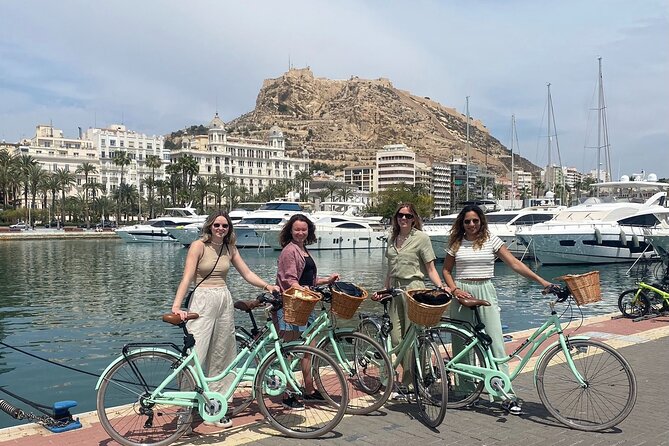
Alicante makes sense from a bicycle seat. In about two and a half hours, you cover the Central Market, waterfront, beach, old town, and main squares without spending the day on foot. Guides including Alen, Diana, Dajana, Juan, Alant, and Diallo have led the route, with practical help and local suggestions along the way.
I like the small maximum of 10 people, which gives the guide room to check your pace and answer questions. I also like the gentle route: one rider described it as easy and free of hills, while another appreciated getting a clear sense of the city’s layout. The main drawback is that Alicante’s sights are modest rather than grand, so this is best for orientation and local context, not a long list of major indoor attractions.
Key points to know
- A 2.5-hour city overview: You visit the market, port, beach, old town, churches, parks, and central avenues in one outing.
- A mostly easy ride: The route has been described as relaxed, with no hills noted in one detailed account.
- A small group size: The tour accepts a maximum of 10 people, and some departures may become private or nearly private if few people book.
- Useful local advice: Guides have suggested places to eat and helped riders with city planning.
- A mix of history and daily life: You see an active food market, working port, public squares, beaches, and old streets rather than only monuments.
- Good timing for first-day plans: The 10:30 a.m. start leaves the afternoon open for the castle, museums, lunch, or the beach.
Why a bicycle is a smart way to meet Alicante

Alicante is compact enough to explore on foot, but its main sights are spread between the center, marina, beach, and Santa Cruz hillside. A bicycle links these areas quickly and gives you a useful map in your head before you set off on your own.
This is not a strenuous cycling excursion. The advertised route is made up of short stops, generally 10 minutes each, with a 15-minute visit in Santa Cruz and a shorter pause at Gabriel Miró Square. One participant specifically described the ride as easy and without hills. That makes the tour a good fit if you want movement without turning sightseeing into exercise.
The guide’s role matters here. Alicante’s attractions are not all self-explanatory. A marble promenade, a baroque town hall, and an old market can blur together if you simply pass by. A good guide gives each place a reason to matter, and the guides connected with this experience have been praised for checking that riders were comfortable, explaining city history, taking photographs, and offering food suggestions.
The group limit of 10 is another practical plus. You are less likely to get separated at crossings or lose the guide in a crowded square. On quieter dates, the group can be much smaller. One rider had a one-to-one outing, while another described a family-run operation with especially friendly service.
More City Bike Tours in Spain
- Alicante: Highlights Bike Tour
★ 4.6 · 141 reviews - Alicante Highlights Bike Tour (min 2 people to book)
★ 5.0 · 64 reviews - Alicante City Tour on E-Bike
★ 4.4 · 57 reviews
Starting near Alicante’s Central Market
The meeting point is at C. Bailen, 14, close to the center, with departure at 10:30 a.m. The ride begins near the Mercat Central d’Alacant, one of the best places on this route for seeing ordinary Alicante life rather than a polished monument.
The market occupies an eclectic early-20th-century building decorated with Valencian modernist details. It remains an active food market, so the appeal is both architectural and practical. You see the place where residents shop, not simply a preserved building with a plaque outside.
The stop lasts about 10 minutes. That is enough for a quick look and explanation, but not enough for a full food crawl or leisurely purchase. If you want to browse stalls at length, return later on your own. The tour gives you the introduction, then keeps moving.
This first stop also sets the tone. You are not only ticking off monuments. You are seeing the working city, the public spaces people use, and the way Alicante connects its historic center to the sea.
From the baroque City Hall to Teatro Principal

The next stop is Alicante City Hall, a baroque palace built in the 18th century. It sits between Town Hall Square and Santísima Faz Square in the Santa Cruz area and still serves as the headquarters of the city council.
The building gives the guide a chance to explain Alicante’s civic past and the look of Spanish baroque architecture. You should expect an exterior visit rather than a long interior tour, with about 10 minutes allotted. That is enough to appreciate the façade and setting, but not to study every architectural detail.
From there, the route reaches the Teatro Principal de Alicante. Built between 1846 and 1847 and financed by local business people, it remains the city’s principal theater building. Its story adds a different layer to the tour. The market represents daily shopping, the City Hall represents government, and the theater points to public entertainment and local civic ambition.
These stops are close enough to connect naturally by bicycle. You are not spending half the morning on transport between isolated sights. The ride itself becomes part of the city lesson, showing how the old center fits together.
The port and the wave-patterned Explanada
Alicante’s port is one of the route’s most useful stops because it explains why the city grew where it did. The port’s history reaches back to its designation as a public Mediterranean port in 1271, while the stone breakwater began in 1476. For centuries, trade through the harbor shaped Alicante’s economy.
You get about 10 minutes here. The stop is brief, so think of it as a clear introduction to the waterfront rather than a port museum visit. The guide can connect the harbor to the streets and commercial buildings you have already seen.
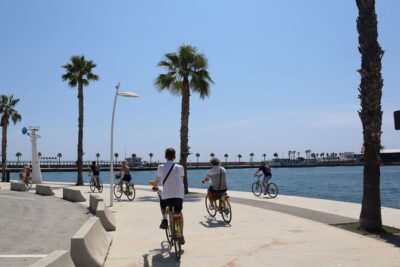
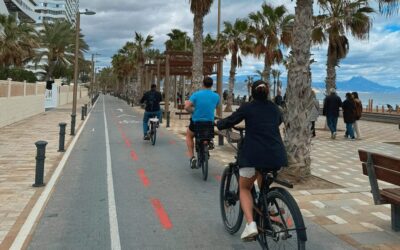
Next comes the Passeig Esplanada d’Espanya, one of Alicante’s signature public spaces. Palm trees line the promenade, which runs beside a port dock. Underfoot, millions of red, cream, and black marble tiles create a wave-like pattern.
The Esplanada is a strong cycling stop because it gives you a broad, open contrast to the narrow central streets. It is also one of the best places to pause for photographs. Still, the 10-minute schedule means you should not expect a long café break here. The included bottled water helps, and coffee or tea is also included, but snacks are not.
More City Highlights Bike Tours in Alicante:
- Alicante City Bike Tour. Only Small groups
★ 4.4 · 14 reviews - Lion City Bike Tour of Singapore
★ 5.0 · 6,211 reviews - 3-Hour Porto Highlights on a Electric Bike Guided Tour
★ 5.0 · 4,392 reviews - Porto: City Highlights 3-Hour Guided Electric Bike Tour
★ 4.8 · 3,092 reviews
Postiguet Beach, Alicante’s easy seaside pause

Platja del Postiguet is Alicante’s main urban beach, with sand, palm trees, cafés, and a two-level promenade. The tour allows around 10 minutes, enough to see the beach’s position beside the center and port.
This is less about swimming than about understanding Alicante’s layout. From the beach, you can see how close the sea is to the historic center. The city does not make you choose between urban sightseeing and a seaside break. They sit side by side.
If beach time is important to you, plan to return after the tour. Ten minutes is too short for a proper swim, sunbathing session, or café stop. As a quick introduction, though, it works well. You can decide later if you want to spend the afternoon here.
The route’s seaside sections also help explain why an easy bicycle tour is useful. You cover the port, promenade, and beach in one continuous stretch, with less backtracking than you would manage on foot.
San Nicolás and Alicante’s older center
The Concatedral de San Nicolás de Bari is one of the most important historic buildings on the route. Construction took place between 1613 and 1662, over the site of an earlier mosque. Its older cloister dates from the 15th century and uses Valencian Gothic design.
The stop lasts about 10 minutes. You should treat this as an exterior and historical introduction unless your guide specifically arranges more. The building’s story helps show how Alicante changed across religious and political periods, while the older cloister points to an earlier medieval city.
The church is also a good reminder that Alicante’s history is layered rather than concentrated in one grand monument. The tour moves from an old market to a baroque civic building, a 19th-century theater, a port, a beach, and a former mosque site. Each stop is short, but together they sketch the city’s development.
If you want a slower church visit, return independently. The bike tour’s strength is range, not long time inside any one attraction.
Gabriel Miró Square, Canalejas Park, and the central avenues

Gabriel Miró Square is a small but useful stop in the city center. It was once called Plaza de las Barcas because boats could reach it in earlier times. Later names included Plaza de Isabel II, before it took the name of local writer Gabriel Miró.
The scheduled pause is about five minutes, shorter than most stops. That tells you what to expect: a quick explanation, a look around, and perhaps a photograph before continuing.
The route also passes Canalejas Park, Alicante’s oldest park, designed in 1886 and running beside the marina near the Esplanada. The park’s position helps connect the city’s central streets to the waterfront.
You also ride along Rambla de Méndez Núñez, a major avenue separating the center and old town. Its route follows the line of a former defensive wall. After Alicante’s walls were demolished in 1820, rubble was used to fill the ravine and form the street.
These details are easy to miss when walking from one attraction to another. On a bicycle, you see the connections between places. That is one of the tour’s strongest practical benefits: you learn not just what a building is, but how the city grew around it.
Santa Cruz and the final climb into old Alicante
The final major stop is Barri Vell Santa Creu, commonly known as El Barrio. This hillside quarter has winding streets, cocktail bars, tapas places, and landmarks including the blue-domed Co-Cathedral of St. Nicholas and the City Hall area.
The stop lasts about 15 minutes, the longest pause listed on the route. Santa Cruz gives the tour its most atmospheric finish, with a sharper sense of old Alicante than the broad waterfront spaces provide.
There is one point to consider here: Santa Cruz is a hillside district. One rider described the overall tour as having no hills, but the neighborhood itself is not as flat in character as the port or Explanada. If you are concerned about cycling uphill, ask the guide about the exact riding approach before setting out.
The short visit will not replace an evening spent exploring tapas bars or walking the old streets. It does, however, show you where to return later. I would use the tour to identify the areas that deserve more time, then come back without the bicycle for dinner or a slow wander.
The tour ends back at the meeting point. That makes the finish convenient if you want to collect belongings, continue into the center, or plan lunch nearby.
What the $42.05 price gives you

At $42.05 per person, the cost is reasonable if you value a guide and want a fast city introduction. You receive bicycle use, bottled water, and coffee or tea. The route covers many separate parts of Alicante, and the small group limit gives the experience a more personal feel than a large sightseeing convoy.
The value is strongest on a first visit, especially if you have only a day or two in the city. In two and a half hours, you get the basic geography, a run through key neighborhoods, and suggestions for where to eat and what to revisit. One guide was praised for giving restaurant recommendations, which can be as useful as another historical fact when you have limited time.
The value is less clear if you already know Alicante well or mainly want long visits inside monuments. The stops are short, and snacks are not included. You are paying for movement, explanation, and orientation, not admission to a series of paid attractions.
Coffee or tea is included, but the tour does not list a full meal. Eat beforehand or plan lunch afterward, especially if you prefer a substantial breakfast.
Guides, group size, and the feel of the ride
The guides connected with the experience include Alen, Diana, Dajana, Juan, Alant, and Diallo. The strongest pattern is personal attention. Alen was described as checking regularly that a first-time rider was doing well. Dajana was praised for interesting facts and taking photographs, while Diana was singled out for city tips and a clear overview of the layout.
The operation is family-run, according to one account, and the atmosphere appears informal rather than corporate. That can be a plus if you like direct local contact and flexible conversation. It also means the experience may vary somewhat with the individual guide and the size of the day’s group.
The maximum group size is 10. Most people can participate, and the meeting point is near public transportation. The tour is offered in English and uses a mobile ticket, which keeps arrival simple.
The tour requires good weather. You can cancel for a full refund up to 24 hours before the start time. If poor weather causes the operator to cancel, you are offered another date or a full refund.
Who should book this Alicante bike tour?
I would choose this for a first morning in Alicante, a short stay, or a day when you want to combine sightseeing with light activity. It suits couples, families, solo riders, and anyone who wants a guide to handle the route while explaining what matters.
It is also a good option for first-time cyclists. The experience is described as easy, and a guide checks on your comfort. Still, you should be happy riding through a city and able to manage a bicycle independently.
I would be more cautious if you want a major sightseeing spectacle at every stop. Alicante’s appeal is spread across its market, port, beach, public squares, old streets, and layered history. The tour gives you a useful overview, but it does not turn each stop into a long museum visit.
Should you book it?
Book this tour if you want to get your bearings quickly, see Alicante’s main districts, and receive practical advice from an English-speaking local guide. The best reasons are the small group size, easy pace, waterfront route, and chance of a nearly private outing on a quiet date.
Skip it if you prefer to explore slowly, spend an hour inside each church or market, or have already seen the center and port. For most first-time visitors, though, $42.05 is a fair price for a guided introduction that covers more ground than a casual walk and leaves the rest of the day free.
FAQ
How long does the Alicante City Bike Tour last?
The tour lasts approximately 2 hours and 30 minutes.
What time does the tour start?
The tour starts at 10:30 a.m.
Where does the tour begin and end?
It begins at C. Bailen, 14, 03001 Alacant, Alicante, Spain, and ends back at the meeting point.
How many people can join the tour?
The activity accepts a maximum of 10 people.
Is bicycle use included in the price?
Yes. Bicycle use, bottled water, and coffee or tea are included. Snacks are not included.
What happens if the weather is poor?
The tour requires good weather. If the operator cancels because of poor weather, you can choose another date or receive a full refund. You can also cancel up to 24 hours before the start time for a full refund.
Just added around Alicante
- Alicante Private Bike Tour (min 2p) MEDIUM CYCLE LEVEL REQUIRED★ 5.0 · 14 reviews
- Alicante Highlights Bike Tour (min 2 people to book)★ 5.0 · 64 reviews
- Alicante E-Bike Coast Tour with Román Fishpond and Snorkeling★ 4.5 · 16 reviews
- Alicante: Calas & Beaches Snorkeling with E – Bikes★ 4.5 · 20 reviews
- Alicante: Spot the Mediterranean by E-bike★ 4.7 · 93 reviews
- Alicante: E-Bike, Snorkeling and Paddle Surf Tour★ 4.8 · 69 reviews
- Alicante: Guided Tapas Tour by Bike with Tastings★ 4.9 · 81 reviews
- Alicante: Calas and Beaches E-Bike Tour with Snorkeling★ 4.8 · 104 reviews
Alicante Bike Tours, compared.
E-Bike Coast Tour, Roman Fish Farm and Snorkeling
Read our review →

Browse the lists this tour appears in