
REVIEW · KRAKOW
3-Hour E-Bike Tour In Krakow
Krakow is wonderfully suited to two wheels, and this tour covers its main historic districts in three hours. You move from the grand Main Market Square to Wawel Hill, follow the Vistula, then continue through Kazimierz and the former ghetto before returning to the medieval city gates. The mix of major sights and local streets is the real draw.
I like the comfortable Sparta C-Grid e-bikes, especially on Krakow’s cobbled streets, and I like the local guides’ practical advice about food and places to visit later. The route is mostly flat, so the electric motor is helpful for comfort and speed rather than steep climbs. The drawback is that three hours gives you only a short look at each stop, and busy city streets can slow the group.
Key points to know before booking

- Covers several Krakow districts: Old Town, Wawel, the Vistula riverfront, Kazimierz, the former ghetto, and the medieval walls.
- Local guides lead the ride: Guides including Michael, Chris, Krzysztof, Tom, Alex, and Mick have been praised for clear explanations and personal knowledge of Krakow.
- Mostly a sightseeing ride: You stop outside landmarks, but entrance fees and museum visits are not included.
- E-bikes add comfort, not mountain power: The route is largely flat, though the motor helps on cobbles, bridges, and a long day of sightseeing.
- Small groups are possible: The maximum group size is 15 people.
- A good first-day activity: The route gives you a useful map of the city and ideas for where to return later.
Why a bicycle is a smart way to see Krakow

Krakow’s best-known sights are spread across a compact but varied area. The Old Town sits beside Wawel Hill, Kazimierz lies just south of the castle, and the former ghetto is across the river in Podgórze. You can walk between some of these places, but a bicycle lets you connect them without spending much of your day on foot.
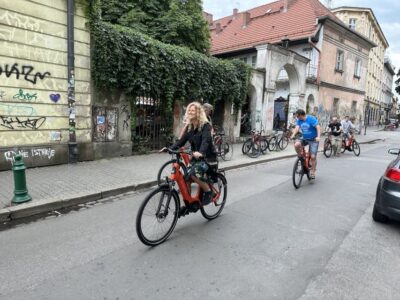
This route also gives you changing views of the city. One moment you are beside the Cloth Hall in the center of the Old Town. Soon after, you are riding beside the Vistula, then passing cafes and galleries in Kazimierz, followed by quiet reminders of the Jewish community and wartime Krakow.
The electric motor is useful in a practical way. It reduces effort on cobbles and lets the group keep moving after several hours of sightseeing. Several guides have noted that regular bikes are also suitable because Krakow is mostly flat. If you are a confident cyclist, you may not need the motor. If you want an easier ride, have sore knees, or simply prefer to save your energy for walking and museums, the e-bike makes sense.
The bikes are described as Sparta C-Grid models with front suspension. That detail matters in Krakow, where old streets can be uneven. You still need to ride carefully, but the bike should feel less punishing than a basic city bicycle.
More E-Bike Tours in Krakow:
- Krakow: 3-Hour Small Group Tour on E-Bike
★ 4.8 · 135 reviews - 3-Hour Porto Highlights on a Electric Bike Guided Tour
★ 5.0 · 4,392 reviews - Lisbon: Hills, Alfama, and Mouraria Tour by Electric Bike
★ 4.8 · 3,438 reviews
Starting on Sławkowska Street
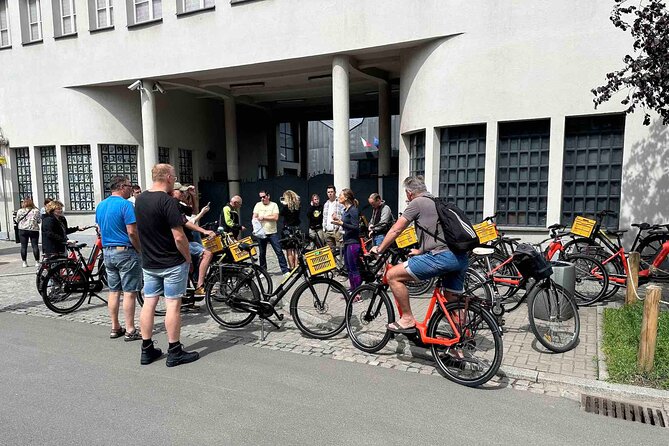
The meeting point is at Sławkowska 11, near the Old Town. The staff set you up with a bike, explain how to use it, and help you choose a suitable model. A toilet is available before departure, which is a small but useful touch before a three-hour ride.
The tour includes a local English-speaking guide, bicycle use, local taxes, and a rain poncho if needed. Food, drinks, and admission fees are not included. You should arrive ready to ride, with suitable clothing and shoes.
The maximum group size is 15 people, though some departures may be much smaller. A small group makes it easier to hear the guide and ask questions. In a full group, the ride may feel less personal, particularly in crowded parts of the Old Town.
Guides named in the feedback include Michael, Chris, Krzysztof, Tom, Alex, and Mick. The strongest feature across the guide team is their ability to combine dates, local stories, restaurant suggestions, and useful orientation. Chris is also noted for speaking several languages, while Tom brings family connections to Krakow’s past.
Main Market Square and Collegium Maius
The first major stop is Stare Miasto, Krakow’s Old Town, centered on the enormous Main Market Square. This is the city’s grand public room, framed by the Cloth Hall, St. Mary’s Basilica, and the remains of the old Town Hall Tower.
You stop for about 15 minutes, long enough to understand the layout and hear the main stories. The guide can point out the medieval shopping role of the Cloth Hall and explain why the square has remained the center of Krakow life for centuries.
Do not expect time to explore the interiors. This is an orientation stop, not a museum visit. If St. Mary’s Basilica or the Cloth Hall interests you, mark it for a later visit on foot.
The ride continues to Collegium Maius, the oldest building of Jagiellonian University. Nicolaus Copernicus studied at the university, giving this stop a direct connection to one of Europe’s best-known astronomers.
The building is handsome and historically important, but the tour does not include entry. You see the exterior and hear its place in Krakow’s academic story. That approach works well early in your visit because it helps you decide which buildings deserve more of your own time.
Wawel Hill, the dragon, and the Vistula

At the Monument of the Wawel Dragon, the guide tells the old tale of a clever cobbler who defeated the fire-breathing creature through a trick rather than brute force. It is a light moment in a tour that later deals with much darker events.
Wawel Royal Castle is the next major sight. The guide explains the hill’s role as the seat of Polish kings and introduces the importance of the castle complex to Poland’s national story. You stop outside, so plan a separate visit if you want the state rooms, cathedral, or castle exhibitions.
This is one of the places where the tour’s limits are clear. Ten minutes gives you a useful introduction and a chance to take photographs, but Wawel deserves much longer if you want to see it properly. The value here is the guide’s context and the easy connection to the next part of the route.
After Wawel, the ride follows the Vistula on one of Krakow’s nicest cycle paths. This stretch gives you a break from the stone streets and crowded central squares. It also shows how the river fits into the city rather than treating Krakow as a collection of monuments.
The route includes a pleasant ride through green garden areas and picturesque alleys. These sections are not listed as formal stops, but they help keep the tour from becoming a chain of quick photo opportunities.
More Three-Hour Bike Tours in Krakow:
- 3-hour Complete Prague Bike Tour
★ 5.0 · 3,674 reviews - Porto: City Highlights 3-Hour Guided Electric Bike Tour
★ 4.8 · 3,092 reviews - Copenhagen: Highlights 3 Hour Bike Tour with a Local Guide
★ 4.8 · 2,312 reviews - Classic Vienna: 3-Hour Guided Bike Tour
★ 4.7 · 2,146 reviews
Kazimierz, Krakow’s former Jewish district
Kazimierz is one of the most important parts of the route. Once the center of Krakow’s Jewish community, it is now filled with cafes, bars, galleries, and local meeting places. The district’s current energy sits alongside traces of its Jewish past, and a bicycle lets you cover more of its streets than a short walking circuit.
You spend about 20 minutes in Kazimierz, the longest formal stop on the tour. That extra time is welcome because the district has several layers to explain. The guide discusses its former role as a separate city and the way it later became part of Krakow.
The tour then stops at the former medieval market square of Kazimierz. This helps explain how the district grew and why it developed its own identity. It is easy to think of Kazimierz only as a nightlife area, but the old urban layout tells a longer story.
Szeroka Street is especially important. Although called a street, it feels more like a square and once formed the heart of the Jewish district. It was also used as a ghetto-square setting in Steven Spielberg’s film about Oskar Schindler.
You will hear about the area’s Jewish life, wartime destruction, and later renewal. The short stop is enough to give you bearings, but not enough for a full study of the district. I would return here independently for a slower walk, especially if you want time to look at cafes, galleries, and historic buildings.
The former ghetto and Schindler’s factory
The route crosses to Plac Bohaterów Getta, the former Main Ghetto Square. The most striking feature is the Empty Chairs memorial. The chairs represent the people forced from their homes during the German occupation, and the monument gives the square a quiet, spare character.
This is a place where a good guide matters. The stop is brief, but the subject deserves care and clear explanation. You should expect a serious change in tone from the dragon story and the lively streets of Kazimierz.
The group then stops outside Oskar Schindler’s former enamel factory. The building is now associated with the story of Schindler and the Jewish workers he employed during the Second World War. The factory houses a museum, but museum admission is not part of the bike tour.
That arrangement can be useful. You get the location and the basic context without spending the tour inside one museum while the rest of Krakow waits outside. If the factory museum is high on your list, schedule a separate visit and allow enough time for it.
The route does not attempt to explain every part of Krakow’s wartime past. Instead, it places several key locations in relation to one another. That makes the experience especially useful for first-time visitors who need a clear map before returning to the subjects that matter most to them.
Returning through the medieval fortifications
The final section takes you back toward the Old Town through green paths and quieter city routes. The ride ends at the Barbican, one of the surviving pieces of Krakow’s medieval defenses.
The Barbican once protected the approach to the city walls. Today, its rounded brick form gives you a strong idea of how guarded the Old Town once was. The nearby St. Florian’s Gate was the main medieval entrance and marks the beginning of the Royal Way, the ceremonial route used by monarchs entering Krakow.
These final stops provide a neat ending. You have seen the royal center, the river, the former Jewish district, the wartime memorial area, and now the defenses that once enclosed the city. You finish back at the original meeting point rather than being left in another neighborhood.
Again, the stops are outside only. If you want to walk along the surviving walls or enter a museum, you will need to return later.
What the $66.37 price includes
At $66.37 per person, this is not the cheapest way to get around Krakow, but the price is reasonable if you value a guide, a maintained e-bike, and a route that links several districts in one morning or afternoon.
You are paying for more than bicycle hire. The guide handles route planning, traffic decisions, local history, and the practical task of keeping a group together. The bike also saves you from arranging separate transport between the Old Town, Wawel, Kazimierz, and the former ghetto.
The value is strongest at the beginning of your stay. Several guides provide tips about food and later sightseeing, and the route gives you a working sense of direction. You can use the tour to decide where to spend the rest of your visit.
The value is weaker if you want long museum visits or detailed time at each landmark. Since no admission fees are included and no buildings are entered, you should treat this as a guided city overview rather than a substitute for Krakow’s main museums.
Who should book this ride
I would choose this tour if you are visiting Krakow for the first time and want to cover a lot of ground without exhausting yourself. It suits couples, families with older children, and active adults who enjoy seeing a city from the street rather than through a vehicle window.
Children must be accompanied by an adult, and most people can participate. You should be comfortable riding a bicycle in an urban setting and following the guide through city streets. The route is mostly flat, but cobbles, pedestrians, and busy periods can still require care.
You may prefer a walking tour if you want to spend longer at each monument or dislike cycling near traffic. You may also prefer a regular bicycle if you are fit and want to save money, since the city has few serious climbs.
For an e-bike, bring layers and check the forecast. A poncho is provided if needed, but one rider specifically advised carrying a hat, scarf, and gloves in cooler weather. The tour requires good weather, so poor conditions can lead to a new date or a full refund.
Booking advice and final verdict
The activity is recommended by 99 percent of participants and has a 4.9 rating from 79 reviews. Those figures fit the tour’s strongest qualities: good bikes, engaging local guides, a sensible route, and a useful introduction to Krakow.
I would book it for the first or second day of a Krakow visit. You will see enough to choose where to return, and guides such as Michael, Chris, Krzysztof, Tom, and Alex add local detail that a map cannot provide.
Book it if you want a lively overview with regular stops and practical advice. Skip it if your main goal is entering museums, lingering at Wawel, or taking a slow walk through Kazimierz. For most first-time visitors, the combination of Old Town, royal Krakow, the river, Kazimierz, and the former ghetto makes this a useful and enjoyable way to get your bearings.
FAQ
How long is the Krakow e-bike tour?
The tour lasts approximately three hours and ends back at the meeting point on Sławkowska 11.
What areas of Krakow does the tour visit?
The route includes the Old Town, Main Market Square, Collegium Maius, Wawel Hill, the Vistula riverfront, Kazimierz, the former ghetto area, Oskar Schindler’s factory, the Barbican, and St. Florian’s Gate.
Does the tour enter Wawel Castle or the museums?
No. The tour stops outside the landmarks and does not include entrance fees or visits inside museums and other buildings with paid admission.
Is the route suitable for people who do not need an e-bike?
Yes. The route is mostly flat, and regular bicycles can also be suitable. The e-bike mainly makes pedaling easier and helps with cobbled streets, longer riding, and a bridge on the route.
What is included in the tour price?
The price includes bicycle use, a local English-speaking guide, local taxes, and a rain poncho if necessary. Food, drinks, and entrance fees are not included.
How many people can join the tour?
The maximum group size is 15 people.
Can I cancel the tour for a full refund?
You can cancel at least 24 hours before the start time for a full refund. If poor weather or an insufficient number of bookings causes the company to cancel, you will be offered another date or experience, or a full refund.
Just added around Krakow
- Private Bike Tour in Krakow★ 5.0 · 152 reviews
- Hidden Krakow Bike Tour★ 5.0 · 275 reviews
- Discover Kraków by Bike with a Dutch guide★ 5.0 · 16 reviews
- 2 Hours Old Town Guided Bike Tour in Krakow★ 4.5 · 15 reviews
- Polish Countryside and Tyniec Abbey Bike Tour from Krakow★ 5.0 · 37 reviews
- Krakow: Old Town Bike Tour with a Guide★ 4.5 · 54 reviews
- Krakow: Complete Bike tour with all the highlights★ 4.9 · 90 reviews
- Krakow: 3-Hour Small Group Tour on E-Bike★ 4.8 · 135 reviews
Krakow Bike Tours, compared.
Complete Cracow Bike Tour (small group of maximum 15 people!)
Read our review →
Bike Tour of Old Town, Jewish Quarter and the Ghetto
Read our review →
Full Bike Tour – the Old Town, Jewish Qtr & the Ghetto NEW BIKES
Read our review →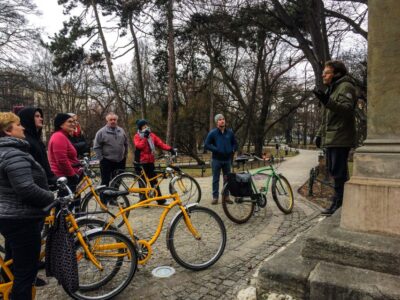


Browse the lists this tour appears in